VibeThinker-3B: Chinese 3B Model Matches Opus 4.5 in Coding
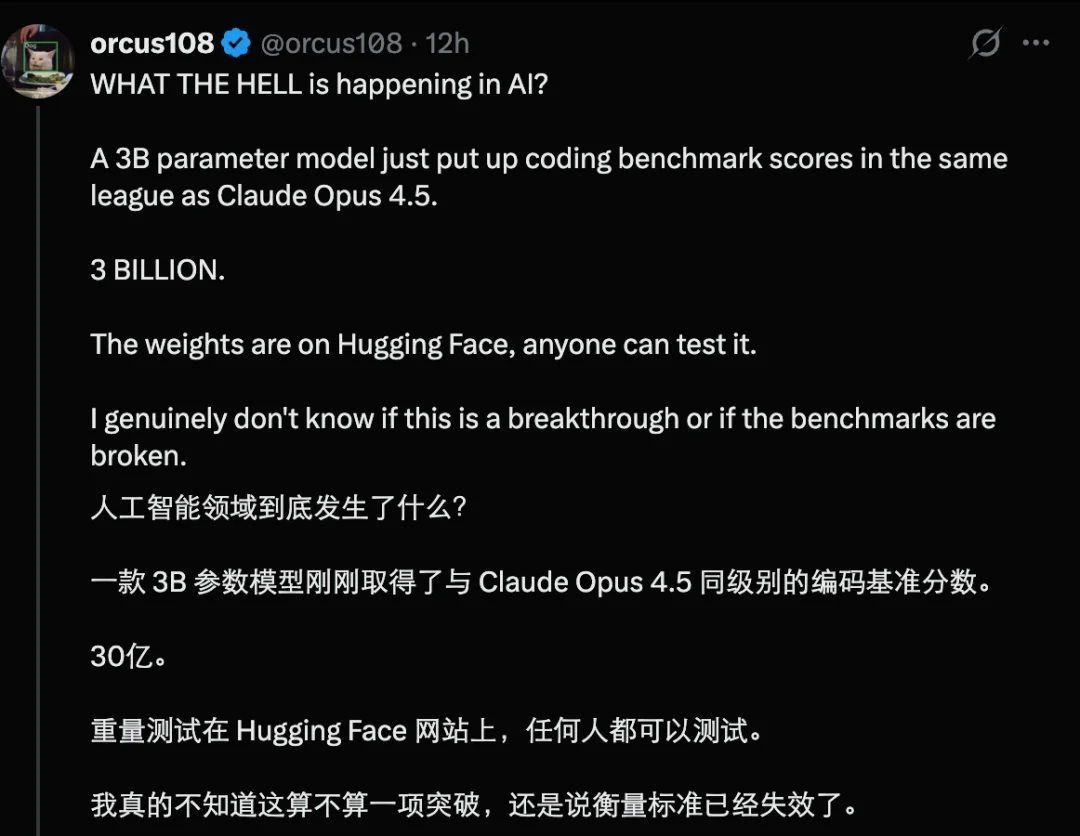
In recent days, a compact 3-billion-parameter language model—VibeThinker-3B—has gone viral on X (formerly Twitter), demonstrating coding and reasoning performance comparable to frontier models such as Claude Opus 4.5, Gemini 3 Pro, GPT-5 High, GLM-5, and Kimi K2.5, despite its dramatically smaller size.
A Purpose-Built Small Model for Verifiable Reasoning
Developed by the Weibo AI team, VibeThinker-3B is a dense inference model explicitly designed to push the limits of verifiable reasoning within strict parameter constraints. Its architecture prioritizes tasks with reliable, objective evaluation signals—including:
- Mathematical reasoning (e.g., AIME, HMMT)
- Competitive programming
- STEM-domain logical inference
- Constraint-aware instruction execution
Benchmark Results: State-of-the-Art at 3B Scale
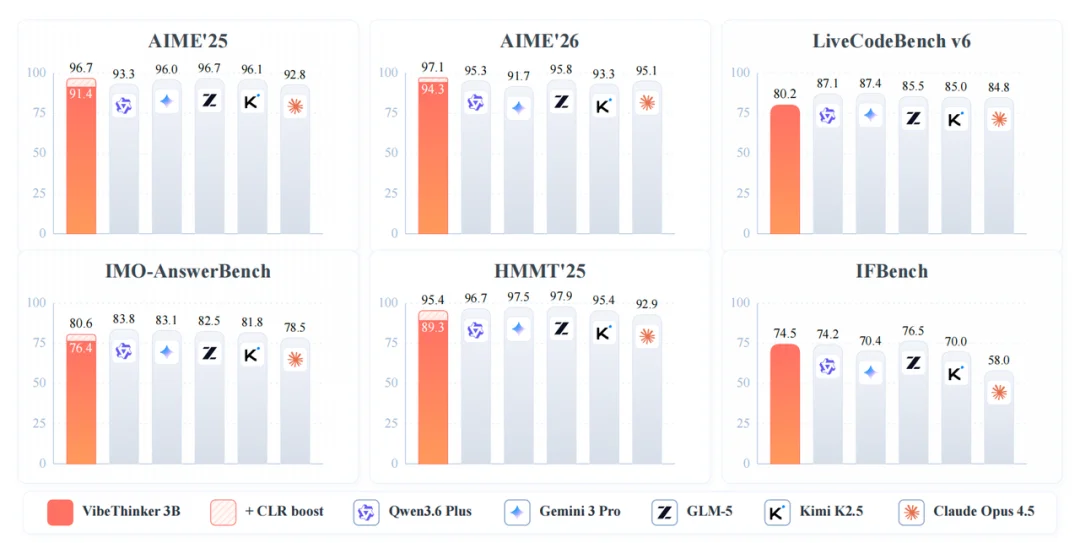
VibeThinker-3B achieves remarkable scores across rigorous, answer-verifiable benchmarks:
| Benchmark | Score | Notes |
|---|---|---|
| AIME26 | 94.3 → 97.1 (with CLR) | Upgraded via Claim-Level Reliability (CLR) assessment |
| HMMT25 | 89.3 → 95.4 (with CLR) | Significant gain from test-time scaling |
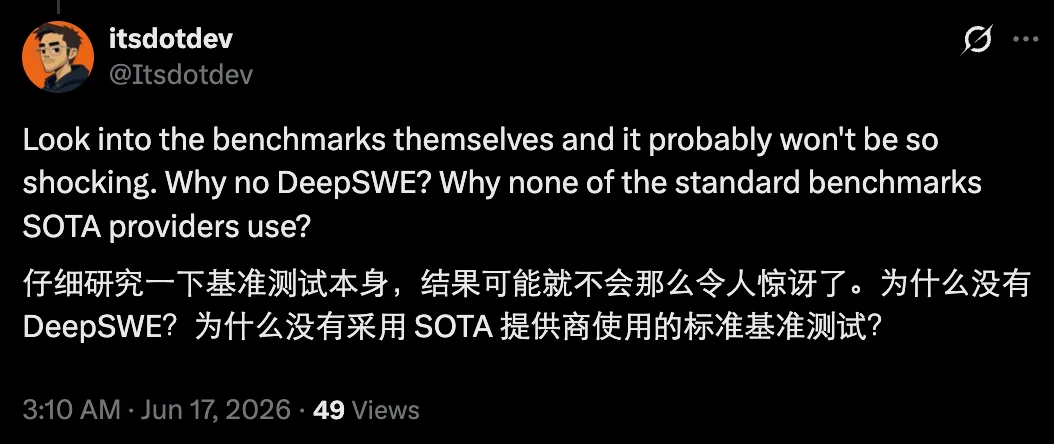
| LiveCodeBench v6 (Pass@1) | 80.2 | Strong real-world coding capability |
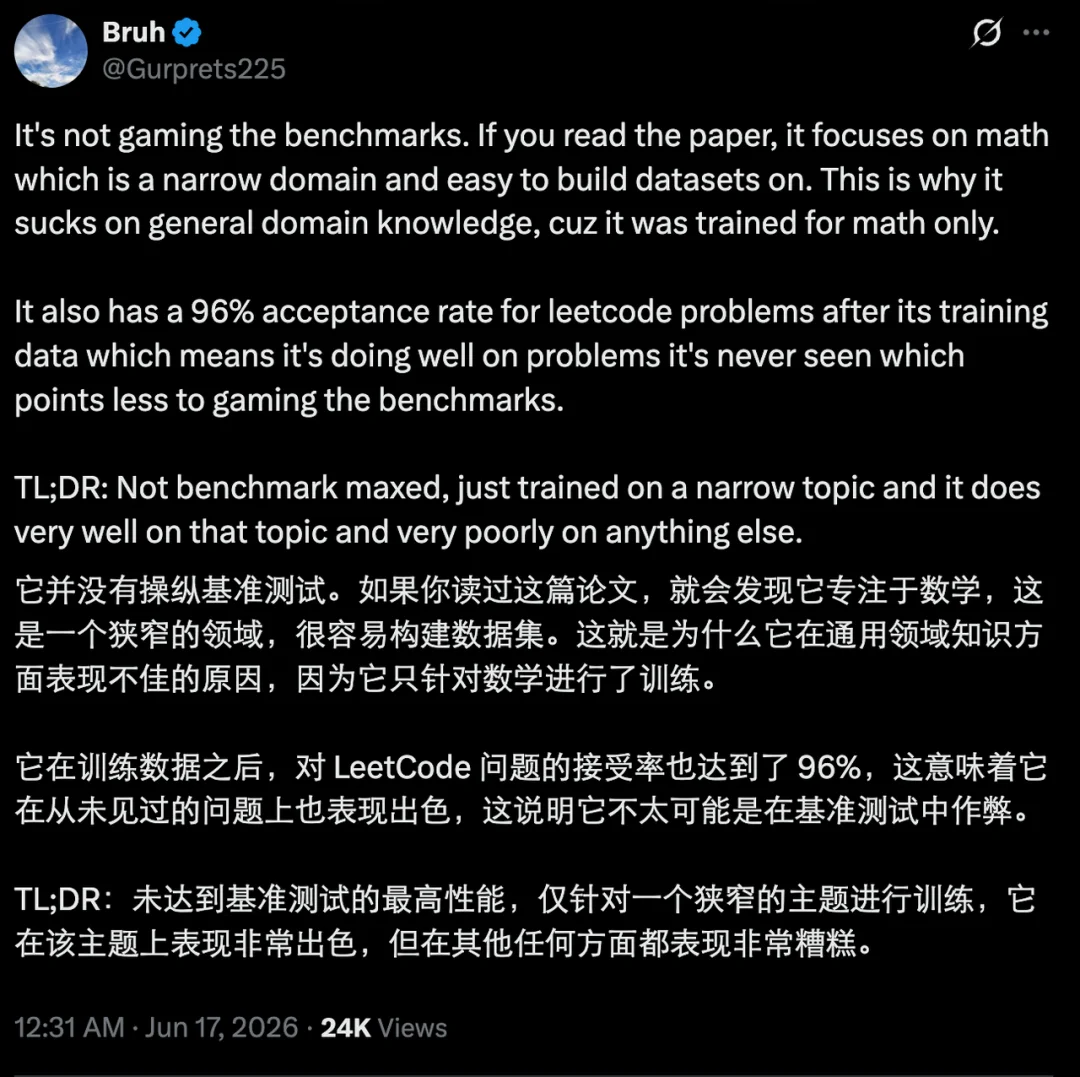
| LeetCode Weekly & Biweekly Contests (Apr–May 2026) | 96.1% pass rate | Based on unpublished, live contest data |
| BruMO25 | 99.2 | With CLR enhancement |
Technical Innovation: Spectrum-to-Signal Training Pipeline
VibeThinker-3B builds upon Qwen2.5-Coder-3B, enhanced through an advanced Spectrum-to-Signal post-training framework:
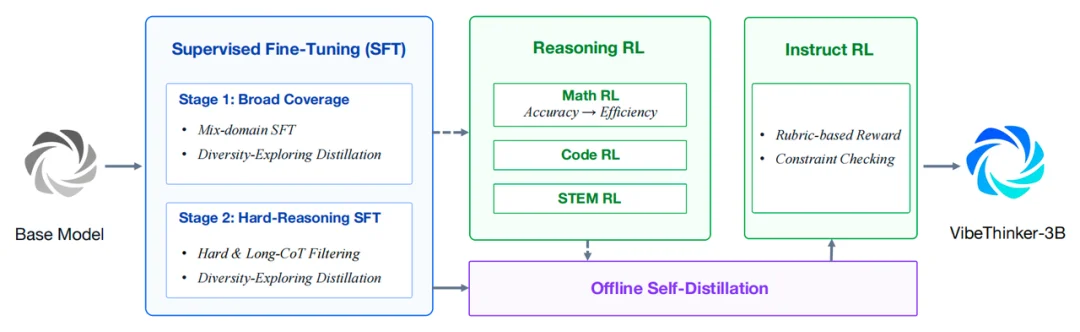
Key Stages:
🔹 Two-Phase Curriculum SFT
– Phase I: Broad coverage (math, coding, STEM, dialogue, instruction-following)
– Phase II: Higher-difficulty, wide-scope reasoning + diversity-preserving distillation
🔹 Multi-Domain Reinforcement Learning (MGPO-style)
– Sequential RL applied to math → coding → STEM tasks
– Full 64K-context windows retain long-horizon reasoning traces
🔹 Offline Self-Distillation
– High-quality trajectories distilled from RL checkpoints
– “Learning potential scoring” prioritizes correct-but-underserved solutions
🔹 Instruct RL for User Alignment
– Rule-based validators + criteria-driven reward modeling for format-sensitive/open-ended teaching data
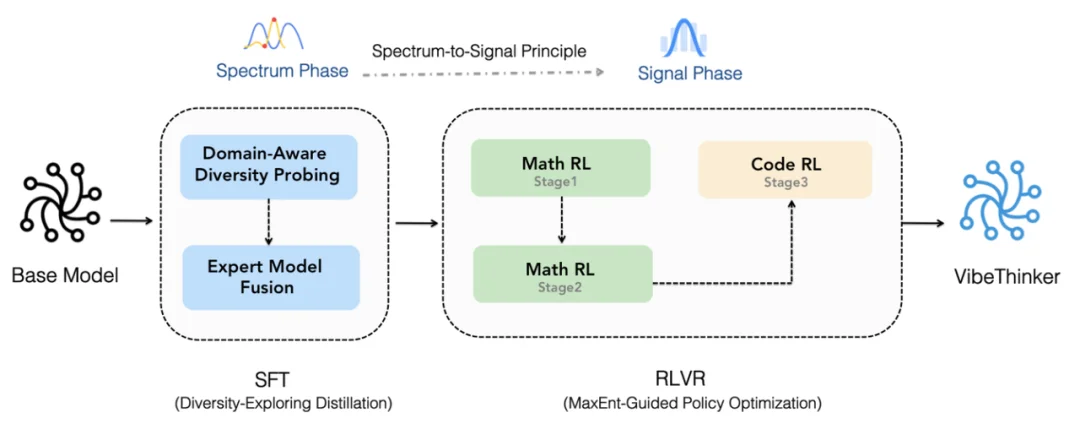
The Parameter Compression Coverage Hypothesis
The team introduces a foundational insight—the Parameter Compression Coverage Hypothesis:
Verifiable reasoning is highly compressible and parameter-dense—relying on multi-step logic, constraint satisfaction, self-correction, and answer verification. In contrast, open-domain knowledge, general conversation, and long-tail world understanding demand massive parameters for broad factual coverage.
✅ Implication: When task structure is clear and feedback signals are reliable, compact models can rival frontier LMs in specific high-value capabilities—without scaling parameters indiscriminately.
“It reveals partial decoupling between reasoning ability and factual knowledge—and that the former can be compressed more efficiently than previously assumed.”
— VentureBeat
Availability & Limitations
✅ Publicly accessible:
– 📄 Technical Report (arXiv:2606.16140)
– 🤗 Hugging Face Repository
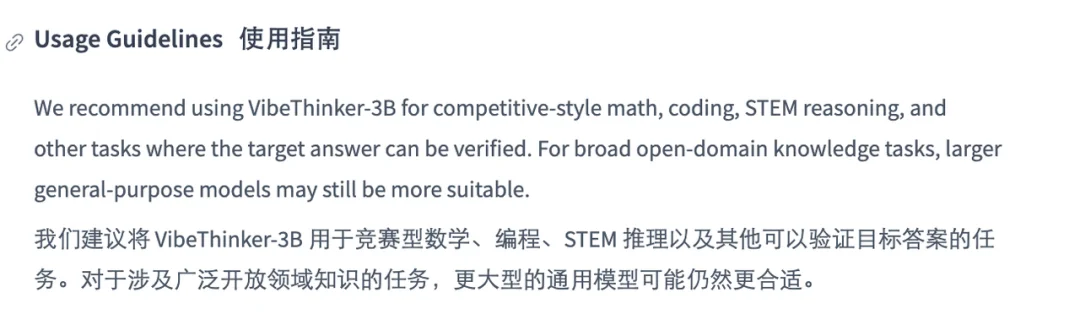
⚠️ Known limitation: Performance degrades significantly on tasks requiring broad factual knowledge or open-ended generalization—confirming its specialized design philosophy.
Beyond Cost-Cutting: A New Paradigm for Small Models
As emphasized by the authors, VibeThinker-3B is not positioned as a “lightweight replacement” for large models—but rather as evidence that small models can be frontiers themselves when engineered for domains with strong validation mechanisms.
This opens a complementary path to traditional scaling laws—where capability is optimized along precision axes, not just scale axes—enabling efficient, auditable, and deployable AI for mission-critical reasoning applications.
🔍 For deeper insights, read Sebastian Raschka’s summary of the technical report:
https://x.com/orcus108/status/2066876960073281582