Breakthrough in AI for Science: USTC少年班 Alum Launches “AI Scientist” Startup with $50M Raise

Closing the wet-dry闭环: Cognitive modeling → Experimental design → Lab execution → Feedback loop → Autonomous relearning.
🚀 Funding & Mission
KeLiXinXu (KELIXINXU) — a Shanghai-based AI-for-Science (AI4S) startup founded in 2026 — has secured nearly $50 million USD in Series A funding, led by Inno Science Capital, with participation from Yijing Capital, Xiaomiao Langcheng, and Linge Venture Capital. Lightsource Capital served as strategic incubator and exclusive financial advisor.
Funds will accelerate:
– Iteration of its multimodal scientific foundation model, unifying DNA, RNA, protein structures, omics matrices, and experimental data;
– Scale-up of its autonomous wet-lab experimentation platform;
– Expansion of its interdisciplinary R&D team across AI, biology, chemistry, and robotics.
The company’s ultimate ambition? To build a self-evolving AI Scientist: an integrated system capable of hypothesizing, designing, executing, validating, and self-improving — across life sciences, materials science, quantum physics, aerospace, and chip design.
👨🔬 Founder Profile: A 95-Gen Visionary
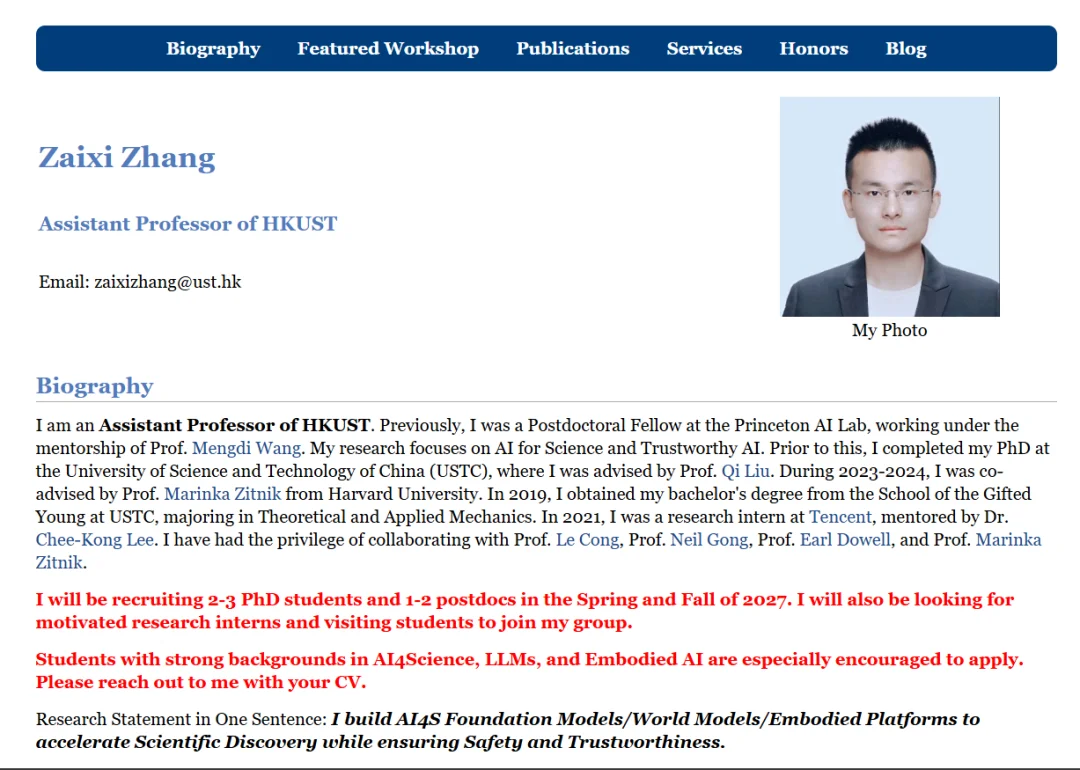
Zhang Zaixi, CEO & CTO of KeLiXinXu, is a 1998-born alumnus of the University of Science and Technology of China (USTC) Young Talent Program, holding a Ph.D. in Computer Science from USTC (advised by Prof. Qi Liu) and joint training at Harvard Medical School (with Prof. Marinka Zitnik) and Princeton University AI Lab (with Prof. Mengdi Wang).
His prior research includes:
– MGSSL: Molecular screening model
– FLAG: Drug molecule generation
– PocketGen: Protein pocket design
– RNAGenesis: RNA therapeutics design
Despite receiving >10 faculty offers—including a $3M startup package from a US Top-20 university—and multi-million-dollar industry offers from major tech firms and biotech labs, Zhang chose academia and entrepreneurship: he joined Hong Kong University of Science and Technology (HKUST) as Assistant Professor in July 2026—jointly appointed across Chemical & Biological Engineering, Computer Science & Engineering, and Medicine.
KeLiXinXu’s core team includes researchers from Princeton, Cambridge, USTC, and engineers from Google DeepMind, Microsoft, Tencent, and Huawei.
🔬 From Tools to True Scientific Understanding
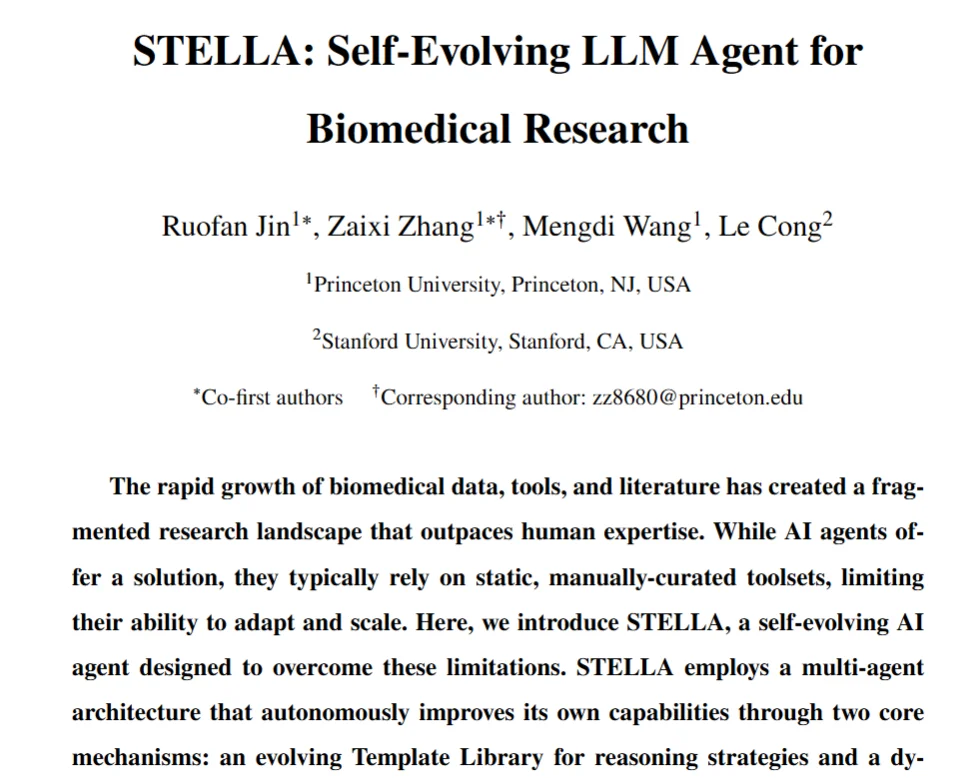
While models like AlphaFold solve isolated subproblems, Zhang’s team discovered that scientific discovery requires orchestration across 20+ tools and iterative cycles. Their early work — STELLA (Self-Evolving LLM Agent for Biomedical Research) and BioClaw — unified models, databases, and lab protocols into end-to-end workflows.
In collaboration with a national key lab specializing in acute myeloid leukemia (AML), STELLA was deployed privately and returned high-priority candidate targets within 10 minutes — one top-ranked target had no prior literature or experimental validation. The lab confirmed it across multiple cell lines — achieving positive preliminary results where manual curation would have taken days to weeks.
But they identified a deeper bottleneck: existing agents rely on language-model-driven tool orchestration, not true scientific reasoning. Converting between text, code, images, and sensor data causes irreversible information loss.
➤ The Scientific Token Paradigm
KeLiXinXu proposes shifting from language tokens to scientific tokens: embedding sequences, 3D structures, microscopy images, mass spectra, and real-time experimental readouts into a unified scientific latent space. This enables:
– Reasoning directly in biophysical space, not just textual prompts;
– Moving from tool usage → scientific discovery;
– From offline prediction → real-time experimental validation;
– From static models → self-evolving systems.
Their first foundation model targets the central dogma: DNA → RNA → Protein → Function → Phenotype, benchmarked on antibody design — targeting 80–90% success rate, far surpassing current industry standards (~10–20%).
🧪 Building the Dry-Wet Closed Loop
Wet-lab automation today favors high-throughput, fixed protocols — ill-suited for exploratory, adaptive experiments. KeLiXinXu is constructing a 200+ instrument sandbox environment, training its Agentic-VLA (Vision-Language-Action) models to:
– Decompose complex experimental tasks;
– Control robotic arms with millimeter precision;
– Monitor reactions in real time via multimodal sensors;
– Self-diagnose failures and autonomously recover.
This system has already been showcased at NVIDIA GTC and CES.
Crucially, the team emphasizes failure intelligence: capturing intermediate data (e.g., reaction kinetics, yield curves, thermal imaging) — often discarded in publications — and feeding it back into model refinement. In partnership with a synthetic biology firm, they deployed custom edge devices to collect and structure such granular process data for continuous model evolution.
✅ Conclusion: The AI Scientist Is No Longer Sci-Fi
The AI4S field is shifting from assisted science to autonomous scientific agency. While most “AI scientists” still stop at hypothesis generation, KeLiXinXu bridges the gap — integrating foundation models, agentic reasoning, and physical-world action. Their dual-track strategy — advancing both scientific understanding and embodied laboratory intelligence — positions them at the vanguard of a new paradigm: AI as a co-inventor, not just a tool.
Source: Zhidongxi (Intelligence Things), by Jun-Da Chen.