US AI Infrastructure Crisis: 47 Data Centers Halted
$10 Trillion AI Buildout Stalls Amid Financing Squeeze and Regulatory Pushback

The trillion-dollar AI infrastructure boom in the United States has hit a critical inflection point. According to the Financial Times (October 18, 2026), at least 47 major AI data center projects—part of a planned $10 trillion (≈¥66.9 trillion) national infrastructure initiative—have been delayed, withdrawn, or blocked as of 2026.
This unprecedented scale of investment exceeds historical U.S. infrastructure surges—but mounting financial, regulatory, and logistical headwinds are now threatening its viability.
📉 Market Signals: Sharp Decline in AI Debt Issuance
Global AI-related debt issuance has plummeted ~80% from its June 2026 peak, signaling tightening credit conditions and growing investor caution.
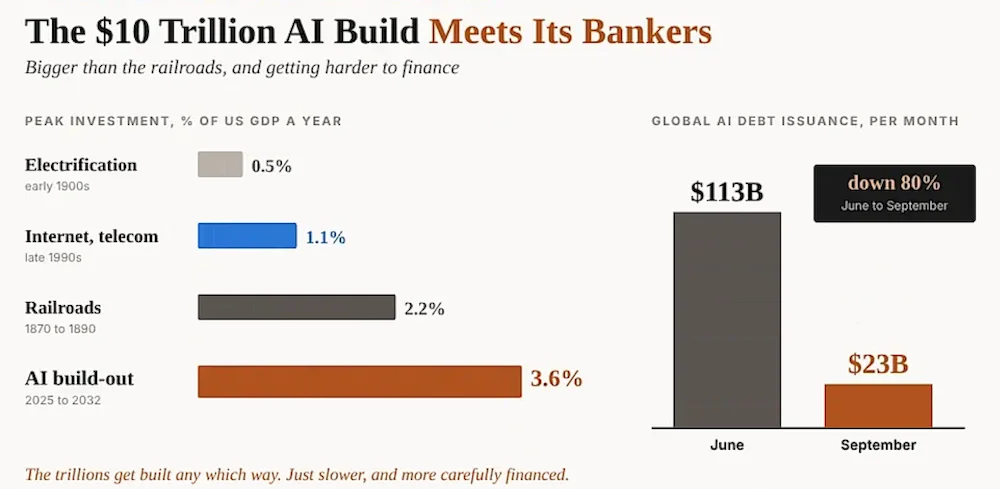
▲ U.S. AI infrastructure investment as % of GDP vs. AI debt issuance volume. Source: Financial Times
💼 Mega-Tech Capital Commitments — And Their Cash Flow Reality
S&P Global forecasts that Amazon, Microsoft, Alphabet, Oracle, Meta, and SpaceX will collectively spend over $7 trillion (≈¥46.8 trillion) on AI data centers and related capex between 2025–2030.
However, this massive outlay comes at a steep liquidity cost:
- These six firms are projected to maintain negative free cash flow through at least 2027, with recovery not expected until 2029.
- Free cash flow (FCF) = Operating cash flow − Capital expenditures. Sustained negative FCF implies heavy reliance on reserves or external financing.
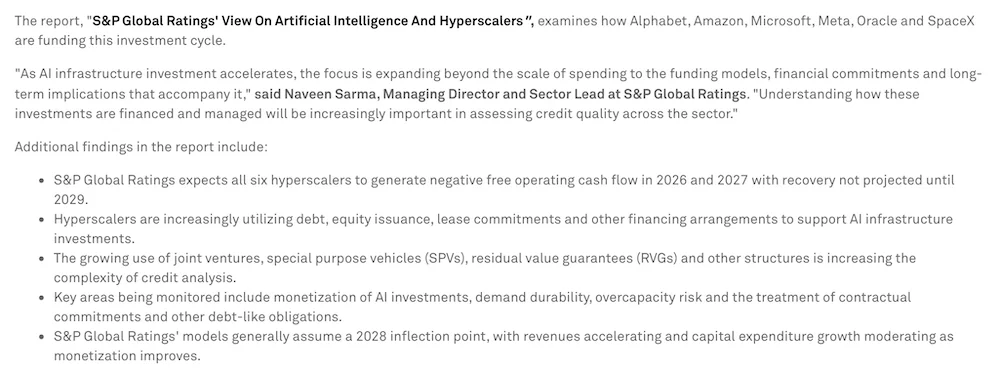
▲ S&P Global research report, August 27, 2026. Source: S&P Global
⚠️ Section 1: 47 Projects Stalled — From Planning to Gridlock
U.S. data center expansion—dubbed the “Wild West” by market observers—has collided with real-world constraints:
- Geographic concentration: Texas, Virginia, Georgia, Ohio, and the Midwest host the densest clusters of operational and planned facilities.
- Regulatory friction: Over 1,000 U.S. communities have proposed moratoria or restrictions on new data centers.
- Grid access barriers: Several utility regulators refuse grid interconnection for projects lacking self-generation capacity.
- Project-specific setbacks:
- Oracle’s OpenAI “Stargate” initiative faces permitting delays, executive departures (e.g., Sachin Katti, Compute Lead, resigned October 14), and revised timelines.
- TeraWulf and Cipher renegotiated lease terms with Anthropic and Fluidstack—extending delivery windows amid design adjustments.
- Cipher agreed to absorb $359 million (≈¥2.41B) in cost overruns for its Texas project—and raised an additional $750M (≈¥5.02B) in equity, backed partly by an $850M (≈¥5.69B) convertible bond offering (October 16).
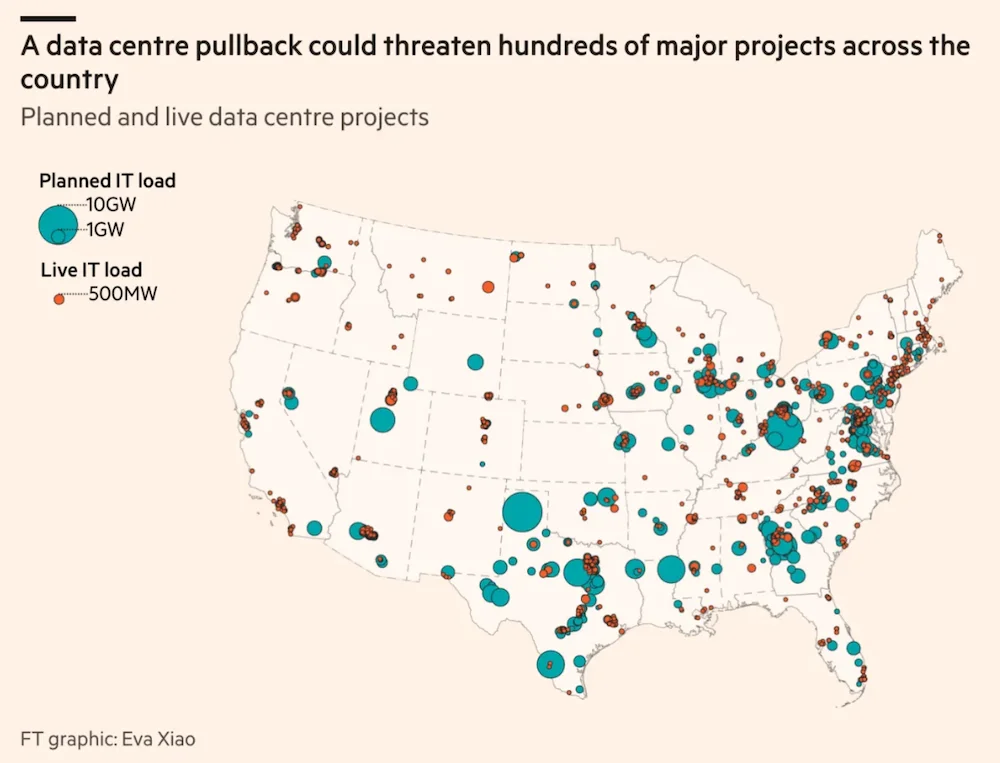
▲ Operational and planned U.S. data center projects. Source: Financial Times
According to Bernstein analysts (October 2026), only ~35% of announced AI infrastructure projects possess credible execution pathways.
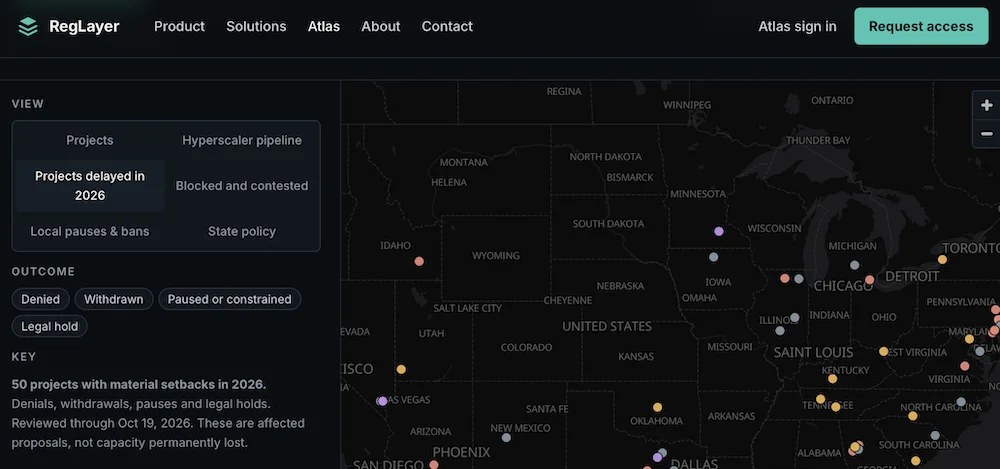
▲ As of October 20, RegLayer shows 50+ stalled large-scale projects (conservative estimate). Source: RegLayer
⚖️ Section 2: Rising Borrowing Costs — CoreWeave Bonds Surge to 15%
Financing stress is intensifying across the AI cloud sector:
- CoreWeave (NVIDIA-backed): Its June 2026 bond issue—initially priced at 9.675% yield—now trades near 15%, reflecting sharp risk repricing.
- CoreWeave’s stock fell ~25% in one week (per FT, October 18); though it rebounded +7.4% intraday recently, it closed −0.4%, underscoring volatility.
Other impacts:
– SB Energy (SoftBank) and Firmus (NVIDIA-backed) have postponed IPO plans.
– OpenAI’s public listing timeline has been pushed back.
– Nscale, bound to Anthropic under a $45B (≈¥301.5B) contract, risks termination if its West Virginia facility misses financing or delivery milestones.
– Nscale has deployed ~25,000 advanced AI chips but targets ~500,000 — and aimed for a $35B (≈¥23.45B) NYSE valuation (now challenged by market conditions).
– Nebius (CEO Arkady Volozh) seeks $250B (≈¥1.67T) to build 5GW of AI compute—yet has secured only ~20% so far.
📊 Section 3: Hidden Liabilities & Revenue Gaps — A Structural Mismatch
S&P Global warns that AI-related liabilities may be significantly underreported due to opaque financing structures—including cross-guarantees among tech giants, developers, and startups.
Gartner forecasts a stark imbalance:
| Metric | 2026–2030 Projection |
|---|---|
| AI Infrastructure Spending | $7T (≈¥46.8T) |
| AI Data Center Revenue | ≤ $3.6T (≈¥24.1T) |
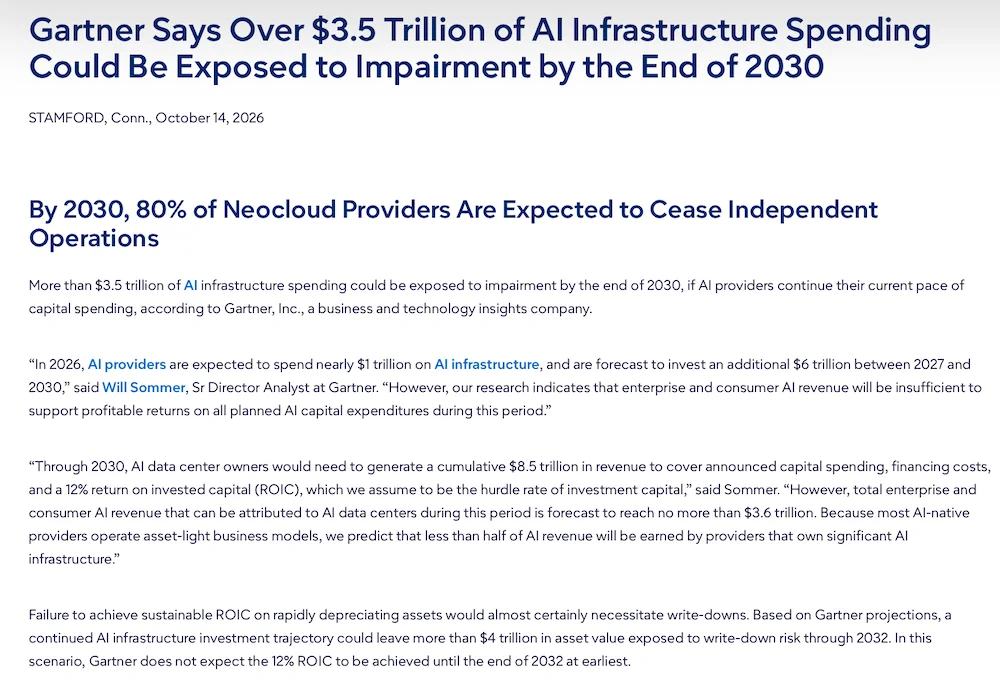
▲ Gartner projection highlights structural revenue shortfall. Source: Gartner
Columbia Business School economist Stijn van Nieuwerburgh estimates total U.S. AI infrastructure, power, and chip investments (2025–2032) will exceed $10T (≈¥66.9T) — equivalent to ~3.6% of annual U.S. GDP.
🔚 Conclusion: Beyond Hype — The ROI Reckoning Has Begun
The AI infrastructure surge is no longer just about demand—it’s about execution discipline, capital efficiency, and sustainable monetization.
Key takeaways:
– Delayed projects = deferred compute capacity for AI firms + delayed revenue for developers.
– Rising yields and IPO deferrals signal eroding investor confidence in near-term profitability.
– Negative FCF across mega-tech signals systemic pressure—not isolated company risk.
As one industry insider put it: “Demand doesn’t print money—revenue does.”
Sources: Financial Times, Reuters, S&P Global, Gartner, RegLayer, Brookings Institution, Columbia Business School
Originally reported by Zhixi Dong (Zhixi News), October 20, 2026.