Prompt Graph Engineering: The Next Evolution of Prompt Engineering
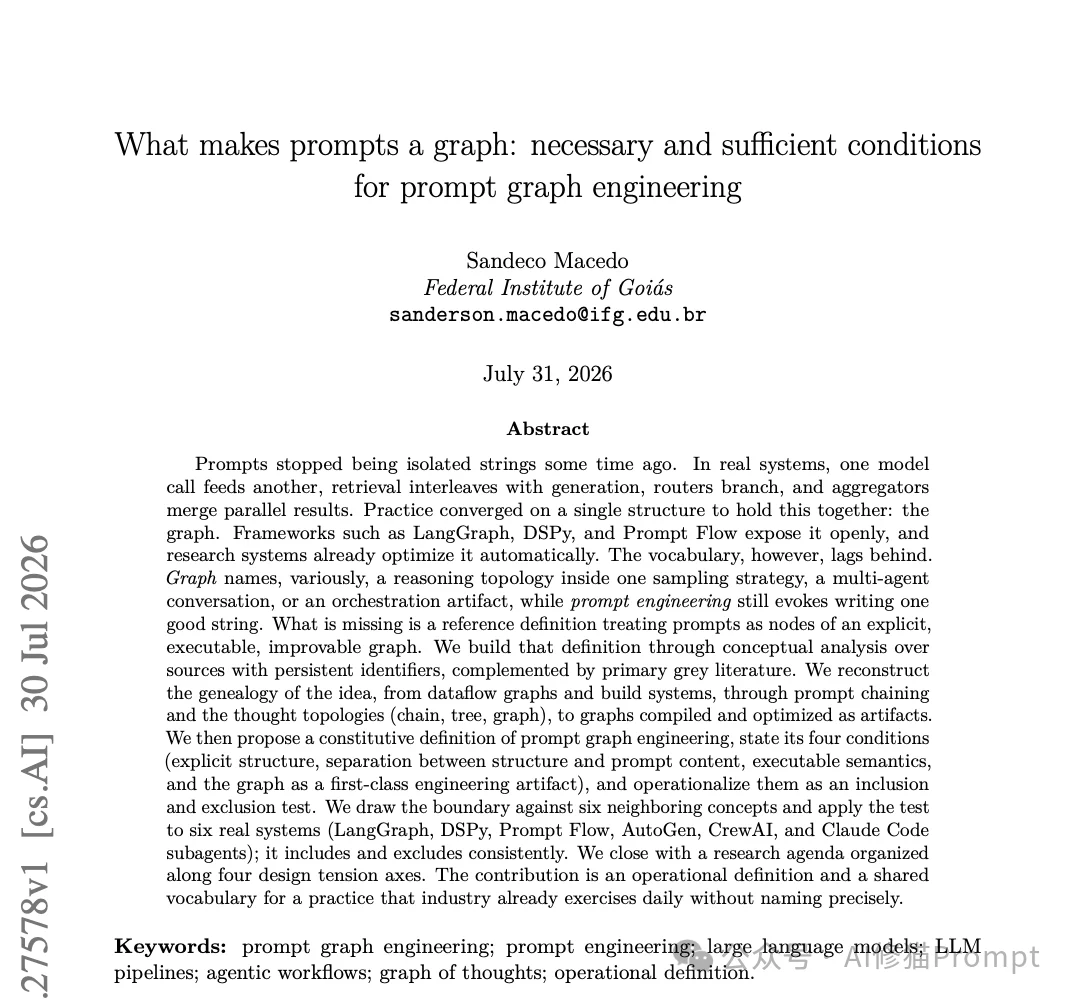
Following concepts like Loop Engineering and Graph Engineering, a landmark paper published in late July 2026 introduces Prompt Graph Engineering — a paradigm shift that treats prompts not as isolated strings, but as nodes in an explicit, executable, maintainable graph.
Beyond Single-Prompt Optimization
Traditional Prompt Engineering focuses on how to write one prompt better. Prompt Graph Engineering shifts attention to how multiple prompts, model calls, and tools interconnect — transforming prompt design from textual craft into system architecture.
When a prompt becomes a node — and dependencies (data flow, control logic) become edges — engineering scope expands from wording to topology, composition, and runtime semantics.
Four Necessary & Sufficient Conditions
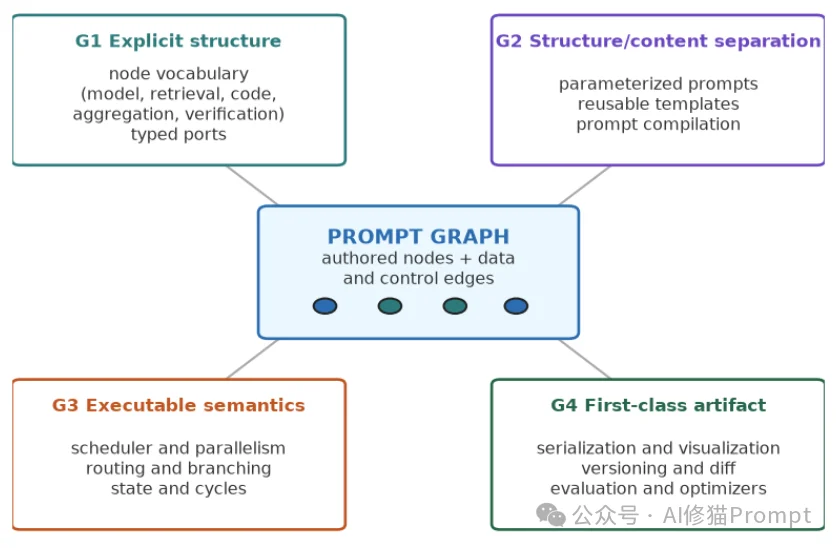
The paper defines rigorous criteria for true Prompt Graph Engineering — distilled into four testable conditions (G1–G4):
| Condition | Key Requirement | Why It Matters |
|---|---|---|
| G1: Explicit Structure | Nodes & edges must be fully declarable before execution — not inferred from logs. | Enables static analysis, debugging, and versioning. |
| G2: Separation of Structure & Content | Modifying a prompt shouldn’t force rewriting the graph; changing the graph shouldn’t require rewriting all prompts. | Supports independent iteration and modular maintenance. |
| G3: Executable Semantics | The graph must drive runtime behavior — scheduling, branching, state passing, parallelism, and cycles — not just serve as documentation. | Turns design into actionable program logic. |
| G4: First-Class Engineering Artifact | The graph must persist independently: savable, inspectable, version-controlled, evaluable, and optimizable. | Makes it a tangible asset — not ephemeral execution trace. |
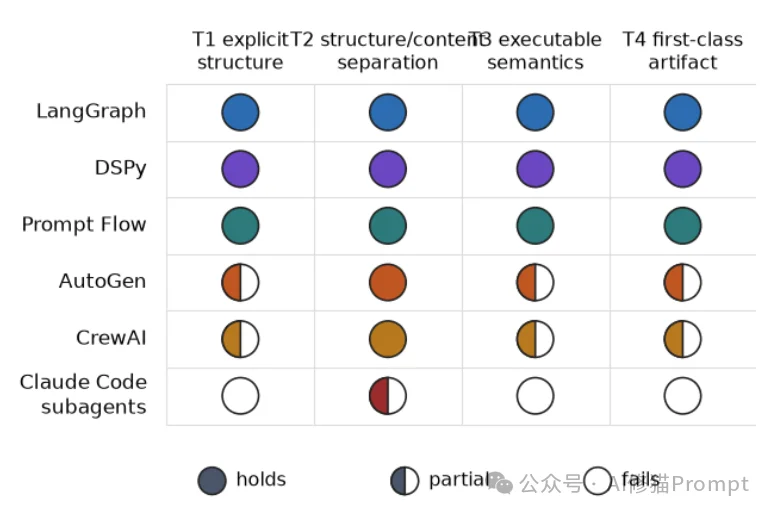
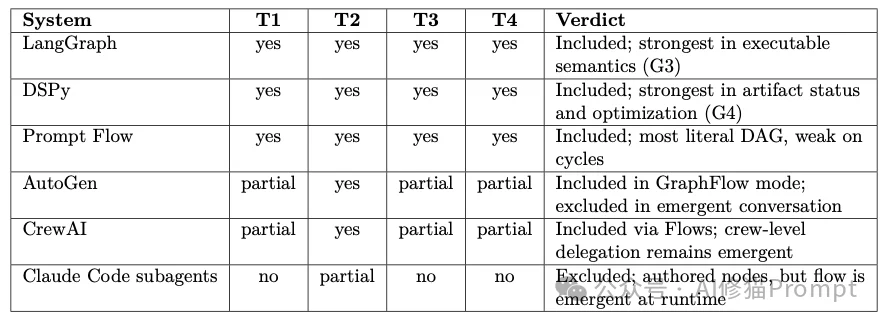
✅ All four must hold. The paper converts them into practical tests (T1–T4): Can you list it pre-execution? Can structure/content change separately? Does runtime obey it? Can tools process it as data?
How It Compares to Related Concepts
✅ Meets All Four Criteria:
- LangGraph: Native StateGraph supports checkpoints, conditionals, loops, and state management — strongest on G3 (executable semantics).
- DSPy: Clear separation between program structure, I/O specs, and prompt optimization — excels at G4 (graph as artifact).
- Prompt Flow: YAML-defined DAGs with decoupled templates — strong on G1 & G2.
⚠️ Partial Alignment:
- AutoGen / CrewAI: Only qualify when using explicit flow definitions (e.g., GraphFlow), not dynamic agent conversations.
❌ Fails Core Criteria:
- Claude Code Subagents: Delegation decisions are made at runtime by the main agent — violating G1 (no pre-execution graph), G3 (no graph-driven execution), and G4 (no persistent artifact).
Why Graph — Not Just Chain or Tree?
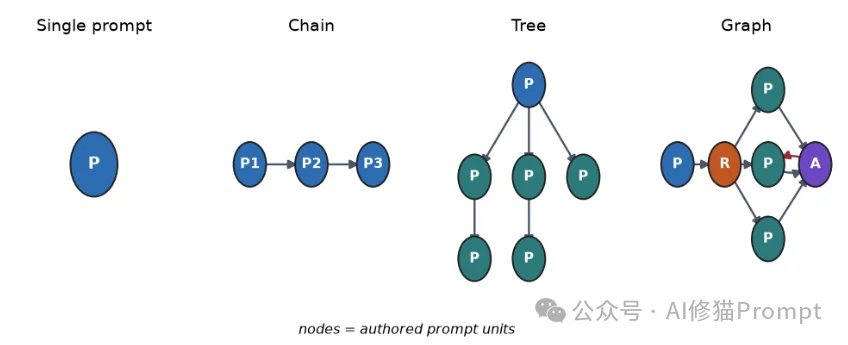
Prompt evolution follows a structural hierarchy:
Single Prompt → Chain → Tree → Graph
- Chain: Linear sequencing (e.g., retrieve → generate).
- Tree: Branching (e.g., self-consistency, ToT).
- Graph: Adds routing, parallelism, aggregation, and cycles — enabling arbitrary, composable control/data flow.
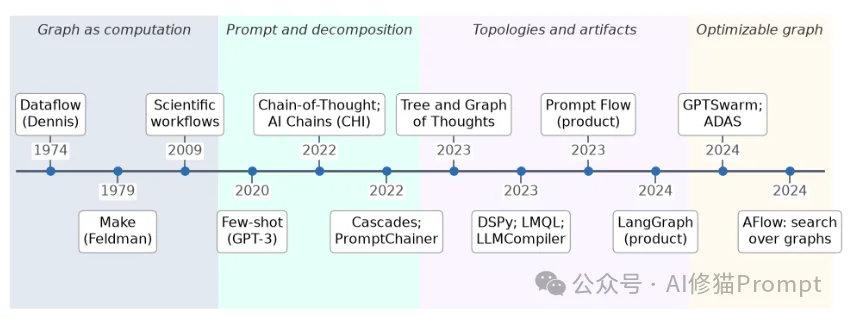
This reflects convergence of two paths:
– Computational heritage: Dataflow systems (Make, Scientific Workflows) established explicit dependency graphs as first-class artifacts.
– Prompt evolution: From few-shot → decomposition → multi-step orchestration → programmable topology.
Clarifying Boundaries
| Concept | Relationship to Prompt Graph Engineering |
|---|---|
| Prompt Engineering | Focuses inside nodes (wording, patterns); now becomes local optimization within a graph. |
| Graph of Thoughts | Node = model-generated thought; topology emerges during inference. PGE requires engineer-defined nodes. |
| Multi-Agent Systems | Emergent interaction ≠ PGE — unless interaction flows are explicitly modeled and executed as a graph. |
| RAG | Hardcoded retrieve→generate? Not PGE. But if Router, Retriever, Generator, Verifier form a versioned, executable graph? Yes. |
| Traditional Workflow Engines | Already have graph + runtime — but lack LLM-specific semantics: stochastic outputs, natural language parameters, token cost modeling, semantic validation. |
🔑 The Boundary in One Sentence: Traditional Prompt Engineering has prompts but no graph; traditional workflows have graphs but no prompt semantics; Graph of Thoughts has graphs but model-defined nodes — Prompt Graph Engineering demands engineers explicitly own and execute the graph.
Conclusion: Prompts Are Now System Nodes
As LLM applications mature — integrating retrieval, planning, routing, parallel execution, verification, and feedback loops — the critical engineering question shifts:
🟢 Not “How do I write this prompt?”
🟢 But “How do these prompts, tools, and models compose into a robust, observable, evolvable system?”
Prompt Graph Engineering provides the conceptual foundation, formal criteria, and practical framework to answer it — elevating prompt design from art to disciplined, scalable engineering.
Article originally published by AI XiuMao Prompt.