PHYMI Unveils Sagi: Open-World Physical Agent After $100M Funding
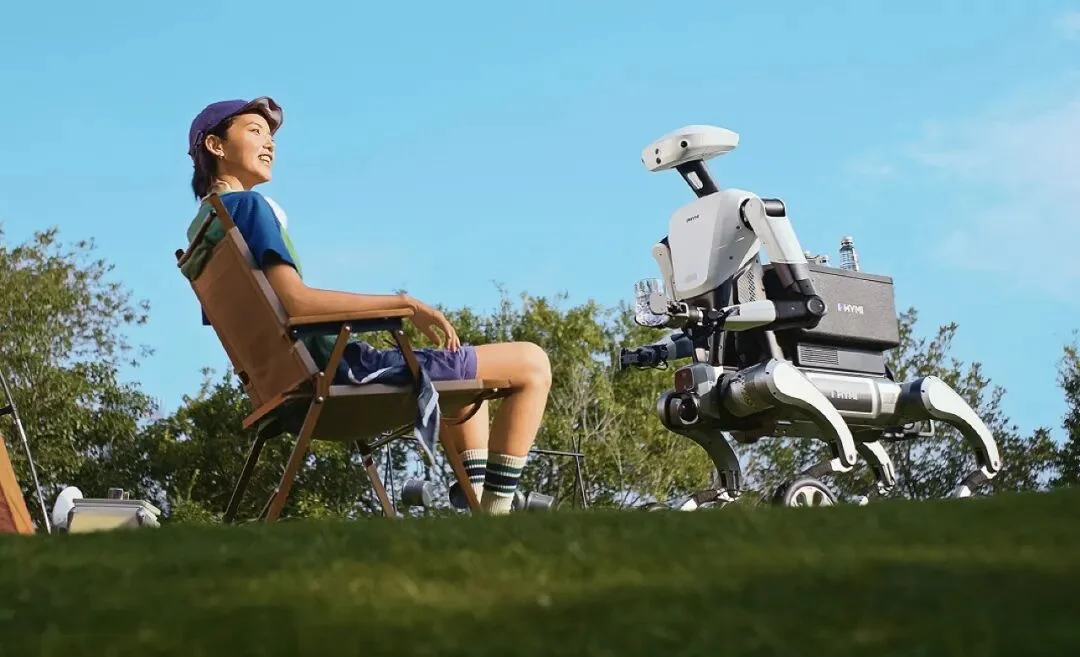
Embodied AI is finally stepping into daily life — returning time to people by handling real-world tasks autonomously.
A Real-World Map vs. A Walking Mind
Jorge Luis Borges once wrote a parable about an empire whose cartographers created a map the exact size of its territory — down to every inch of land and river. Later generations found it useless and abandoned it to rot in the wilderness.
Those who truly walk a place don’t rely on a 1:1 blueprint. They use proprioception, visual judgment, and the ability to adapt when they take a wrong turn.
The embodied intelligence industry is living this parable today.
For two years, humanoid robots have dazzled with choreographed dances, backflips, and piano performances — all rehearsed meticulously in controlled, static environments. But what happens in the open, dynamic world? What can they actually do for you?
That’s the question PHYMI (Feimo Yi Technology) set out to answer.
After closing a near-$100M seed round led by IDG Capital — with participation from Yunqi Capital, Didi Chuxing, Fosun RuiZheng, Yaotu Capital, and Hesai Technology — PHYMI launched Sagi, its first “Action Partner”.
Introducing Sagi: The First True Action Partner
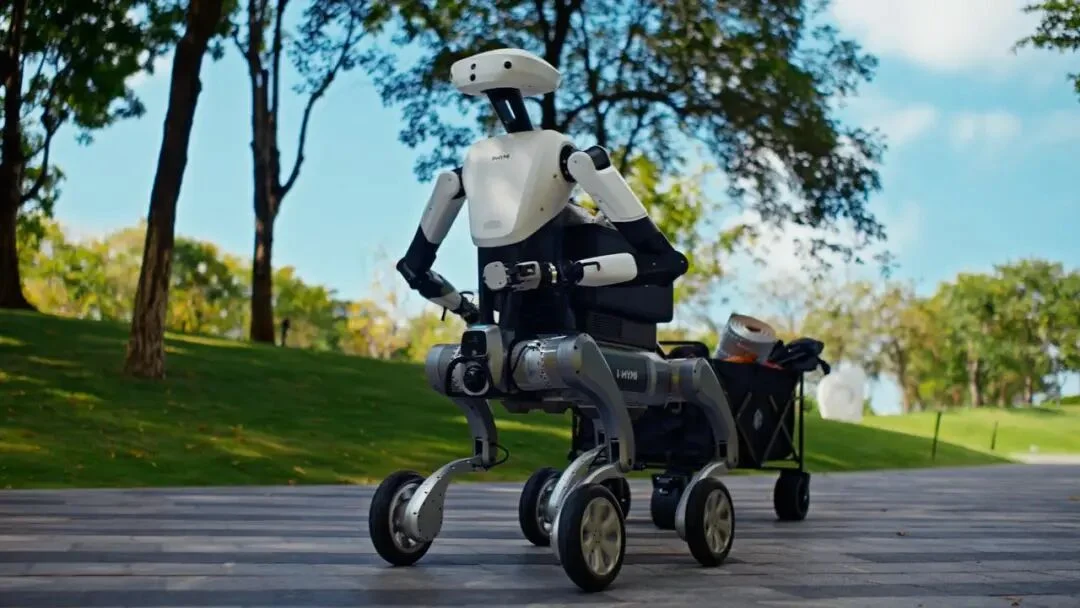
Action Partner Sagi | Image Source: PHYMI
Launched on October 28, 2026, Sagi is the industry’s first Physical Agent explicitly designed as an Action Partner. Its distinctive form — quadrupedal wheels + humanoid upper torso + detachable cargo backpack — draws inspiration from Sagittarius (the centaur). It doesn’t aim to mimic humans; instead, it’s engineered holistically around three core functions: long-range mobility, object manipulation, and task-oriented carrying.
The term “Action Partner” defines its human-machine relationship:
– Understands user goals,
– Operates independently or collaborates via real-time feedback,
– Delivers end-to-end task completion — even across multiple locations and changing conditions.
Sagi isn’t built for feats of dexterity like screwing bolts or suturing wounds. It’s built for real work: retrieving packages, delivering office supplies, or following users across uneven terrain — adapting on the fly.
Why “Action Partner” — Not Just Another Service Robot?
Traditional service robots demand environmental adaptation: QR code stickers, magnetic guide strips, elevator protocol integrations, and centimeter-accurate pre-mapped spaces. Humans must reconfigure their world to accommodate the machine.
PHYMI flips that logic:
“Let the Physical Agent adapt to human society — not the other way around.”
Real life is messy, open, and unpredictable: reception desks shift, hallways fill with pedestrians, doors stand ajar. Human workflows span locations — and goals evolve mid-task.
Sagi was designed from Day 1 for unmodified, real-world deployment. Its foundational capability is long-horizon, open-scene mobility and manipulation — stitching together perception, navigation, interaction, and decision-making into a coherent, goal-driven loop.
This is no demo. It’s the deep water — where space can’t be pre-mapped, objects and needs change constantly, and autonomy means understanding context in real time — not performing scripted routines.
Out-of-the-Box Deployment: No Mapping. No Retrofitting.

In live demos, Sagi moves fluidly through unstructured environments:
-
📦 At a neighborhood parcel station: navigates cluttered corridors, identifies target packages, lifts them with dual arms, loads them into its backpack, rides elevators autonomously, and delivers to apartment doors.
-
🏢 Across an office campus: traverses lobbies, queues for elevators, navigates hallways, and completes inter-departmental deliveries.
-
🌳 In outdoor park settings: maneuvers uneven grass, avoids randomly placed folding chairs, carries gear alongside users, and accepts ad-hoc new instructions mid-route.


Crucially, Sagi requires zero pre-deployment mapping or site modification. Unlike legacy systems needing a week of engineering setup, Sagi begins operating immediately — learning routes as it goes, like a new intern finding the break room on day one.
This “map-free” capability stems from PHYMI’s heritage in autonomous driving. Co-founder Liu Nianqiu — former Technical Partner & Director at DeepRoute.ai — pioneered “mapless intelligent driving” in China. That philosophy transfers directly: perceive, reason, act — in real time — without relying on exhaustive prior world models.
The Four-Pillar Architecture: BRAIN • BODY • DATA • LINK
To enable robust open-world operation, PHYMI built a unified four-layer stack:
1. BRAIN: Asynchronous Multi-Frequency Cognition
Sagi runs PHYMI BRAIN 1.0, an asynchronous, multi-modal architecture dividing cognition into three coordinated spaces:
- Cognitive Space: Handles high-level intent understanding, long-horizon task decomposition, and dynamic replanning when obstacles arise.
- Behavioral Space: Orchestrates real-time sensorimotor fusion — integrating vision, LiDAR, and physics prediction to generate precise locomotion and manipulation actions.
- Contact Space: Processes high-frequency tactile and force feedback for safe, compliant interactions — e.g., gently opening doors or lifting fragile items.
2. BODY: Pragmatic Centaur Design
Sagi’s morphology — quadrupedal wheels + humanoid upper body + modular cargo backpack — balances stability, efficiency, and utility:
- Wheels provide energy-efficient long-range travel;
- Quadrupedal base ensures load-bearing stability on varied surfaces;
- Humanoid arms match human-centric workspaces (desks, shelves, door handles);
- The backpack decouples transport from manipulation — freeing arms for interaction while carrying.
“The backpack is a mission container — configurable per use case. We haven’t abandoned bipedal design, but believe morphological diversity will coexist. Centaur form meets immediate real-world needs.” — Liu Nianqiu
3. DATA: Purpose-Built Real-World Collection
Standard open datasets focus on tabletop manipulation. PHYMI needed richer, mobile-first data — so it built a custom 360° head-mounted capture rig, combining wide-angle and telephoto lenses to record full-body human movement, environmental context, and fine-grained object interaction — all synchronized.
This powers a closed-loop evolution: collect → align → train → deploy → gather feedback → retrain.
4. LINK: Real-Time Human-in-the-Loop Collaboration
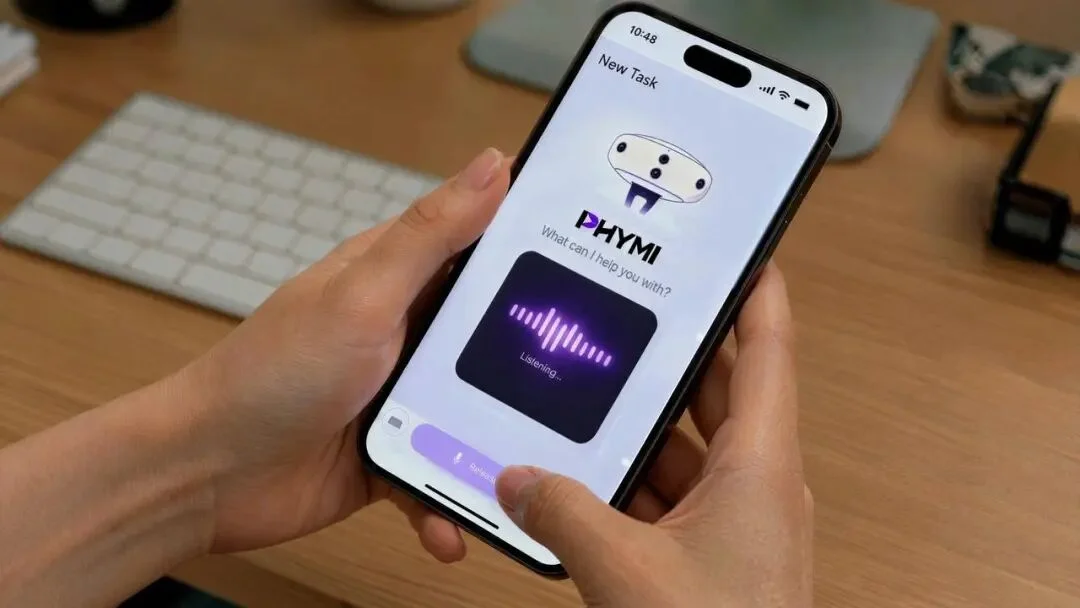
Controlling Sagi via voice command | Image Source: PHYMI
PHYMI LINK is both a real-time collaboration interface and a regional dispatch hub. Users assign goals, grant permissions, monitor progress — and step in when needed.
Example: You ask Sagi to buy cola. It arrives, finds none in stock, and streams its camera feed via LINK. You view alternatives, choose lemonade, authorize payment — and Sagi resumes execution.
LINK also enables multi-user coordination: prioritizing tasks, deferring interruptions, and dynamically assigning jobs across available robots — ensuring continuity and responsiveness.
Timing Matters: Why 2026 Is the Inflection Point
Liu Nianqiu waited deliberately. He judged 2024 premature: robot joint actuators were immature, AI paradigms unstable, and data loops unproven.
By 2026, three pillars aligned:
– ✅ Mature robotics hardware supply chain,
– ✅ Robust AI infrastructure (compute, models, tooling),
– ✅ Proven large-scale data闭环 from autonomous driving.
Meanwhile, the market shifted: over 40,000 Chinese humanoid units shipped in H1 2026 (97% global share), but the “demo rental” bubble is bursting. Demand has pivoted sharply toward deployable utility.
Users don’t care about parameter counts or control theory. They care whether the robot can reliably fetch their lunch.
Sagi answers that call — not with spectacle, but with quiet, competent presence.
Final Thought: The Power of Humble Utility
Physical Agents don’t need superhuman intellect or form to transform daily life. They need reliability, adaptability, and seamless integration.
Sagi embodies that ethos: an unassuming, out-of-the-box partner — ready to move, carry, interact, and collaborate — embedded in the fabric of everyday human activity.
As the AI wave surges, sometimes the most revolutionary thing isn’t what’s most advanced — but what’s most useful.
Header image source: PHYMI
Article adapted from GeekPark; author: Su Zihua.