OpenAI Proposes 5% Equity Stake for U.S. Government — A Strategic Move Amid Regulatory Pressure
In a landmark development reported by the Financial Times, OpenAI has formally proposed granting the White House a 5% equity stake in the company — valued at $42.6 billion, based on its current $852 billion valuation. The offer is unconditional and non-dilutive to existing shareholders.

Context: Regulatory Headwinds Escalate
This proposal arrives amid intensifying political and legislative scrutiny:
- 🇺🇸 Senate Tax Bill: A pending bill proposes a one-time 50% stock tax on major AI firms — effectively seizing half of issued shares.
- ⏳ GPT-5.6 Delay: Last week, OpenAI was compelled to delay rollout of its GPT-5.6 series under direct White House instruction — signaling diminished operational autonomy.
- 🗳️ Midterm Election Cycle: With the U.S. midterm elections just four months away, AI’s impact on employment has become a bipartisan campaign focal point — foreshadowing further regulatory action.
“This isn’t just protection money — it’s a preemptive governance framework.” — Industry analyst commentary
Beyond Compliance: A Three-Tiered Public Wealth Vision
Sam Altman’s initiative extends far beyond appeasement. It reflects a long-standing, deliberately escalated strategy:
| Timeline | Action | Significance |
|---|---|---|
| Jan 2025 | First public mention of government equity participation | Conceptual origin — initiated before regulatory pressure intensified |
| Apr 2026 | Release of AI Policy White Paper + announcement of a “Public Wealth Fund” | Institutional framing; tied to universal economic benefits |
| May 2026 | $250M foundation grant to study “AI’s Economic Future” | Capital commitment reinforcing distributive intent |
| Jun 2026 | Coordination with Anthropic’s IPO filing & public tax-and-dividend advocacy | Industry alignment and norm-setting |
| Jul 2026 | Formal 5% equity offer to White House | Concrete, quantified, actionable proposal |
The full architecture envisions:
- Contribution: OpenAI, Anthropic, Google, and Meta each contribute 5% equity;
- Consolidation: All shares pooled into a sovereign-style AI Public Wealth Fund;
- Distribution: Fund returns distributed as dividends to all U.S. citizens.
This mirrors precedent — notably the U.S. government’s $8.9B investment in Intel (securing 9.9% passive equity), though OpenAI’s move flips the script: the company sets the terms first.
Strategic Anchoring: Four Tables, One Bid
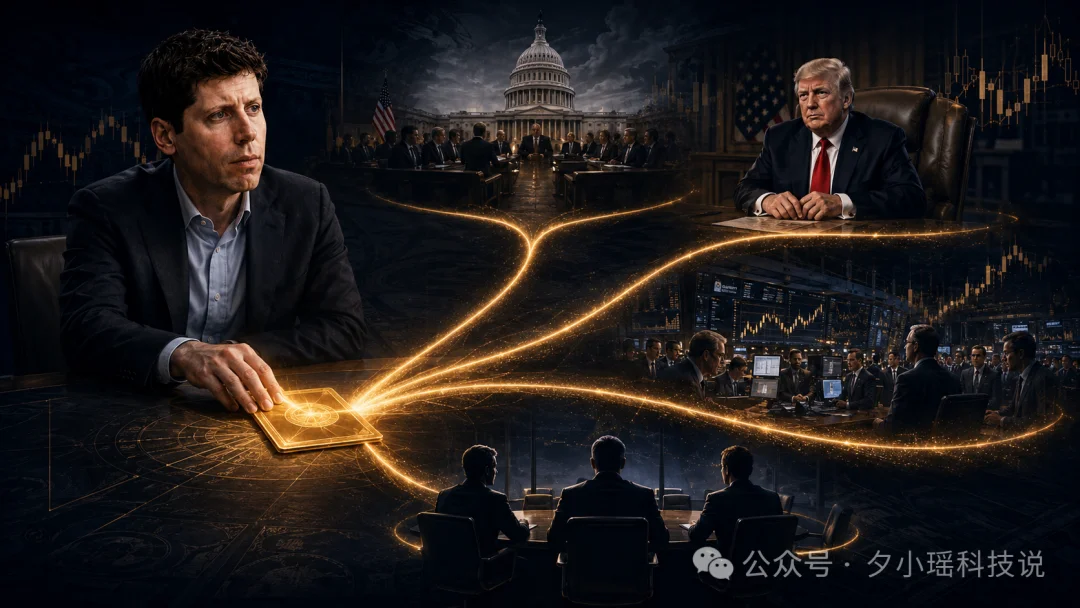
Altman’s 5% is a deliberate anchor — designed to shape negotiation dynamics across multiple fronts:
🔹 To Congress: Shifts debate from whether to how much — transforming existential regulation into incremental bargaining.
🔹 To Political Leadership: Preempts aggressive demands — e.g., former President Trump’s stated openness to AI government stakes makes early, self-imposed 5% both pragmatic and politically astute.
🔹 To Wall Street: Mitigates IPO uncertainty — trading $42.6B in guaranteed value for avoidance of unpredictable, potentially catastrophic future liabilities.
🔹 To Competitors: Embeds peer accountability — naming Anthropic, Google, and Meta creates collective responsibility and raises competitive barriers.
“It’s not generosity — it’s governance-by-precedent.”
Criticism Across the Spectrum
Unsurprisingly, the proposal draws sharp, ideologically divergent backlash:
| Camp | Critique | Core Concern |
|---|---|---|
| Right-Leaning Think Tanks (e.g., R Street Institute) | “First step toward federal control of AI infrastructure” | Erosion of market autonomy; precedent for model version approvals and supply-chain oversight |
| Progressive Advocates | “Tokenism disguised as reform” | $42.6B → ~$130/person, one-time, non-voting — falls far short of structural redistribution or democratic oversight |
| AI Safety Community | “Regulatory capture risk” | Conflicts of interest: Can the White House credibly enforce safety standards while receiving dividends? |
Most strikingly — despite voluminous commentary about the public, no citizen representative sits at the negotiating table. As historical parallels (tobacco settlements, financial regulation) show, industry-led “public benefit” frameworks often prioritize stability over sovereignty.
Final Reflection
“They say the universe ends in heat death. Silicon Valley ends in bureaucracy.”
Whether this marks a new era of public-private co-governance — or merely the most sophisticated regulatory hedging in tech history — remains to be decided. What’s certain is that OpenAI didn’t wait for the knock. It opened the door — and handed the keys.
Source: Originally published by “Xixiaoyao Tech Talk”.