OpenAI Acquires Astral to Dominate Python Developer Infrastructure
AI-powered coding has entered a new phase: from generating code to controlling the entire development stack.
This Thursday, OpenAI announced its acquisition of Astral, a high-profile open-source startup building next-generation developer tools for Python. Following the deal, the Astral team will join OpenAI’s Codex engineering group, marking a strategic pivot toward full-stack AI software development.
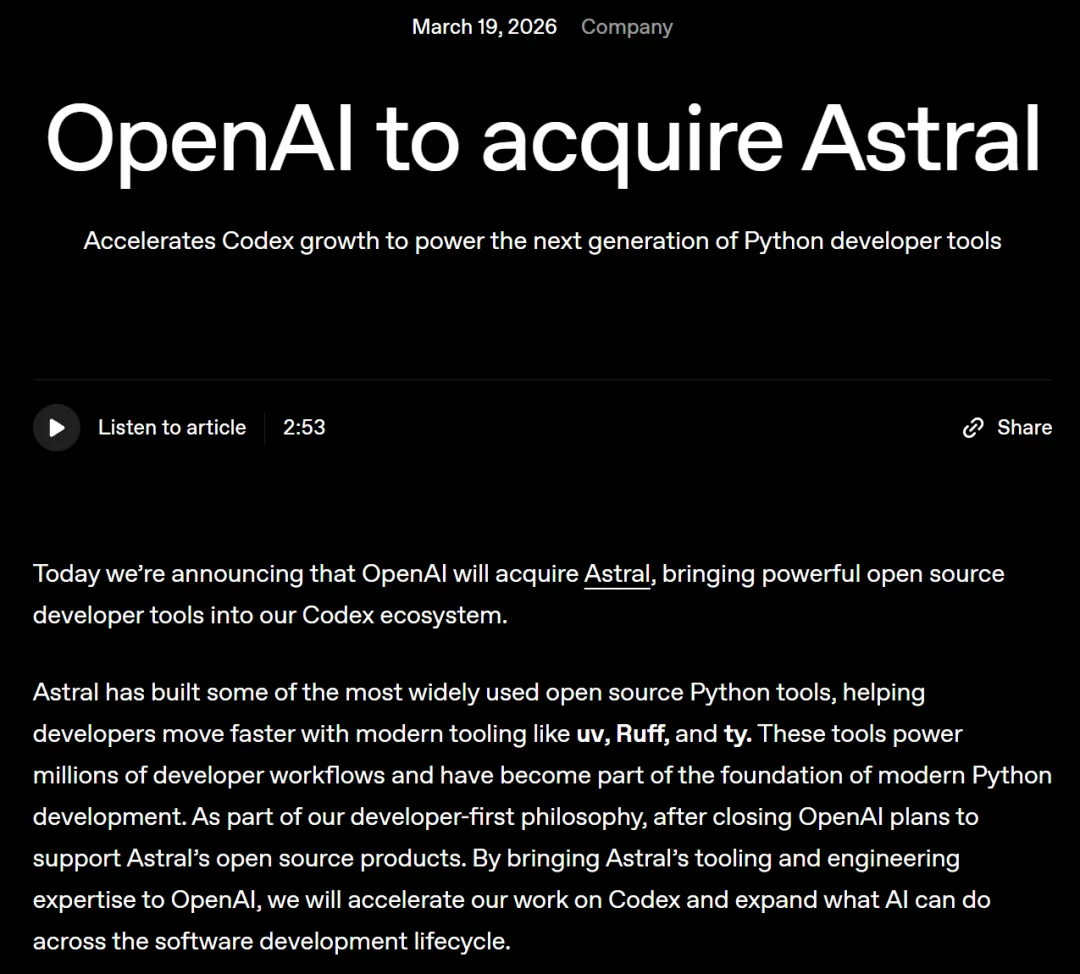
Why This Acquisition Matters
OpenAI’s move signals a decisive shift in the AI coding arms race — moving beyond code generation into infrastructure control. By integrating Astral’s toolchain, Codex aims to evolve from an assistant into a fully autonomous development agent, capable of planning, editing, testing, installing dependencies, enforcing type safety, and maintaining software long-term.
🚀 Astral: Rewriting Python’s Foundation in Rust
Founded in late 2022, Astral is on a mission to “make the Python ecosystem faster” — by rebuilding critical infrastructure in Rust, leveraging its speed, memory safety, and parallelism.
Their flagship open-source tools have become de facto standards for modern Python developers:
- Ruff: A lightning-fast linter and formatter — 10–100× faster than Flake8 and Black. Checks 250,000 lines of code in just 0.4 seconds.
- uv: A next-gen Python package installer and virtual environment manager — replaces
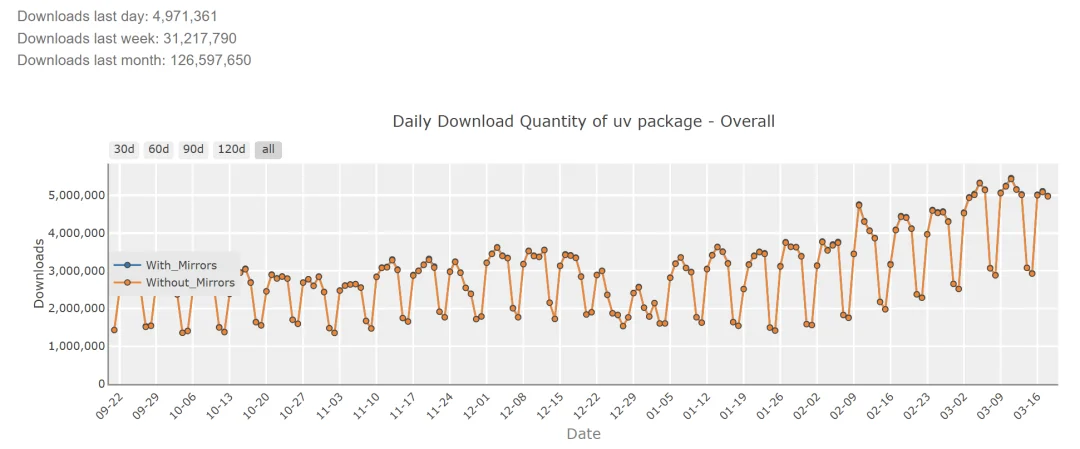
pip,poetry, andvirtualenv. Features a parallel SAT solver for near-instant dependency resolution. - ⭐ 81,000+ GitHub stars
- 📥 126M+ downloads in one month
- ty (formerly Rednot): A blazing-fast, drop-in replacement for MyPy — offering orders-of-magnitude faster type checking.
Together, these tools form the backbone of high-performance Python development — and now, they’re under OpenAI’s umbrella.
Community Concerns & Strategic Implications
The acquisition has sparked widespread discussion across Hacker News and developer forums:
“OpenAI and Anthropic are increasingly capturing the ‘means of production’ in software — not just models, but the tools that shape how developers think, build, and ship.”
While both OpenAI and Astral founder Charlie Marsh affirm continued open-source stewardship, concerns persist around:
- Long-term governance and roadmap independence
- Potential feature gating or delayed open releases for internal Codex integrations
- Competitive asymmetry: OpenAI may deploy ahead-of-public versions of Ruff, uv, and ty within its own AI pipelines
Codex is already scaling rapidly:
– ✅ 3× growth in users since January
– ✅ 5× increase in usage volume
– ✅ 2M+ weekly active users
Yet it still relies on external tooling for critical tasks — installing Python versions, resolving conflicts, linting, and type-checking. Astral closes those gaps — enabling true end-to-end AI-driven development.
Competitive Landscape: A Direct Blow to Anthropic
This acquisition fits into OpenAI’s broader offensive in the AI coding space:
- Earlier this month: Acquired Promptfoo, strengthening pre-deployment agent testing & security
- Late 2025: Acquired Software Applications Inc. and Neptune
It also delivers a tactical blow to Anthropic, whose Claude model has been an active contributor to Astral’s repos — notably appearing as a co-author on GitHub commits.
🔍 Fun fact: Claude Code automatically adds itself as a co-author on every git commit; Codex does not. That’s why you see Claude’s name everywhere on GitHub — and why its future access to Astral’s tooling is now uncertain.
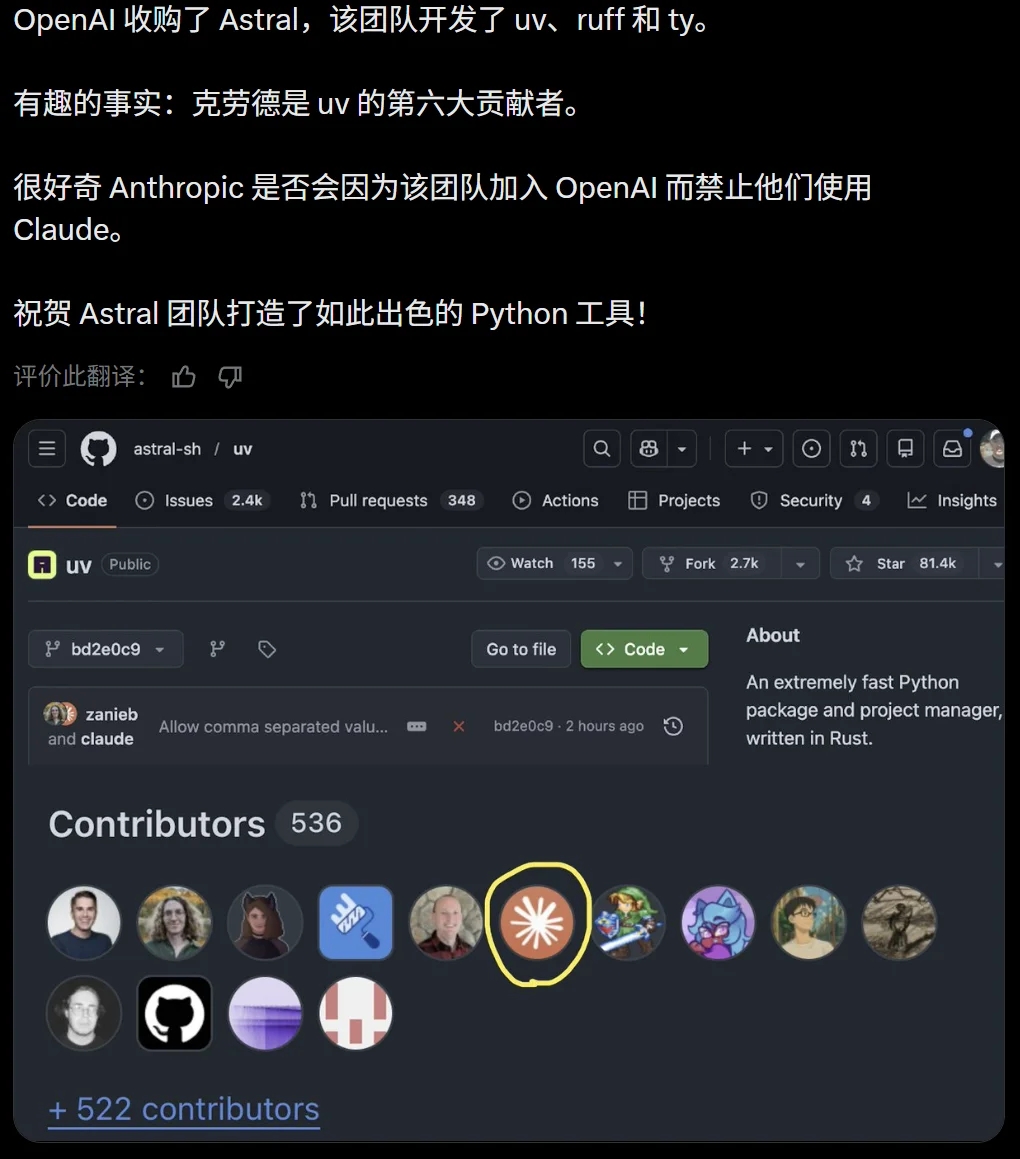
Key question looming: Will Anthropic’s AI be restricted from contributing to or using Astral’s open-source projects post-acquisition?
Sources:
– OpenAI Official Announcement
– Astral Blog Post
– Bloomberg Coverage
– GitHub Commit Analysis (X)
Article originally published by Machine Heart Editorial Team.