ODesign: World Model for Multimodal Biomolecular Design
A groundbreaking open-source AI framework emerges from Nobel Prize-winning labs — unifying protein, nucleic acid, and small-molecule design under a single generative paradigm.
Beyond Seeing: From Structural Prediction to Functional Design
For years, AI-driven breakthroughs in biology have been epitomized by AlphaFold, which revolutionized our ability to predict protein structures at near-experimental accuracy. With AlphaFold 3, the scope expanded further — modeling multi-component complexes involving proteins, nucleic acids, small molecules, and ions.
But as the field matures, a pivotal shift is underway:
🔑 The goal is no longer just to see — it’s to design.
Designing molecules that bind precisely, modulate pathways, correct dysfunctions, or even reconstruct biological capabilities demands more than structural inference — it requires causal, cross-modal reasoning grounded in physical reality.
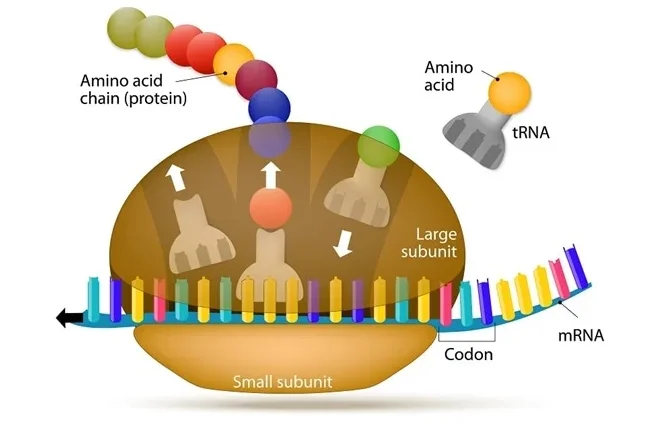
Illustration: Molecular complexity in multi-component biological systems (e.g., ribosome as a drug target)
The Modality Silo Problem
Contemporary AI models for molecular design remain fragmented:
- 🧬 Protein design models
- 🧪 Small-molecule generation & docking tools
- 🧬 Nucleic acid structure predictors
These systems operate in isolated “modality silos” — trained on disjoint data, using incompatible representations, and optimized for narrow tasks.
💡 Note: Here, “modality” refers not to text/image/audio, but to distinct biomolecular classes — proteins, DNA, RNA, ligands, ions — each representing a unique chemical token space.
This fragmentation prevents AI from learning how these entities interact holistically. Yet in real biology, function arises from cross-modal interplay: a drug (small molecule) binds a protein pocket while influencing adjacent RNA folding; an aptamer (RNA) recognizes both protein and ion environments.
Toward a Molecular World Model
What if biomolecular design were governed not by modality-specific heuristics — but by unified physics?
🌐 “Biological interactions are electromagnetic phenomena — different orders of the same fundamental force.”
This insight underpins ODesign, the world’s first multimodal biomolecular design foundation model, developed by a China-based team with deep roots in the 2024 Nobel Prize–winning Baker Lab (David Baker, Nobel Laureate in Chemistry).
Core Innovation: Unified Representation via MCGU
ODesign introduces the concept of the Minimum Chemical Generation Unit (MCGU) — a shared atomic-level vocabulary across modalities. Instead of treating proteins, RNA, and ligands as separate entities, ODesign decomposes them into chemically meaningful building blocks, then reassembles them using:
- Modality Tokens: Indicate molecular class (e.g.,
PROT,RNA,LIG) - Unit Tokens: Encode local geometry and bonding constraints
- Pairformer + Diffusion Architecture: Learns spatial interaction logic and generates full-atom 3D structures under user-defined constraints (rigid/flexible targets)
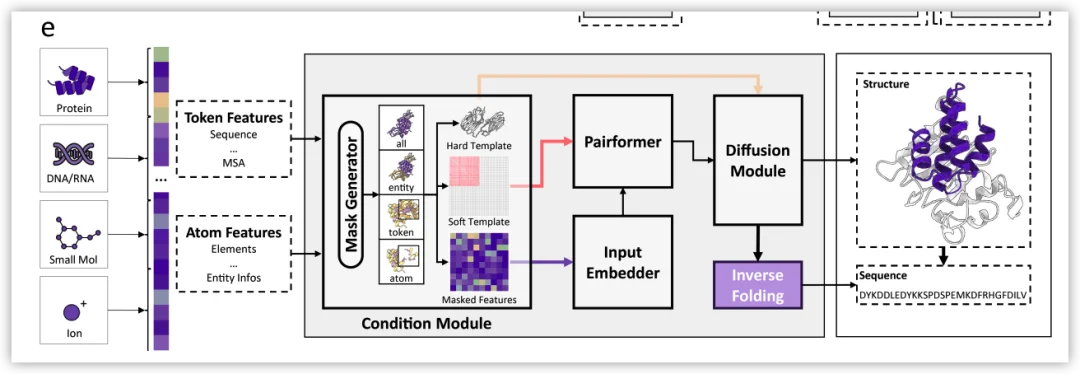
ODesign’s unified representation pipeline: MCGU abstraction → interaction learning → all-atom diffusion generation
Empirical Validation: Cross-Modal Transfer & Wet-Lab Success
ODesign doesn’t just generalize — it transfers knowledge across data-scarce domains:
| Task | Benchmark | ODesign Performance | Improvement |
|---|---|---|---|
| Protein Design | RFDiffusion2 (AME) | 20× higher candidate throughput | vs. RFDiffusion2 |
| RNA Design | RNAFrameFlow | ~2× success rate | on monomer generation |
| Protein–RNA Zero-Shot Design | Out-of-distribution complex | 77.9% avg. success | first-of-its-kind |
| Small-Molecule Binding | SurfGen (protein/DNA/RNA targets) | >40× throughput gain | plus novel cross-target coverage |
Most critically — 8 experimentally validated targets have yielded candidates with nanomolar to picomolar binding affinity, outperforming RFDiffusion, BindCraft, BoltzGen, and PXDesign by orders of magnitude in functional potency.
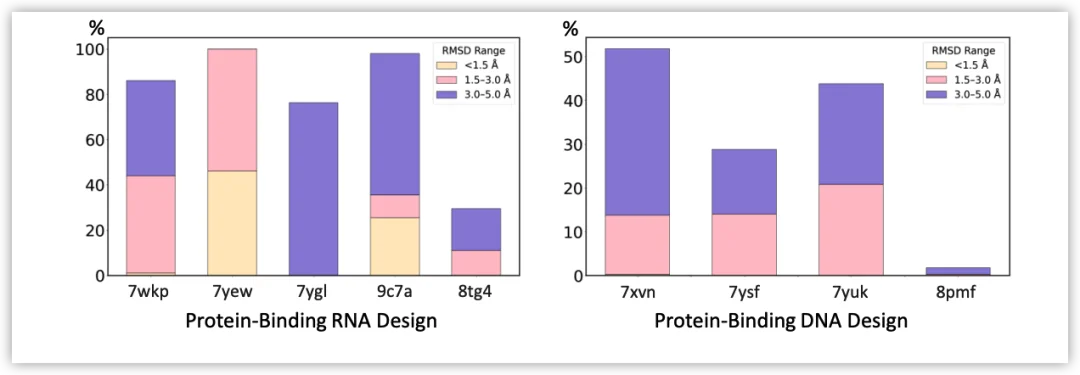
Cross-modal transfer validation: ODesign generalizes protein-learned interaction logic to RNA/DNA design tasks
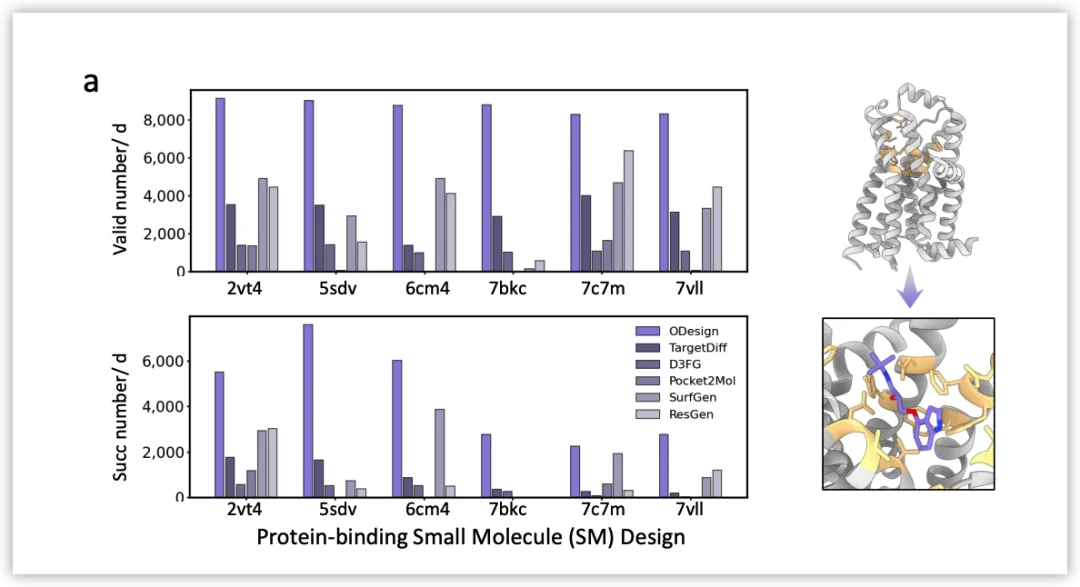
Multitarget small-molecule generation: Covers protein-, DNA-, and RNA-binding ligand design — beyond classical expert models
From Foundation Model to Closed-Loop Science Infrastructure
ODesign is not an endpoint — it’s a prototype for the next generation of scientific AI. Its creators have spun out Valhalla Technologies, backed by WuYuan Capital, to evolve the system across three strategic horizons:
1. AI4Bio — Real-World Drug Discovery Entry Point
Integrates ADMET (toxicity, permeability, immunogenicity, synthetic accessibility) constraints into generative workflows for pharma partners.
2. AI4AI — Self-Explanatory Scientific Reasoning
Transforms black-box outputs into navigable knowledge graphs — linking hypotheses, experimental evidence, failure analysis, and iterative redesign logic.
3. AI4Phy — Autonomous Wet-Lab Loop
Seamlessly connects in silico design → robotic synthesis → high-throughput assay → feedback-driven model refinement.
✨ This closed loop marks the true distinction between a generative model and a world model: the latter learns not just what to generate, but why it succeeded or failed in physical reality.
Team: Interdisciplinary Depth, Proven Execution
The founding team brings rare convergence:
- Dr. Haotian Zhang: Dual BSc (Physics & Pharmacy, ZJU), MD (ZJU), CS PhD (UW); lead author & co-corresponding author of ODesign
- Dr. Kejun Ying: Harvard MD/PhD (Biomedical Informatics), postdoc at Stanford Med & Baker Lab
- Dr. Jiaqi Wang: Computational biology & LLM integration specialist
Their hybrid expertise — spanning quantum-scale physics, clinical medicine, wet-lab validation, and large-scale AI — enables end-to-end ownership of the scientific stack: problem definition → algorithmic solution → experimental proof → industrial deployment.
Resources
Article originally published by “Machine Heart” (Ji Qi Zhi Xin)