Articles / 17-Year-Old AI Prodigy Nathan Chen Leaves Kimi

17-Year-Old AI Prodigy Nathan Chen Leaves Kimi

18 10 月, 2026 • 2 min read • AI-prodigyLLM-Architecture

17-Year-Old AI Prodigy Nathan Chen Leaves Kimi

A landmark departure at the frontier of LLM architecture — and what it signals for the future of AI talent.

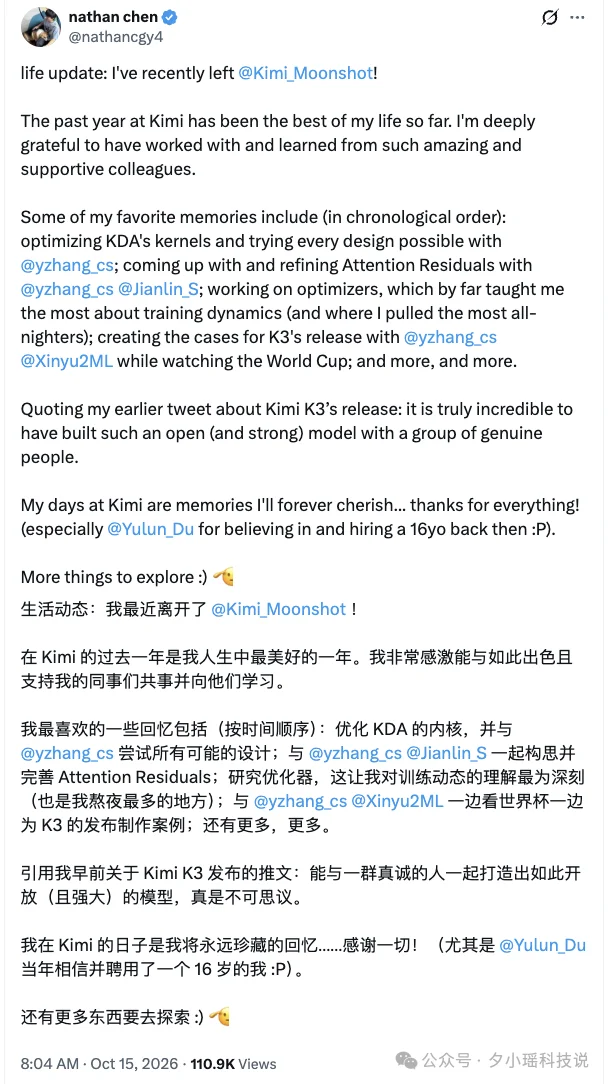
Today, Nathan Chen, the 17-year-old AI prodigy renowned for his groundbreaking Attention Residuals paper, announced his departure from Kimi, the flagship large language model developed by Moonshot AI.


🚀 Rapid Rise: From Teen Intern to Core Architect

  • Joined Moonshot AI at age 16, recruited by Dr. Yulun Du — MIT PhD and generative AI authority.
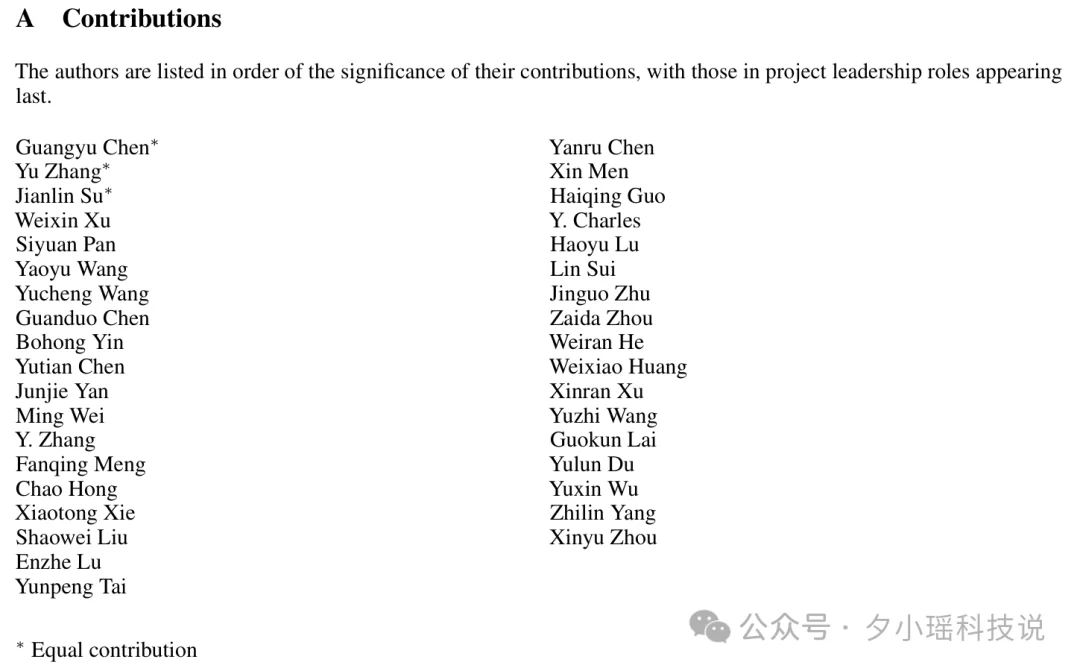
  • Served as first author on arXiv:2603.15031 (Attention Residuals), co-authored with Su Jianlin (“Su Shen”), Zhang Yu, Du Yulun, Wu Yuxin, and Yang Zhilin.
  • Played a pivotal role in:
  • Optimizing the KDA (Kimi Delta Attention) kernel
  • Co-designing the Attention Residuals (AttnRes) architecture
  • Advancing optimizer dynamics & training stability
  • Delivering core components for the Kimi K3 release
Nathan Chen at Moonshot AI


🔬 Attention Residuals: Rewriting a Decade-Old Transformer Primitive

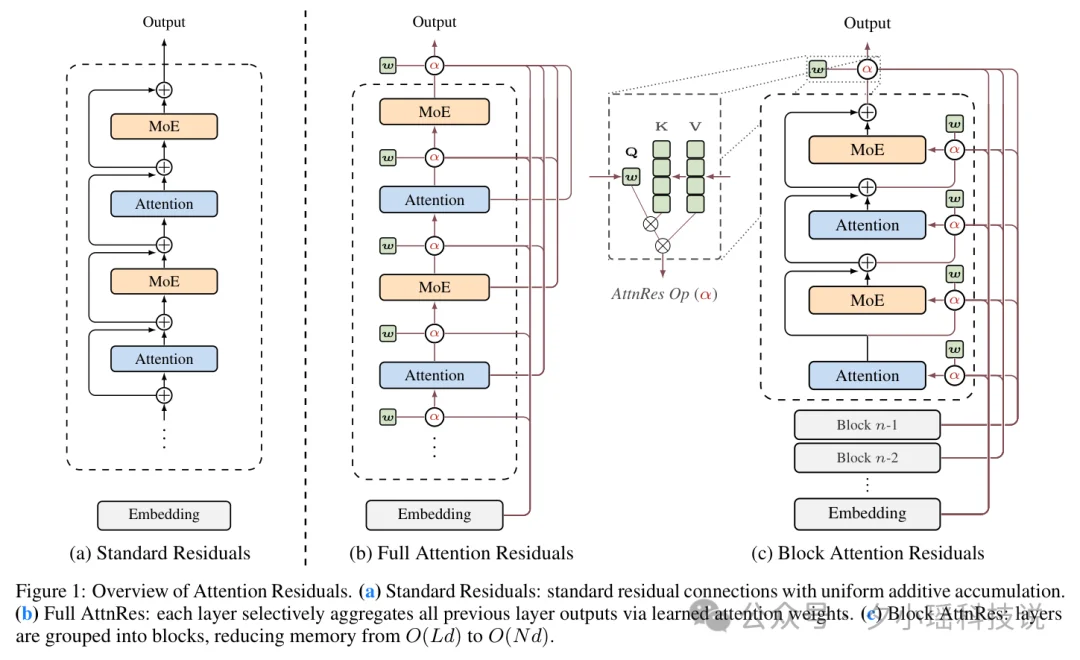
The classic residual connection — foundational to deep Transformers since 2015 — suffers from “PreNorm dilution”: uniform 1:1 layer-wise summation causes shallow features to dominate deep representations.

Chen and team introduced Attention Residuals (AttnRes) — a lightweight, context-aware gating mechanism where each layer attends over prior layers to dynamically weight historical contributions.

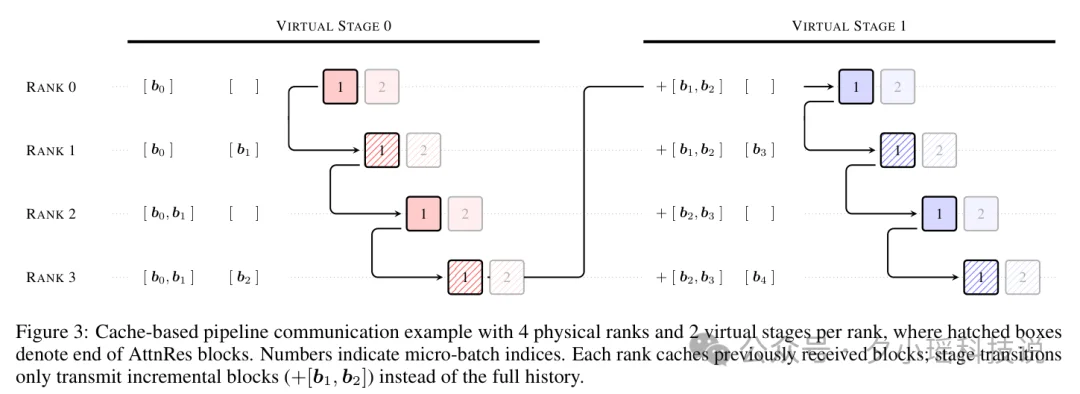
To preserve efficiency, they proposed Block AttnRes: partitioning 48+ layers into blocks, enabling fine-grained intra-block attention and sparse inter-block anchoring.

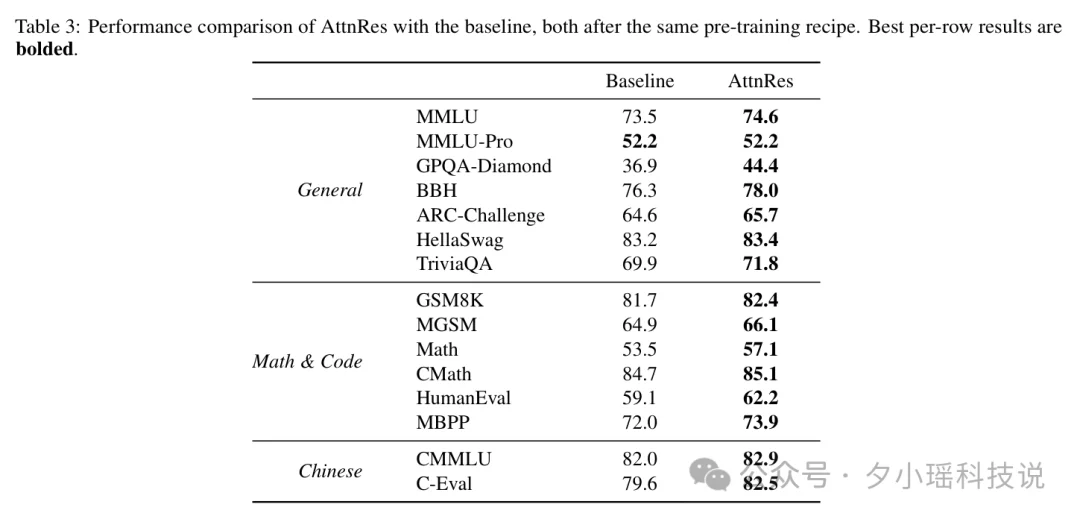
✅ Real-World Impact (Kimi 48B):

Benchmark Improvement
GPQA-Diamond +7.5 pts (36.9 → 44.4)
HumanEval +3.1 pts

Attention Residuals Architecture


🌍 A Paradigm Shift: Age No Longer Defines Expertise

“More things to explore.” — Nathan Chen’s farewell tweet

His trajectory defies traditional career arcs:
– Early 2025: Self-studying ML fundamentals via papers & AI tools
– Mid-2025: Writing high-performance CUDA kernels & open-sourcing research
– Late 2025–2026: Co-leading architecture R&D for a state-of-the-art LLM

This reflects a broader industry inflection: domain intuition, mathematical agility, and rapid prototyping now outweigh seniority in frontier LLM development.

Team Collaboration at Moonshot


🧭 What’s Next?

While Nathan has not disclosed his next move, speculation points to:
– Returning to formal education (e.g., undergraduate/PhD programs)
– Joining elite North American labs (OpenAI, Anthropic, DeepMind)
– Founding or advising an ambitious AI infrastructure startup

His departure underscores a powerful truth: the frontier of AI is being rewritten — not by tenure, but by insight, speed, and fearless curiosity.

Kimi K3 Development Team


Article originally published by “Xixiao Yao Tech Talk”, author “Wanmei Xiaomu”.
Attention Residuals Paper Visualization

Block AttnRes Implementation

Model Performance Comparison

AI Talent Evolution Infographic

Future of LLM Research

17-Year-Old AI Prodigy Nathan Chen Departs Kimi

17 10 月, 2026 • 2 min read • AI-researchLLM-Architecture

Breaking News: Teenage AI Researcher Announces Exit from Moonshot AI

Today, Nathan Chen, the 17-year-old AI prodigy renowned for his groundbreaking Attention Residuals paper, officially announced his departure from Kimi — the flagship large language model developed by Moonshot AI.

Nathan Chen at Kimi

A Meteoric Rise in Just One Year

Chen joined Moonshot AI at just 16 years old, recruited directly by Dr. Yulun Du — MIT PhD and core technical leader at Moonshot. Within months, he became a key contributor to Kimi’s most critical infrastructure:

  • 🔧 Optimized KDA (Kimi Delta Attention) kernel, co-developing high-performance attention implementations with engineer Yu Zhang (@yzhang_cs)
  • 🧠 Co-invented Attention Residuals (AttnRes) alongside Dr. Jianlin Su (@Jianlin_S), reshaping Transformer residual connections after a decade of stagnation
  • ⚙️ Advanced optimizer & training dynamics research, operating deep in the LLM training stack
  • 🚀 Core architect behind Kimi K3 launch, delivering production-ready use cases under tight deadlines

Kimi team collaboration

Revolutionizing Transformer Foundations

Published on arXiv (ID: arXiv:2603.15031), Chen’s first-author work Attention Residuals introduces a paradigm shift:

“Traditional residual connections apply uniform 1:1 summation across layers — causing signal dilution and representation degradation in deep models. AttnRes replaces this with context-aware, lightweight attention scoring over prior layers.”

To maintain efficiency, the team introduced Block AttnRes: partitioning deep networks into blocks, applying fine-grained attention within blocks and anchor-based communication across them.

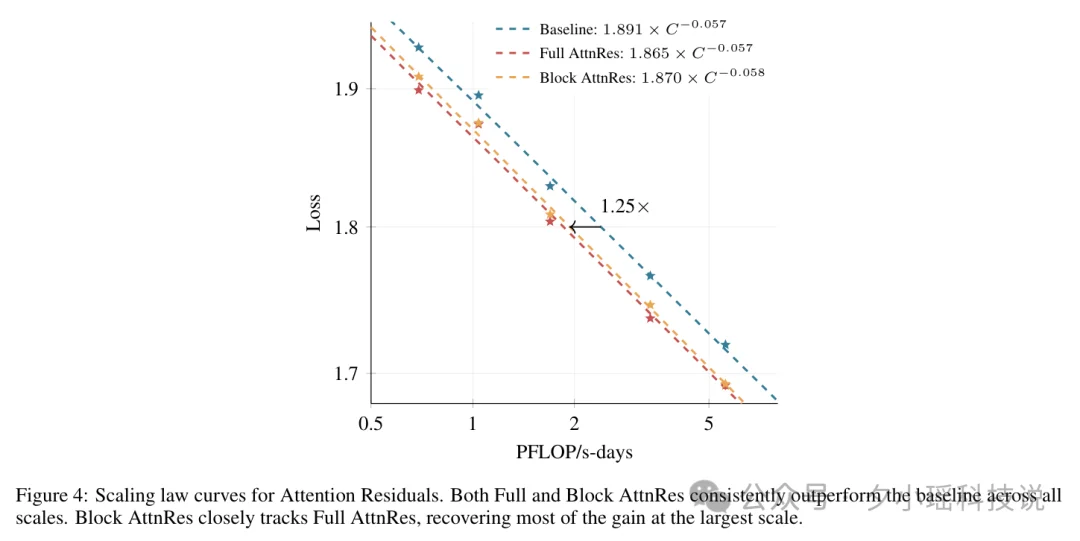
Real-world impact on Kimi 48B:
– ✅ GPQA-Diamond logic reasoning: +7.5 points (36.9 → 44.4)
– ✅ HumanEval code generation: +3.1 points

AttnRes architecture diagram

Block AttnRes schematic

Beyond Age: A New Era of Merit-Based Innovation

Chen’s journey — from self-studying ML fundamentals in early 2025 to co-designing foundational LLM architecture within months — exemplifies how the AI frontier is rapidly devaluing seniority and rewarding raw insight, speed, and mathematical intuition.

As he wrote in his farewell post:

“My year at Kimi was the most meaningful of my life. Thank you — especially to Yulun Du — for believing in a 16-year-old.”

His next step remains unannounced — though speculation points to elite academic programs or ambitious AI startups. His final tweet simply read:

🫡 More things to explore.

Nathan Chen's farewell post

Why This Matters

Chen’s departure isn’t just personnel news — it’s a cultural inflection point. In an era where open-source tooling, accessible compute, and real-time knowledge sharing compress learning curves, the gatekeepers of experience are falling. The future of AI belongs not to those who’ve been longest in the field — but to those who see clearest, fastest, and deepest.

AI research evolution timeline


Article adapted from “Xixiaoyao Tech Talk”, author: Wanmei Xiaomu.