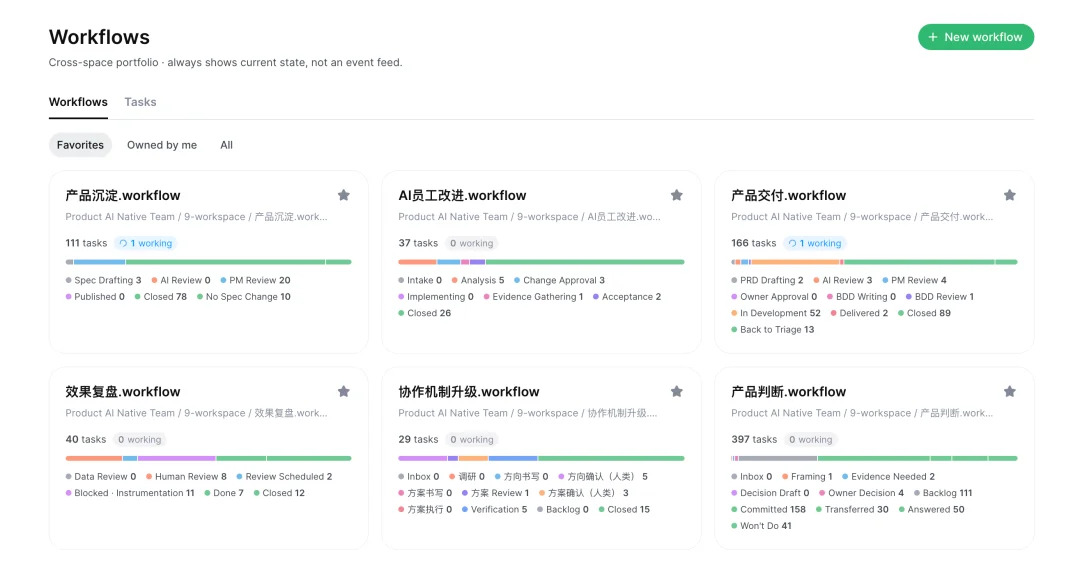
Moxt Half-Year Review: Building AI-Native Teams
Moxt’s mission is “Build Your AI Native Team” — enabling seamless human-AI collaboration through shared context, trusted knowledge structures, and orchestrated workflows.
While the promise of AI agents is widely celebrated, integrating them into real team workflows remains uncharted territory. There are no industry standards for how much context to provide, how to govern permissions, when humans should intervene, or whether they should be in the loop or merely on the loop.
Six months after launch, Moxt co-founder Ming Zhe conducted a candid retrospective — distilling hard-won insights from embedding agents directly into daily product, engineering, and operations work.
This is not theoretical speculation. It’s frontline practice — raw, iterative, and deeply instructive.
01 Agent Can Work — But Why Can’t It Join the Team?
In late 2025, teams increasingly adopted Claude Code and Cursor — not just as dev tools, but for research, reporting, web content creation, and even internal tooling. Coding became less an end goal and more a means for agents to operate in the digital world.
Yet when asked how much AI had truly transformed product management, the answer was sobering: not much.
Agents excelled at learning, summarizing, and researching — but rarely participated in core tasks like feature positioning, value analysis, or PRD drafting. Why? They lacked team context: no awareness of current product state, historical decisions, or the rationale behind them.
Workarounds existed — exporting docs to Markdown, manually injecting background via prompts — but these were siloed, one-off, and non-transferable. One person’s contextual scaffolding didn’t flow to another’s agent.
Key insight: AI collaboration doesn’t hinge on agent intelligence alone — it requires shared, discoverable, and maintainable team context.
That insight became Moxt’s founding principle.
02 Context Is Not Enough: “Readable” ≠ “Trustworthy”
With context identified as foundational, Moxt built a shared workspace — file-based, Markdown-first, supporting CSV and HTML. Agents could search, compare versions, batch-process, and run scripts; humans could read, edit, and navigate natively.
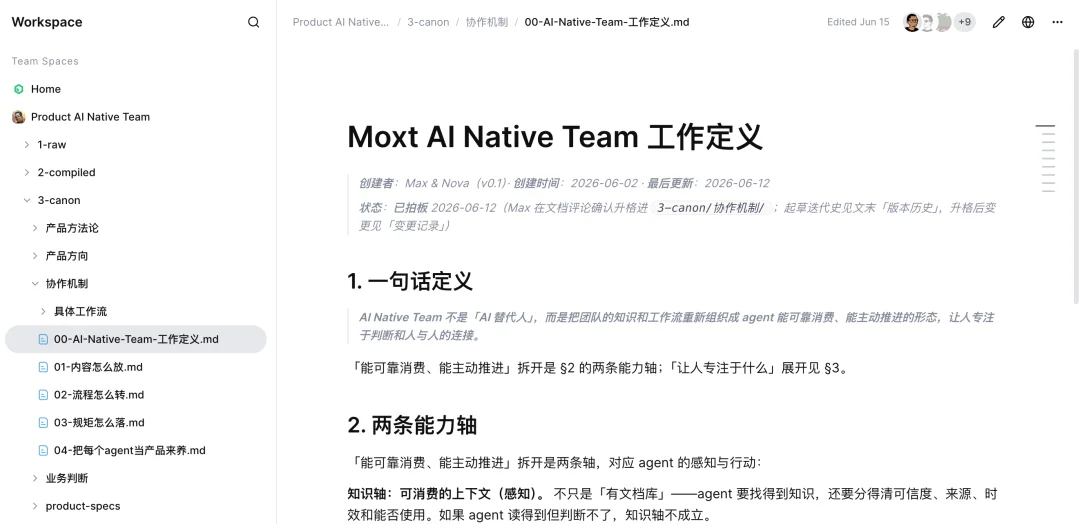
Moxt Workspace Interface
The result? Early euphoria — “Our agent knows everything!” — quickly gave way to doubt. As content accumulated, agents began conflating final decisions, draft proposals, and obsolete notes. Without structural distinction, “readability” bred overconfidence — and risk.
Like chatbot memory, raw recall isn’t enough: agents need to know what’s been ratified, what’s pending, and what’s deprecated — not guess on the fly.
Key insight: Context requires trust architecture — not just volume. Facts, analysis, and final conclusions must be structurally separated.
Knowledge organization shifted from “Let the agent read more” to “Help it discern what’s credible.” Trust is encoded in location, ownership, and update history — not inferred.
03 Shared Capabilities Demand Shared Accountability
As early demos entered daily use, a new challenge emerged: reusable agent capabilities. Tasks like bug triage or data analysis relied on consistent business logic and rules — yet rebuilding them per user created redundancy and inconsistency.
Inspired by OpenClaw-style shared-agent setups (however clunky), Moxt launched two role types on March 18:
– momo: Personal assistant (individual scope)
– AI Teammate: Shared, team-owned agent (collective scope)
Both share the same underlying structure: Rules, Skills, and Memory.
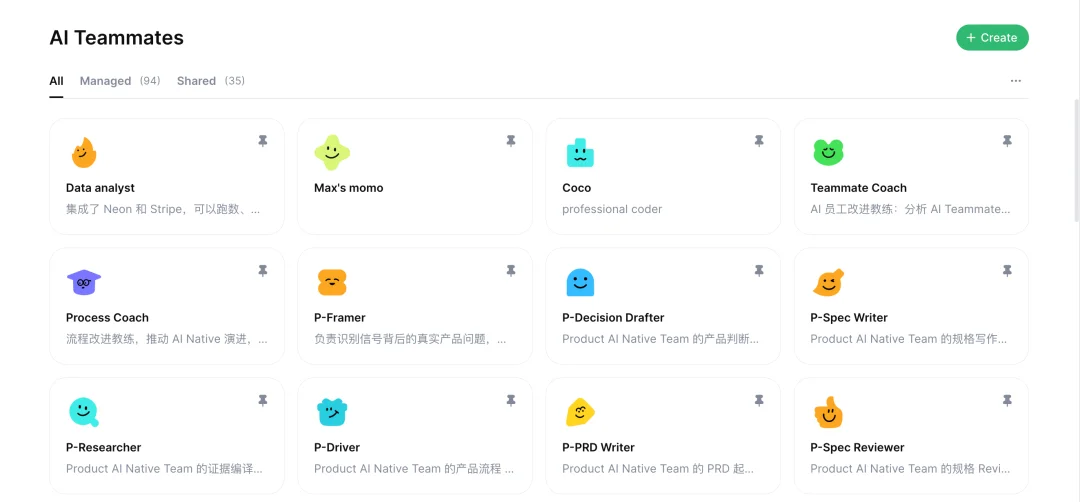
Moxt Teammates and Personal Assistant momo in use
But introducing team roles surfaced governance questions previously irrelevant to tools: Who edits rules? Who assigns tasks? What data can it access? Who owns its failures?
Initial enthusiasm led to role sprawl — many overlapping or one-off agents. Cleanup revealed a deeper truth:
Roles are responsibility units — not functional slices.
A role deserves independence only if it carries stable, evaluable, and sustainably maintained accountability. Too broad → unmanageable rules/memory. Too narrow → exploding governance overhead. Today, Moxt measures team capability not by count of agents, but by clarity of ownership.
04 People + Roles ≠ Self-Running Teams: The Workflow Gap
With Workspace and AI Teammates in place, the puzzle seemed complete — until reality intervened.
Teams instinctively patched coordination gaps: e.g., instructing one agent to @ another in comments to hand off work. These ad-hoc chains worked, but were fragile — a missing @, a misnamed file, or an ambiguous handoff stalled progress.
Worse, acceleration created new bottlenecks: faster PRD drafting meant more human-led reviews, stakeholder alignment, and engineering handoffs. Output scaled — coordination effort scaled faster.
Key insight: AI teams require explicit workflow orchestration — not automation for its own sake, but intentional repositioning of human attention.
Workflow isn’t about removing people — it’s about defining who owns each state, what triggers transitions, and who adjudicates blockages.
05 Workflow in Practice: Design, Human Role, and Impact
Moxt rolled out Workflow internally in early June and launched publicly on June 24.
Core Philosophy
- A Task maps to one real-world objective.
- Each Task moves through states (e.g., Researching, Drafting, Reviewing, Validating).
- Every state has a clear owner — human or agent.
- Handoffs are automatic and auditable. Blockages trigger explicit escalation.
Strategic Prioritization
Moxt prioritized workflows by time impact, not novelty:
– Automating a 1%-time task yields 1% gain — impressive story, minimal ROI.
– Optimizing a 50%-time workflow to 25% effort delivers 25% systemic lift.
Example: The Product-to-Dev Flow
1. Feedback enters → Agent preserves original, deduplicates, defines problem.
2. If evidence gaps exist → Agent fetches code status, user logs, external data.
3. Evidence-rich proposal → Goes to PM for decision.
4. Approved → Agent drafts PRD → Independent Agent verifies facts/completeness.
5. Dev phase → Agent implements within defined boundaries; escalates for ambiguity, risk, or permission gaps.
6. Post-merge → Product沉淀 flow updates internal docs → Help-docs flow assesses public-facing updates.
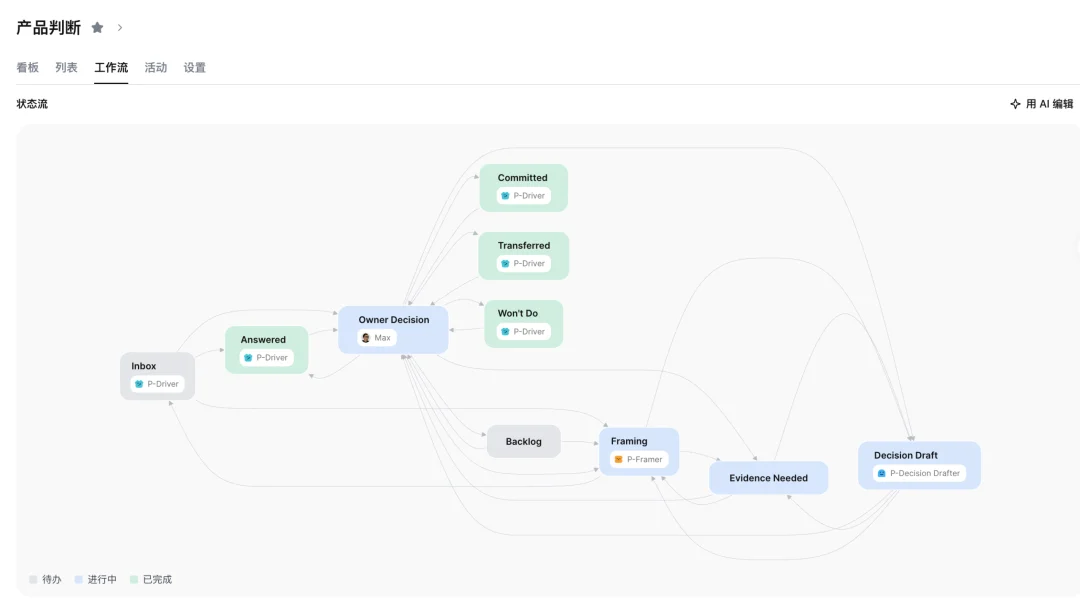
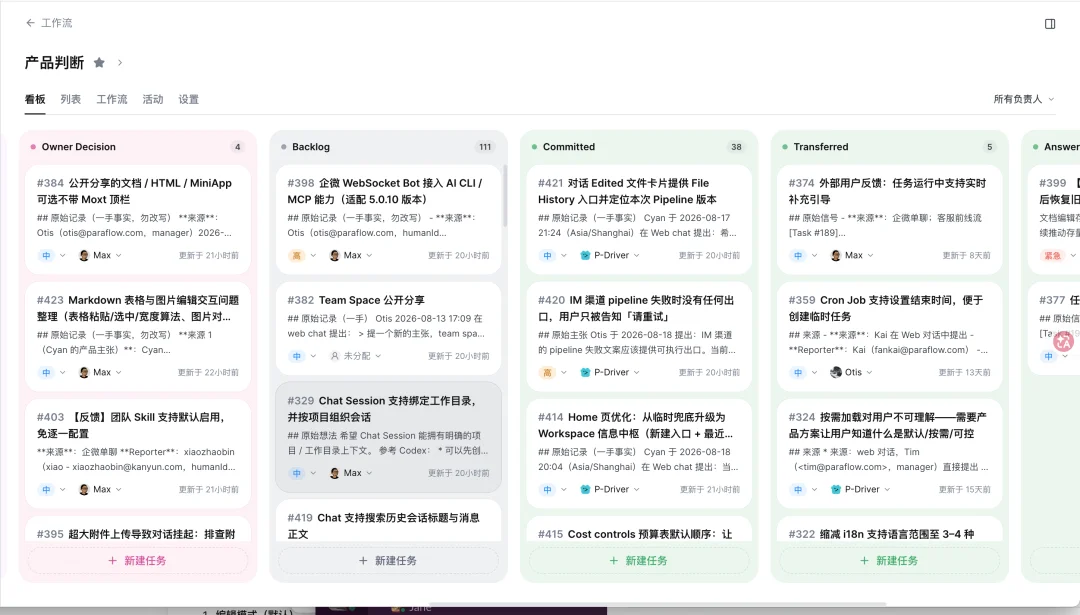
Product judgment flow: process diagram and kanban view
Human Participation: From Synchronous Guidance to Asynchronous Review
- Old model: Humans stood beside agents — prompting, correcting, iterating live.
- New model: Agents submit full-context deliverables → humans review asynchronously → feedback loops back automatically.
Results (as of Aug 4):
– 92.5% of 106 PRDs completed via review-based workflow (median: 1 round; 90% finalized in ≤3 rounds).
– 39.9% of 168 dev tasks implemented fully by Coding Agent, with engineers focused on review.
– 5× increase in weekly demand output vs. pre-Workflow baseline.
– 40% reduction in end-to-end cycle time (PRD→dev: 5.3 → 3.1 days; PRD→delivery: 14.6 → 9.0 days).
– 1,386 Tasks processed across 5 core flows in <2 months.
Workflow didn’t remove humans — it refocused them on judgment, taste, risk assessment, and final validation.
06 From “Finish This Task” to “Improve the System”
Once agents operated daily, a meta-question arose: How do we make the next iteration better than this one?
Two goals often conflict: completing today’s task vs. improving tomorrow’s capability.
When an AI Teammate underperformed, the knee-jerk fix was real-time correction — effective for the moment, but ephemeral. The same error recurred elsewhere.
Moxt now treats every AI Teammate as a product requiring ownership and iteration. When issues arise, teams audit systematically:
– Was the goal clear?
– Was input complete & trustworthy?
– Were tools, permissions, and paths well-defined?
– Was human feedback captured in Rules/Skills/Memory?
Agents now self-review nightly — generating auto-assessments and 360° peer feedback. Issues feed into two dedicated workflows:
– AI Employee Improvement Workflow: Fixes to agent behavior (rules, skills, memory).
– Collaboration Mechanism Upgrade Workflow: Fixes to cross-role processes.
Crucially, success isn’t “the rule changed” — it’s “the same failure does not recur in the next real task.”
Key insight: An AI-native team isn’t a static system — it’s a living, self-correcting organism requiring continuous improvement loops.
07 Looking Back: How AI Truly Enters Team DNA
Moxt’s journey reveals four evolutionary stages of AI adoption:
1. Thinking Partner → 2. Personal Assistant → 3. Team Member → 4. Embedded Workflow Primitive
At maturity, two pillars define true AI-native operation:
– ✅ Accurate Context: Knowledge is findable — and discernibly categorized (current fact vs. draft vs. obsolete).
– ✅ Active Workflow: Processes self-advance — agents know where work stalls, who receives outputs, who adjudicates blocks, and how failures surface.
A revealing litmus test emerges:
If all agents were removed tomorrow — would the team merely slow down… or need to rebuild its entire operating system?
- Slowing down = AI as efficiency tool.
- Rebuilding workflows, roles, and knowledge systems = AI as operating system.
Three weeks builds a prototype. Six months of relentless iteration — placing agents in real work, observing where they stall, then refining context, roles, and workflows — builds a native team.
AI-native teams aren’t designed. They’re evolved — layer by layer, failure by failure, insight by insight.
Article contributed by Founder Park.