Microsoft CEO Satya Nadella’s Landmark Thread: A New Economic Framework for the AI Age
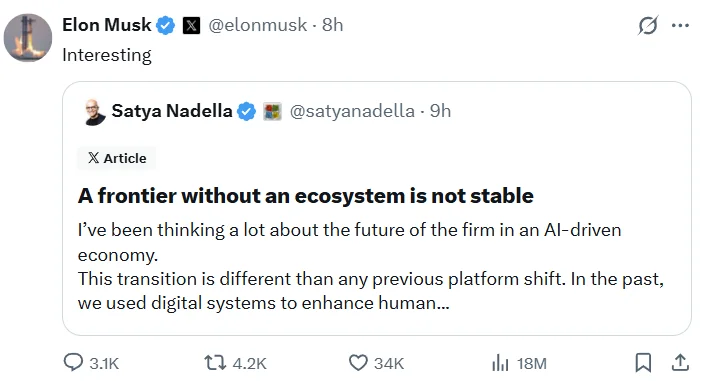
Yesterday evening, Microsoft CEO Satya Nadella published a highly influential long-form thread on 𝕏 titled “A frontier without an ecosystem is not stable” — sparking over 28 million views and widespread discourse across tech, policy, and enterprise circles.
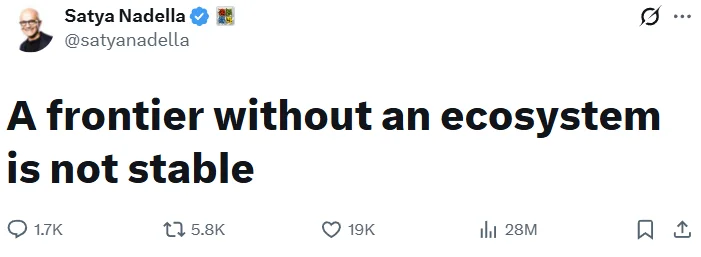
Original post: https://x.com/satyanadella/status/2066182223213293753
🔑 Core Thesis: Two Foundational Capitals
Nadella argues that AI is fundamentally reshaping corporate value creation — moving beyond traditional software augmentation toward cognitive co-evolution. He introduces two interdependent, non-substitutable forms of capital:
| Capital Type | Definition | Key Components |
|---|---|---|
| Human Capital | The irreplaceable cognitive and relational assets of people | Domain expertise, judgment, creativity, interpersonal trust, pattern recognition, ethical reasoning |
| Token Capital | Proprietary AI systems trained on organizational knowledge | Fine-tuned models, private RAG infrastructures, reinforcement learning loops, enterprise memory graphs, domain-specific agents |
💡 “Human capital does not depreciate with rising token capital — it becomes more valuable. Human agency is the engine of token capital growth.”
🔄 The Learning Loop: Where Value Compounds
Nadella envisions a self-reinforcing cycle — not model selection, but system architecture:
graph LR
A[Human Workflows & Judgment] --> B[Private Token System]
B --> C[Real-world Action & Feedback]
C --> D[Refined Institutional Knowledge]
D --> A
- ✅ Private evaluation frameworks, not public benchmarks, measure real business impact
- ✅ Intra-organizational RL environments, where models learn from operational execution traces
- ✅ Searchable institutional memory, turning tacit expertise into queryable, composable assets
- ✅ Swappable base models, while preserving hard-won “corporate veteran” knowledge encoded in fine-tuning, tooling, and orchestration
This loop is the next-generation IP — a compound-interest intelligence engine, where every optimized workflow generates better training signals, accelerating proprietary knowledge accumulation.
⚠️ Critical Warning: Avoiding the “AI Hollowing-Out” Trap
Nadella draws a stark parallel to early globalization:
“Just as offshoring hollowed out industrial economies — GDP rose while jobs vanished — we must prevent AI from hollowing out organizational knowledge. If value flows only to a handful of all-consuming foundation models, political and economic systems will reject it.”
He explicitly warns against value leakage: when enterprises unknowingly commodify their unique capabilities via third-party APIs, losing control over data provenance, decision logic, and economic upside.
🌐 The Imperative: Build a Stable Frontier Ecosystem
The thread culminates in a call for ecosystem-first AI development:
- Platforms must enable more value creation outside than inside
- Every organization must own its learning loop — preserving digital sovereignty
- Human capital must be amplified, not automated away: judgment becomes codified, expertise becomes scalable, relationships become infrastructure
“When this happens, employees see their knowledge multiplied. Their insights become systemic, replicable, and economically rewarded — benefiting not just their company, but entire ecosystems.”
🧭 Strategic Implications
- For enterprises: Prioritize building internal token stacks with human-in-the-loop governance — not just API integrations
- For developers: Focus on orchestration layers, private evaluation metrics, and knowledge-graph tooling over model tuning alone
- For policymakers: Incentivize sovereign AI infrastructures and anti-commoditization safeguards (e.g., model provenance standards, data rights portability)
Source: MachineZone Editorial Team (translated and adapted for global AI leadership audience)