MemSlides Agent Tops Hugging Face Charts
△ MemSlides paper homepage and author information
Breakthrough in AI-Powered Presentation Creation
Researchers from Tsinghua University, Shanghai Jiao Tong University, and Beijing University of Posts and Telecommunications have introduced MemSlides, a memory-driven Slides Agent framework designed for personalized slide generation and multi-turn localized editing. Unlike conventional AI PPT tools that suffer from context drift and inconsistent revisions, MemSlides addresses core pain points head-on:
- ✅ Personalization at scale: Generates slides tailored to individual stylistic preferences (e.g., low-text density, diagram-heavy layouts, consistent footer conventions).
- ✅ Memory-aware iteration: Remembers both long-term user habits and transient task-specific constraints across editing rounds.
- ✅ Precision editing: Implements scoped, boundary-respecting modifications — no accidental overwrites or formula deletions.
Performance Highlights
| Metric | Baseline | MemSlides | Improvement |
|---|---|---|---|
| Closed-loop completion rate | 81.5% | 96.3% | +14.8 pts |
| Strict validation pass rate | 31.0% | 53.4% | +22.4 pts |
| First-correct edit time | 609.5 s | 242.5 s | −60% faster |
These results were validated under diagnostic paired-editing benchmarks — confirming MemSlides’ robustness in real-world iterative workflows.

△ MemSlides online workspace interface
Architectural Innovation: Three-Tier Memory System
MemSlides departs from brute-force context stuffing. Instead, it implements a structured memory hierarchy, enabling precise state management across the PPT lifecycle:
1. User Profile Memory
- Captures cross-task, stable preferences: e.g., “always use sans-serif fonts”, “end slides with action items”.
- Dynamically retrieves relevant traits per task — not static prompt injection.
- Directly influences Round-0 generation quality: slides reflect intent + identity, not just content decomposition.
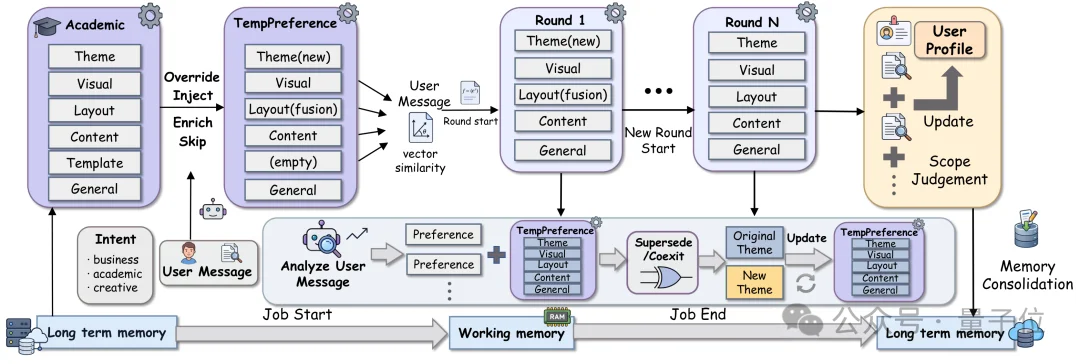
△ User profile memory mechanism
2. Working Memory
- Tracks ephemeral, deck-specific constraints: e.g., “all new title slides use blue text”.
- Persists across turns — even if invoked later — ensuring delayed execution fidelity.
- Enables continuous stateful editing, not disjointed Q&A cycles.
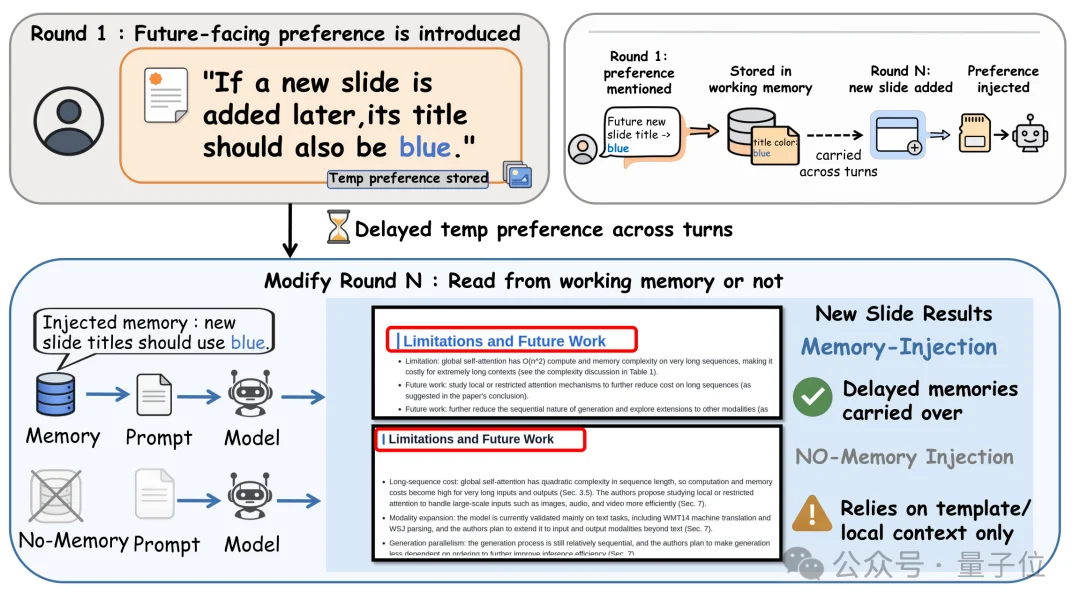
△ Working memory supports delayed preference activation
3. Tool Memory
- Records operation-level experience: e.g., “when adjusting chart labels, always preserve axis scaling”.
- Comprises two layers: single-turn lessons and fine-grained procedural heuristics.
- Ensures edits are safe, minimal, and reproducible — acting as an internal QA guardrail.
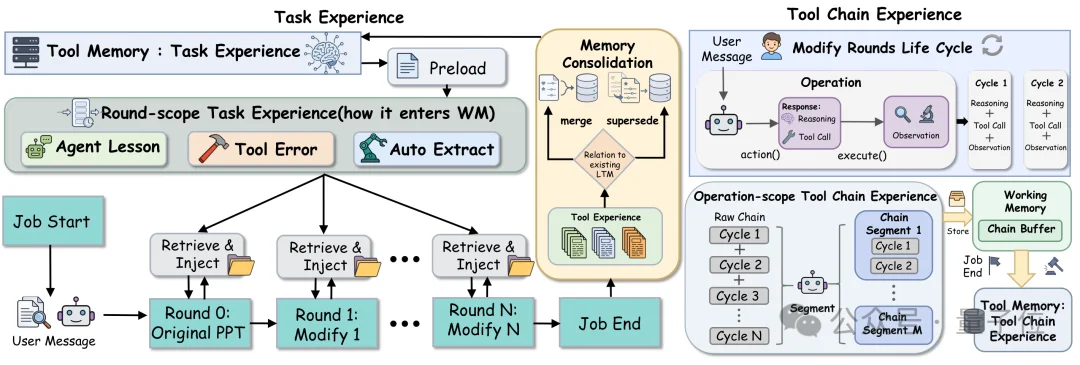
△ Tool memory mechanism
Scoped Local Revision: The “Guardrails” Protocol
To prevent over-editing, MemSlides enforces a strict three-phase revision workflow:
- Plan → Translate user request into an explicit edit contract: scope (which slides/regions), constraints (what must stay unchanged), and target (exact changes).
- Execute → Apply only the minimal, contract-compliant transformation — no global regeneration.
- Guard → Validate completeness, correctness, and non-intrusiveness: ensures pre-edited content remains fully intact.
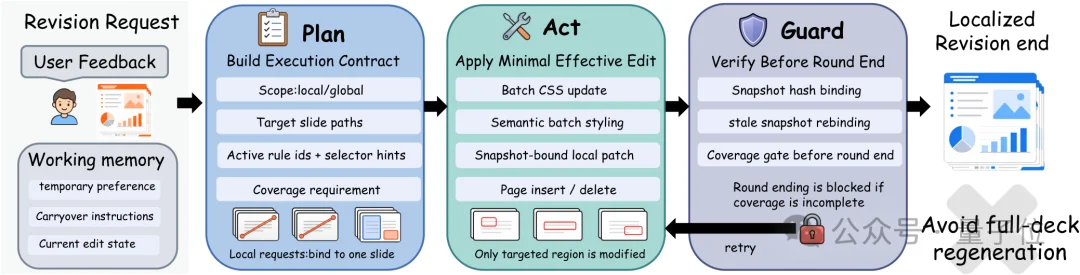
△ Scoped local revision workflow
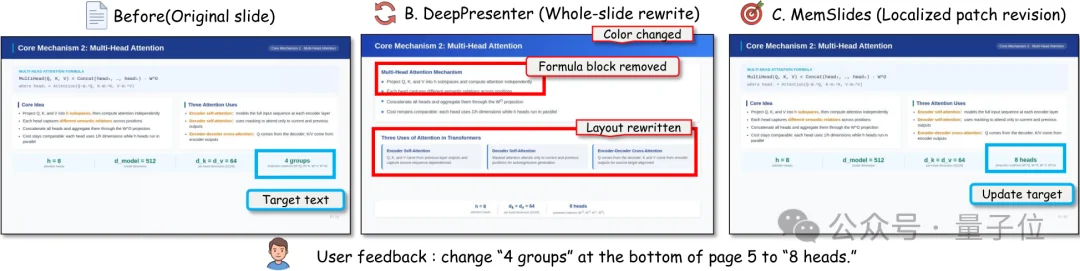
△ Scoped local revision example
Community & Adoption Metrics
- 🚀 #1 on Hugging Face Daily Papers (as of July 2026)
- 📈 #1 Weekly, #10 Monthly, #32 Trending on HF
- ⭐ 400+ GitHub stars
- 👥 100+ active demo users, growing steadily
- 📄 Preprint published on arXiv
⚠️ Note: These metrics reflect community traction — not final performance ceilings. They signal strong alignment with real-world collaboration needs.
Beyond PPTs: A Blueprint for Long-Horizon Agents
MemSlides transcends presentation automation. Its memory architecture answers universal challenges in long-context, multi-step AI tasks:
- What deserves persistent storage vs. ephemeral tracking?
- How do we isolate task-specific states without contaminating cross-task knowledge?
- Which operational patterns generalize across domains — and how do we encode them safely?
As AI moves from single-shot generation to sustained human-AI co-authoring — whether in documentation, code, or enterprise knowledge systems — MemSlides sets a new benchmark: understanding isn’t enough; remembering right, editing precisely, and protecting what matters is what makes collaboration truly viable.
Article adapted from QuantumBit (WeChat Official Account)