Karpathy Backs Engram AI Memory Startup
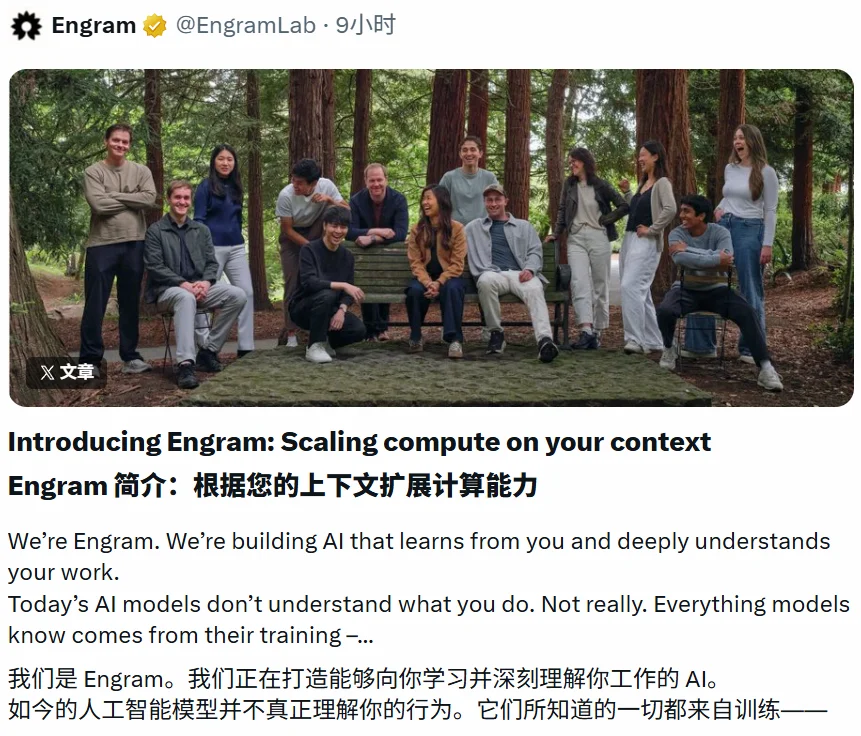
When most large language model (LLM) companies race for longer context windows, stronger reasoning, and more complex agent workflows, a new startup—Engram—is betting on a fundamentally different question: Can AI learn continuously from daily data, conversations, and experiences—just like humans?
$98M Funding & High-Profile Backing
Engram has officially launched with $98 million in funding, led by top-tier venture firms including:
- General Catalyst
- Kleiner Perkins
- Sequoia Capital
Its advisory and investment roster features renowned AI leaders:
- Andrej Karpathy (ex-Tesla AI, ex-OpenAI)
- Assaf Rappaport (ex-Cohere CEO)
- Pieter Abbeel (UC Berkeley AI professor, robotics pioneer)
Both Karpathy and Jason Wei publicly congratulated the team—underscoring strong technical validation.


The Core Problem: AI Knows the Internet—but Not Your Company
Today’s LLMs excel at answering questions, reading code, and drafting documents—but they remain profoundly unfamiliar with organizational knowledge: project decisions, historical trade-offs, internal Slack threads, or Notion documentation. This gap forces enterprises to repeatedly inject context—increasing latency, cost, and error risk—while models forget everything after each interaction.
Engram’s thesis: AI shouldn’t just read context—it should learn and retain it.
Building a True “Memory Layer” for AI
Engram’s mission is to create a continuous learning memory layer, shifting from reactive retrieval to proactive assimilation:
- ✅ Pre-training forward: Instead of re-retrieving GitHub repos, Slack logs, or Notion pages for every query, Engram trains models in advance on proprietary organizational data.
- ✅ Beyond RAG & long-context: Unlike Retrieval-Augmented Generation (RAG) or extended context windows—which fetch then reason—Engram embeds knowledge into the model itself, enabling natural, stateful recall across sessions.
- ✅ New scaling paradigm: Rather than chasing ever-larger foundation models, Engram invests compute into personalized, private-data training, making models incrementally smarter with use.
Real-Time Learning Roadmap
| Target Frequency | Status |
|---|---|
| Daily learning | ✅ Live internally |
| Hourly updates | 🚧 In development |
| Minute-level sync | 🎯 Long-term goal |
The ambition? A unified training algorithm that ingests any scale, any format—and makes models reliably improve over time without catastrophic forgetting.
Early Product & Strategic Partnerships
Engram’s first offering is an Agent-native API designed for shared, high-knowledge workspaces. Early collaborations include:
- Notion: Building Custom Agents that deeply understand massive Notion workspaces.
- Harvey: Enhancing legal and enterprise knowledge workflows with persistent context.
- Microsoft: Piloting customized agents within Microsoft 365 for dynamic, organization-aware assistance.
All three share a critical trait: high-knowledge density + complex, evolving context—where one-off retrieval fails, but continuous learning thrives.
Research-First Team: Obsessed With Memory & Forgetting
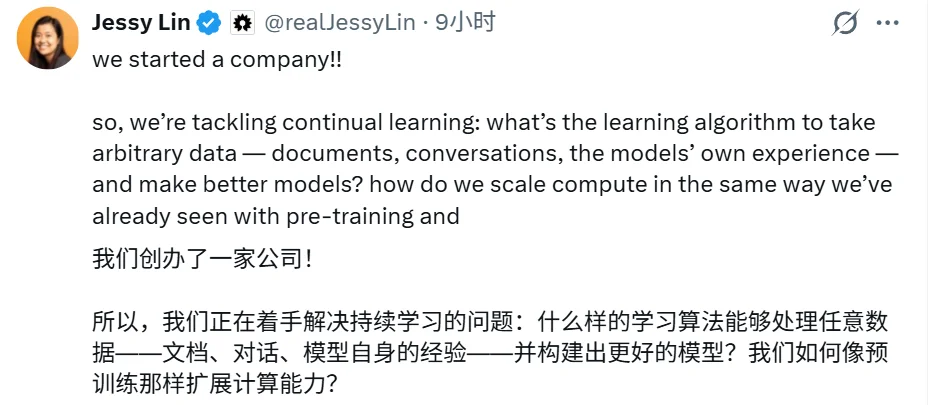
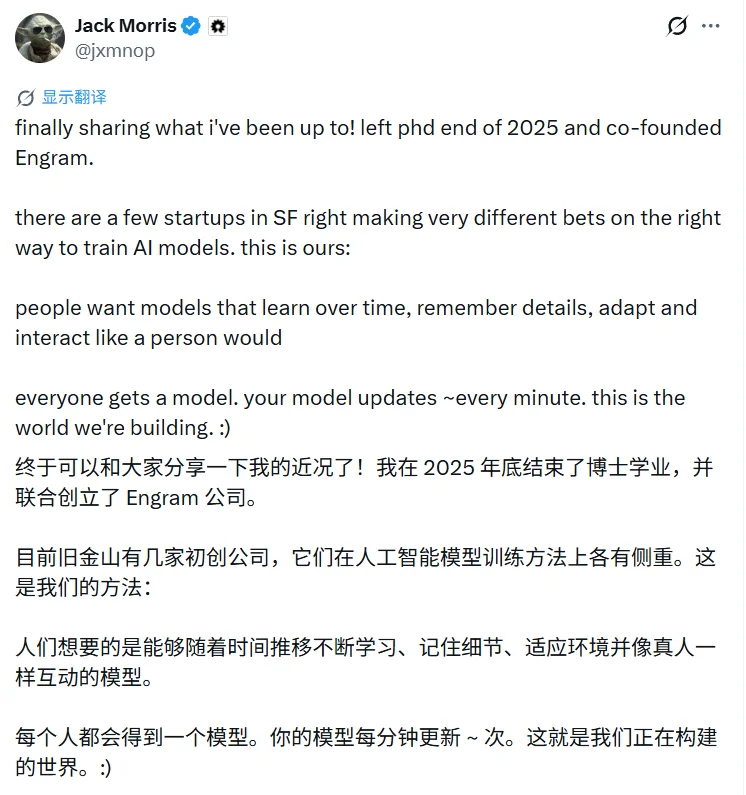
Engram’s founding team comprises world-class researchers focused exclusively on continual learning, context compression, LoRA fine-tuning, synthetic data generation, and memory architecture. Key figures include:
- Dan Biderman, Sabri Eyuboglu, Jessy Lin, Jack Morris
Their research spans:
– How humans encode & retrieve memories
– How models catastrophically forget old knowledge
– How to retain prior capabilities while absorbing new data
The Real Challenge: From Research to Reliable Infrastructure
Engram isn’t building a plug-in memory feature—it’s engineering an end-to-end infrastructure where:
– Training algorithms are auditable and controllable
– Updates are safe, versioned, and explainable
– Performance improves predictably across hundreds of incremental updates
Success means proving that continuous learning transitions from academic curiosity to production-grade reliability—enabling AI systems that grow wiser, not just faster, with every interaction.
Source: Machine Heart Editorial Team