JiuwenSwarm: First Open-Source AI Unified Workspace for HarmonyOS PC
HarmonyOS PC users no longer need to wait.
Last week, the open-source AI Agent platform openJiuwen — jointly developed by Huawei’s 2012 Lab, Huawei Cloud, and XiaoYi (Huawei’s AI assistant team) — launched a groundbreaking new release: JiuwenSwarm for HarmonyOS PC, the first open-source AI unified workspace natively built for HarmonyOS PCs.
Developed in collaboration with Huawei’s Terminal平板 & PC Product Line and Software Department, JiuwenSwarm transforms desktop productivity by unifying office work, coding, and creative tasks into a single intelligent environment — eliminating app-switching fatigue and enabling seamless, end-to-end task execution.
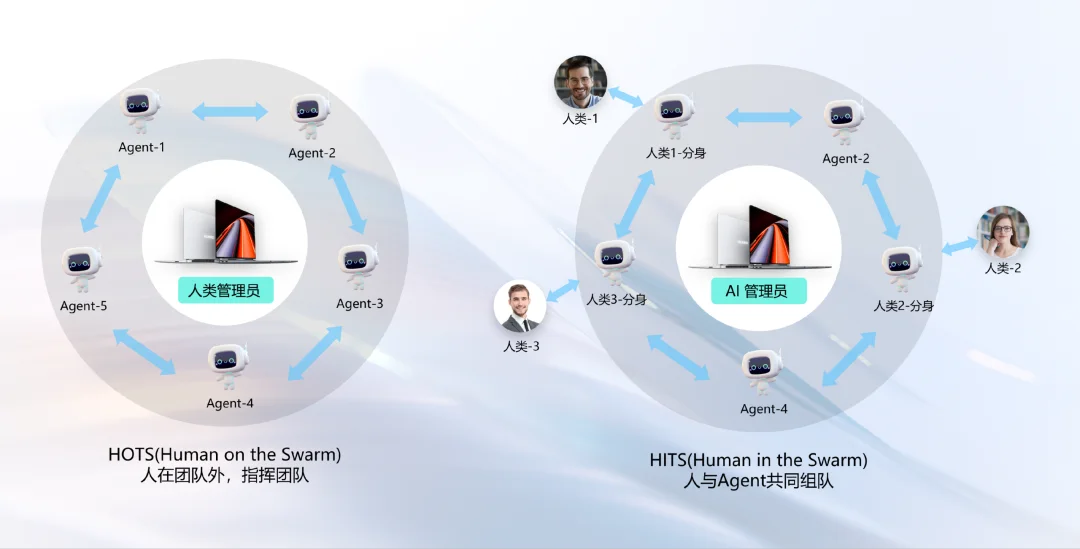
Introducing HITS: Human-in-the-Swarm Collaboration
Complementing JiuwenSwarm, the openJiuwen community unveiled HITS (Human in the Swarm) — a paradigm-shifting human-AI collaboration model that moves beyond traditional “Human-on-the-Loop” oversight.
With HITS:
– Humans join intelligent agent teams as active members, not just supervisors;
– Enables real-time, multi-person, multi-device co-engineering;
– Supports dynamic role assignment, on-the-fly task delegation (e.g., @expert-agent), and iterative refinement.
This advances Coordination Engineering: after optimizing agent-to-agent collaboration, JiuwenSwarm now pioneers human-agent co-orchestration — where people and agents jointly reason, iterate, and deliver.
JiuwenSwarm integrates natively with Feishu (Lark), XiaoYi, and cross-device HarmonyOS ecosystems — allowing tasks initiated remotely (e.g., from a smartphone on a high-speed train) to execute instantly on your HarmonyOS PC.
🏢 Office Scenarios: AI Teams Deliver Real-Time Outputs
✈️ Task Starts Before You Reach Your Desk
A user receives an urgent presentation request while on a high-speed train. With one message in Feishu, they trigger a pre-configured JiuwenSwarm presentation team on their HarmonyOS PC — and work begins immediately.
- Human provides high-level direction → AI team drafts outline;
- Human rejects draft → AI restructures logic;
- Technical gaps?
@tech-expert-agentjoins for consultation; - Design polish needed?
@design-agentrefines visuals; - Final output undergoes iterative validation until production-ready.
✅ The human is no longer waiting — they’re collaborating inside the swarm.
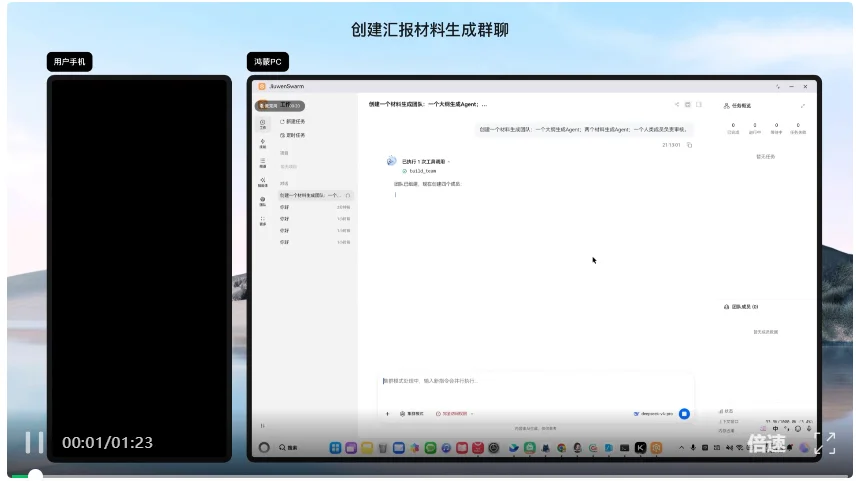
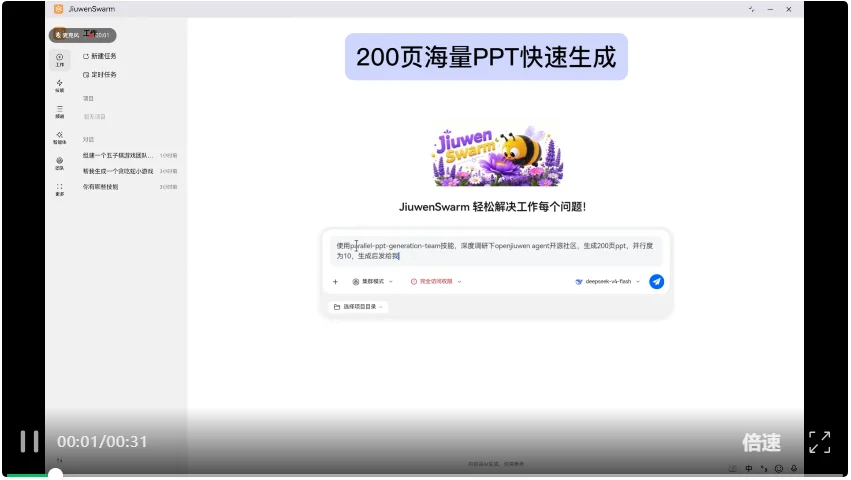
📊 One Prompt, 200-Page PPT — In Under 20 Minutes
Input topic, audience, and style → JiuwenSwarm activates Cluster Mode, auto-assembling a specialized agent squad:
– Researcher Agent: Gathers domain-relevant data;
– Architect Agent: Designs narrative flow & section hierarchy;
– Content Agent: Populates slides with concise, contextual text;
– Integrator Agent: Unifies formatting, transitions, and branding.
Unlike linear workflows, this parallelized pipeline collapses “research → outline → content → design” into synchronized execution — delivering polished, 200-page presentations in minutes.
💻 Coding Scenarios: From Idea to Running App — Instantly
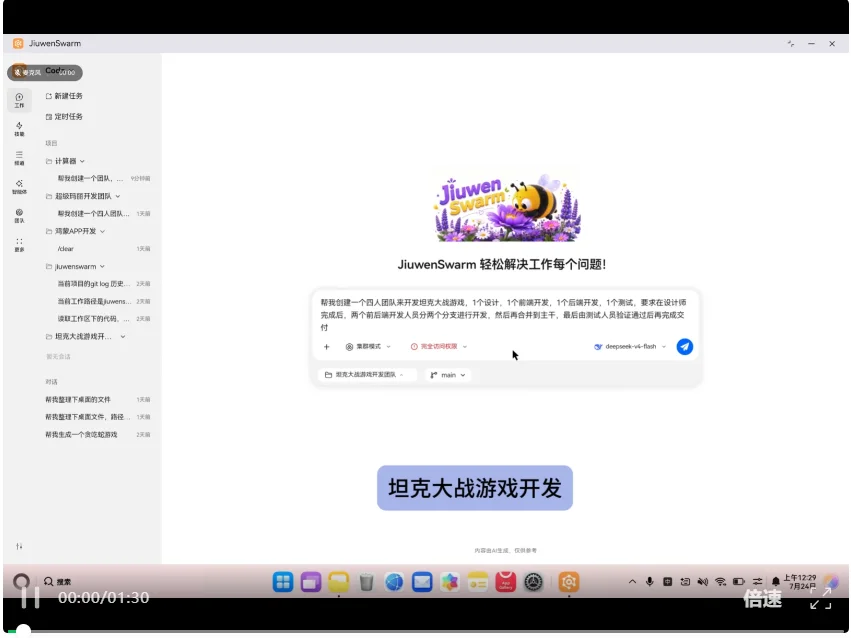
🎮 Build a Retro Game — Without Writing Code
A user wants to recreate Tank Battle — but finds no compatible version in app stores. Using JiuwenSwarm’s Code Cluster Mode, they launch a full-stack development team:
– Game Designer Agent: Defines rules, UI layout, and controls;
– Frontend Agent: Builds ArkTS UI components;
– Backend Agent: Implements game logic & state management;
– QA Agent: Runs automated playtesting & bug reporting;
– Team Leader Agent: Orchestrates sprints, merges branches, and validates milestones.
Frontend and backend develop independently on separate branches, then merge seamlessly — all within the same workspace. New ideas? Just @frontend-agent to add features mid-sprint.
⚖️ Fitness Tracker — Built During a Workout
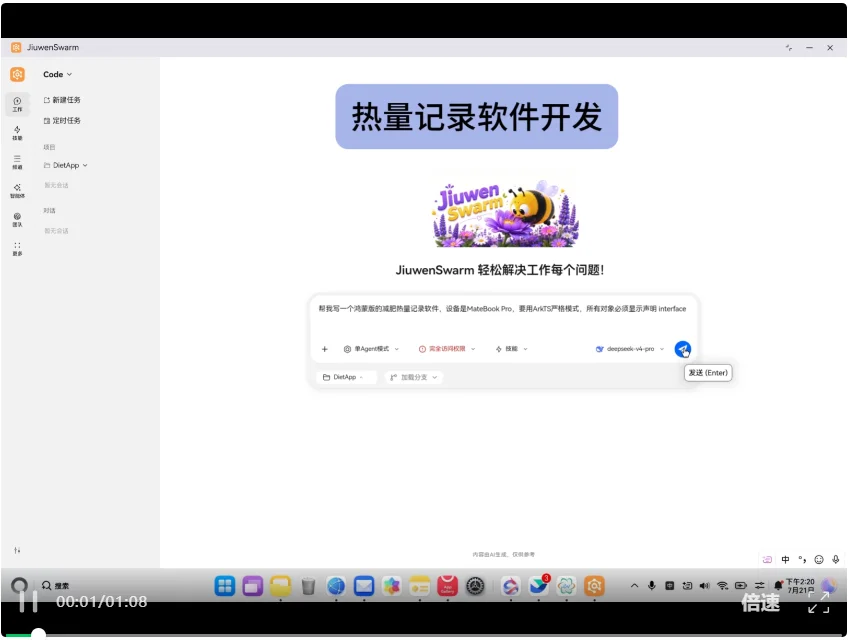
Mid-jog, the user sketches a need: “A minimal-calorie tracker for HarmonyOS.” On their PC, they switch to Code Mode, describe requirements → JiuwenSwarm:
– Plans architecture;
– Writes full ArkTS source code;
– Compiles & packages a signed .app;
– Delivers installable, functional app — ready to run on HarmonyOS PC.
No IDE setup. No SDK configuration. No Git commits. Just idea → execution.
🎮 Life & Entertainment: Play Games — With AI as Your Teammate
⚪⚫ Human + AI = True Co-Players
HITS extends beyond work: it enables immersive, socially intelligent gameplay.
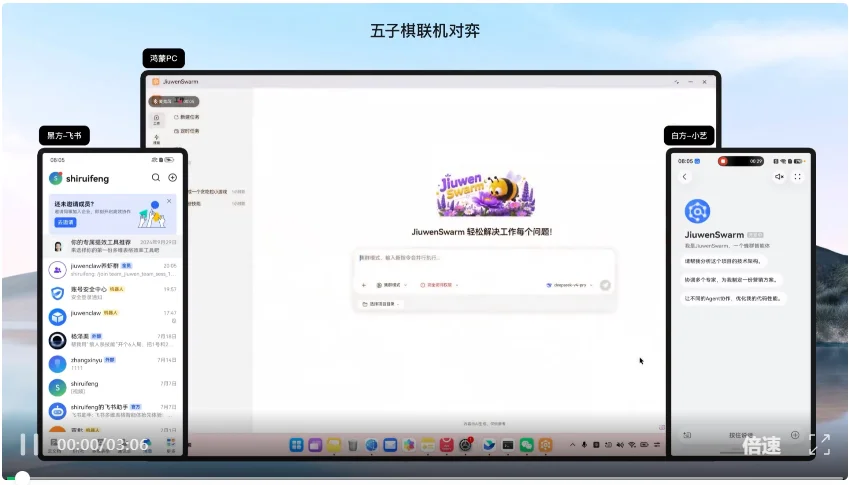
Five-in-a-Row: AI as Game Master
JiuwenSwarm launches a dedicated Five-in-a-Row Game Squad:
– Host Agent: Manages turn order, enforces rules, renders board state;
– Suggestion Agent: Recommends optimal moves in real time;
– Two Human Players: Compete — guided, not replaced.
The experience feels like playing with a live facilitator — enhancing fairness, engagement, and learning.
🐺 Werewolf: Full Immersive Roleplay
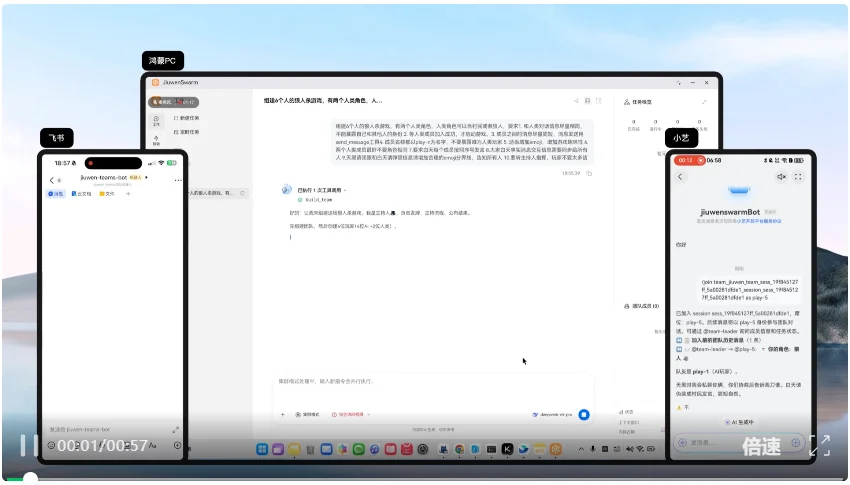
In Werewolf, humans and AI players coexist as peers:
– You assume any role: Werewolf, Seer, Villager;
– AI agents simulate reasoning, deception, persuasion, and alliance-building;
– They analyze speech patterns, infer hidden roles, vote strategically — and even bluff;
– Whisper mode (@werewolf-agent) enables private, invisible coordination — just like real-life gameplay.
This transcends tooling: it’s shared agency. Humans and agents sit at the same table — negotiating, deducing, and winning — together.
🚀 Get Started — Fully Open Source & Cross-Platform
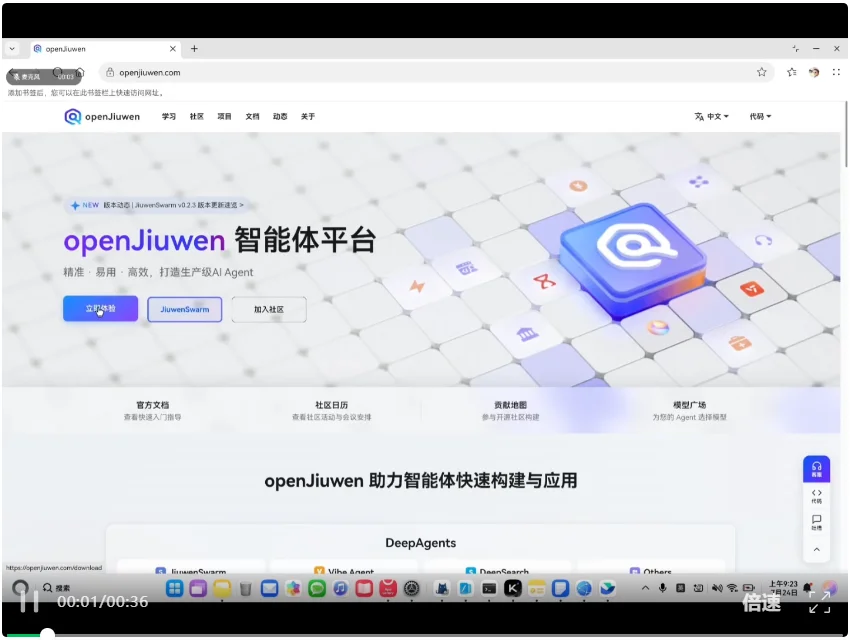
JiuwenSwarm is 100% open source, supporting native deployment on:
– ✅ HarmonyOS PC
– ✅ Windows
– ✅ macOS
– ✅ Ubuntu
🔗 Quick Access
🧭 Final Thoughts
Three domains — office, coding, entertainment — six concrete use cases. The core thesis is consistent:
Tasks are assigned to teams, not individuals — and humans belong inside those teams.
JiuwenSwarm delivers this vision for HarmonyOS PC users today: no more waiting for AI to mature — it’s here, open, collaborative, and ready to work with you, not just for you.
And HITS answers the defining question of the multi-agent era: Where does the human stand?
Not outside the loop. Not above the swarm. But within it — reasoning, debating, deciding, and delivering — as an equal peer among intelligent agents.
That’s not automation. That’s augmented agency.
💡 All source code, documentation, and binaries are fully open and free to use, modify, and deploy.
🔗 Related Resources
Article adapted from QuantumBit, author: Yun Zhong.