Jev: A New Era of Decision-First AI Models
Last week, Jev became the hottest new AI model across the entire AI community.
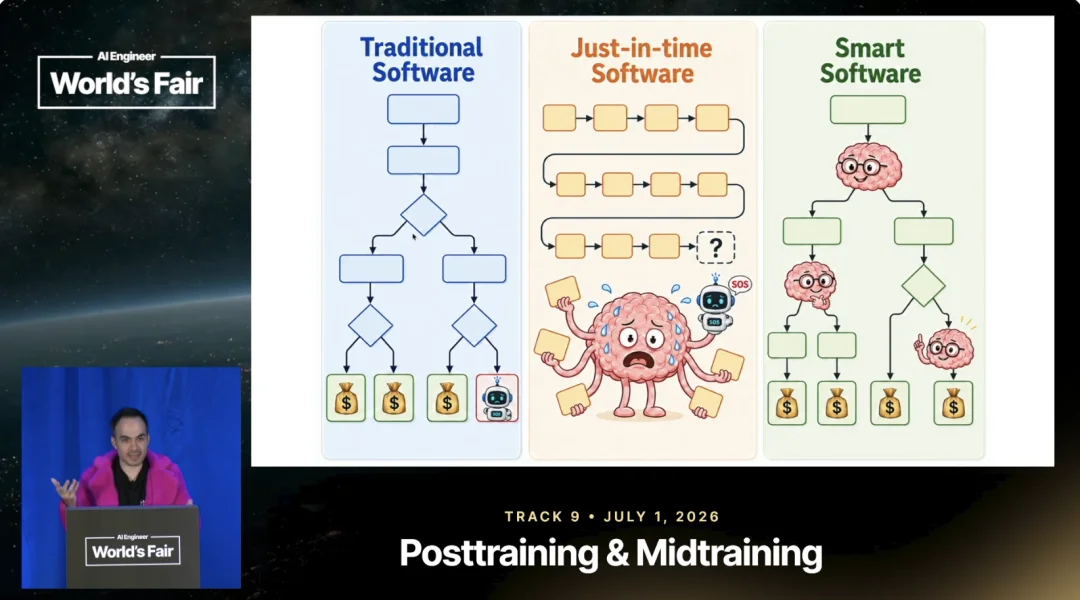
The Core Philosophy: System One Thinking
Jev is engineered for fast, calibrated judgment — not text generation. It operates exclusively in System One mode: delivering structured outputs for deterministic decision-making:
- ✅ Choice: Discrete selection from predefined options (e.g.,
"allow","reject","escalate") — designed to map naturally toswitch/matchlogic. - ✅ Score: A normalized confidence value (0–1) — ideal for ranking, thresholding, or dynamic routing.
- ✅ Noul: A probabilistic yes/no answer — enabling conditional branching (
if noul > 0.95 { execute() }) with statistical rigor.
Unlike traditional LLMs fine-tuned via RLHF (Reinforcement Learning from Human Feedback), Jev is trained using RLCD (Reinforcement Learning from Calibrated Decisions) — optimizing for decision reliability, not human preference.
From OpenAI Pioneer to Architect of Automation
Founder Diogo Almeida, formerly a core researcher at OpenAI on InstructGPT, ChatGPT, and GPT-4, deliberately pivoted away from “smarter chat” toward true software automation. As he stated:
“RLHF puts humans in the training loop — its goal is satisfaction, not autonomy. But automation requires models that act correctly regardless of whether it looks good to a human.”
His critique highlights a critical gap: today’s LLMs excel at tasks designed to please users in the loop, yet falter at silent, background operations — like real-time fraud checks, API validation, or autonomous workflow gating.
TypeSafe & Strategic Milestones
- 🏢 Company: TypeSafe — founded in stealth mode; emerged publicly on September 15, 2026.
- 💰 Funding: Closed a $40M seed round, led by DCVC, validating demand for specialized inference infrastructure.
- 🚀 Mission: Redesign the full AI stack — from pretraining interfaces to API contracts — for software-native intelligence.
Why Jev Matters: The Great Unbundling of Intelligence
Investor Jaya Gupta (Foundation Capital) frames Jev as a catalyst in “The Great Unbundling of Intelligence”:
| Capability | Traditional LLM Cost | Jev Cost | Use Case Fit |
|---|---|---|---|
| Text generation | High (frontier-model compute) | ❌ Not supported | ❌ Inappropriate |
| Binary classification | Overkill + latency | ✅ < $0.01 / call, sub-200ms | ✅ Ideal |
| Document ranking | Expensive token usage | ✅ Optimized scoring API | ✅ Highly efficient |
| Tool selection | Redundant decoding overhead | ✅ Direct choice output | ✅ Minimal latency |
This shift enables architectures where:
– Simple decisions → Jev (low-cost, high-frequency)
– Complex reasoning → Frontier LLM (high-value, infrequent)
– Deterministic logic → Native code
– Search/retrieval → Dedicated vector engines
Real-World Applications Emerging
- 🔍 Dark Data Activation: Analyzing petabytes of unstructured enterprise logs previously deemed too expensive to process with LLMs.
- ⚡ Real-Time Intelligent Products: Millisecond-grade judgment in voice assistants, browser extensions, and game NPCs.
- 🛡️ LLM Verification Layer: “Judge everything” — validating outputs, detecting hallucinations, enforcing safety rails before downstream actions.
- 🧩 Composable AI Software: Building modular agents where each cognitive operation (filter, rank, decide, route) is sourced from the most cost-optimal provider.
Developer-Centric Design
Jev’s interface is built for engineers:
- 📦 Structured Input: Accepts JSON payloads (
state,instructions,criteria) — no prompt templating required. - 🧪 Deterministic Debugging: Built-in calibration metrics, stability testing (e.g., random ID perturbation), and granular error tracing.
- 📈 Usage-Driven Validation: Over 1 trillion tokens/day consumed — predominantly by automated systems running 24/7, not human trials.
As Diogo emphasizes: “Trust isn’t about perfect accuracy — it’s about predictable behavior across semantically similar inputs, and clear failure modes you can test and monitor.”
The Future: Intelligence as a Background Service
Jev signals a paradigm shift: intelligence is no longer an event — it’s an always-on infrastructure layer.
When judgment becomes cheap, fast, and composable, software gains the ability to:
– Audit 100% of customer interactions — not just 1%
– Validate every contract clause, transaction, or API response
– Embed micro-intelligence into browsers, OS kernels, and IoT firmware
– Turn every state change into an opportunity for intelligent intervention
“The next decade won’t be about stuffing more capabilities into one model — it will be about unbundling them, pricing them transparently, and reassembling them intelligently at the application layer.”
Content synthesized from Diogo Almeida’s public talks, podcast interviews, and Jaya Gupta’s essay “The Great Unbundling of Intelligence”, edited by Founder Park.