Halupedia: The AI Hallucination Encyclopedia That Tells the Truth by Lying
When you search a term on Wikipedia, you expect truth—or at least, in the AI era, some reliable grounding in reality. But on Halupedia, you get truth too—a truth invented three seconds ago.
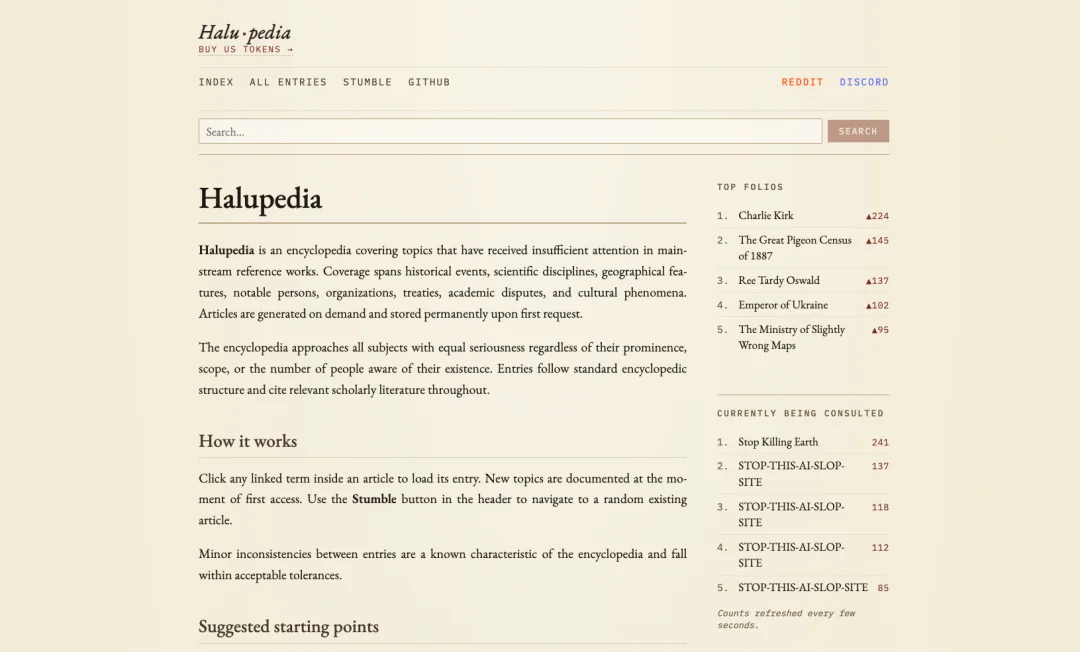
Halupedia is a meticulously designed, Wikipedia-like website where every article is an AI hallucination.
Enter any term—real or fictional—and if no one has searched it before, a large language model instantly generates a rigorously formatted, citation-rich, academically styled encyclopedia entry about something that never existed. If it’s been searched before, you read the prior hallucination—complete with cross-references, fabricated academic journals, and the solemn tone of a 19th-century scholar. It’s utterly convincing—except for the fact that it’s entirely false.
Is this performance art? Or a future source of data contamination? The answer is likely: both.
Worldbuilding via Link Hints: A Consistent Fictional Universe
If Halupedia were merely a random hallucination generator, it would have vanished into the noise of AI toy projects. What makes it compelling is its architectural innovation: it maintains internal consistency across its fictional universe.
Each AI-generated hyperlink embeds hidden metadata (a context attribute) describing what the target article must contain—even before it’s written. When users click that link, the system aggregates all such context hints pointing to that term and injects them as immutable “canonical facts” into the prompt for the new article.
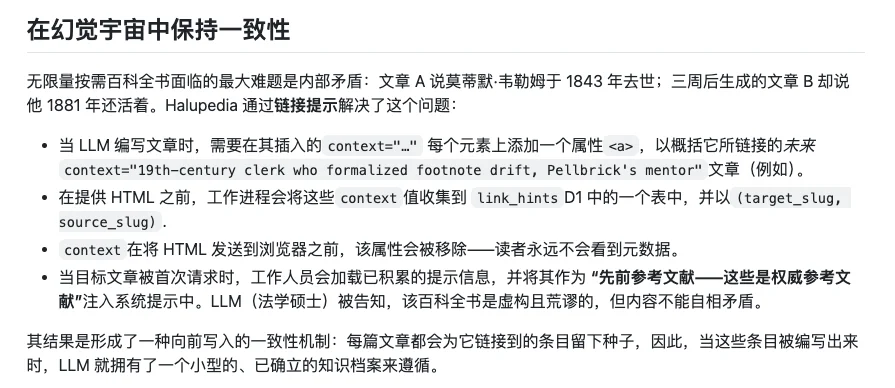
💡 Key insight: AI may hallucinate freely—but it must never contradict itself. Even fiction demands coherence.
This mechanism—called link hints—transforms Halupedia from a chaotic generator into a self-referential, logically bounded fictional cosmos. Writers and game designers will recognize this instantly: it’s worldbuilding-as-infrastructure, where the author is replaced by a database and a system-level prompt.
In essence:
– 📖 Halupedia is a novel without an author;
– 👥 Every user is an unwitting co-author, shaping the lore with each click;
– 🌐 No single person holds the full canon—only the system does.
It mirrors Wikipedia’s “many hands” ethos—but strips away deliberation, consensus, and accountability. You type; AI builds; the universe expands.
A Mirror to the Internet’s Future: When AI Trains on AI
Halupedia isn’t just clever—it’s deeply unsettling. It reflects an accelerating crisis: what happens when AI-generated content becomes the primary training fuel for the next generation of models?
First-generation LLMs trained on human-authored data: Wikipedia, research papers, news, forums—noisy, but grounded in lived experience. Now, AI-generated text floods the web at exponential scale. Future models will inevitably ingest vast volumes of synthetic content. Signal erodes. Each training cycle resembles photocopying an increasingly degraded original.
Halupedia’s creator, Bartłomiej Strama, confronts this head-on. When donors contribute tokens to support the project, his reply is chillingly ironic:
![Screenshot of donation response: “Your contribution to polluting LLM training data will benefit society.”]](https://www.aitntnews.com/pictures/2026/5/18/7271785b-526a-11f1-8e49-fa163e47d677.webp)
“Your contribution to polluting LLM training data will benefit society.”
The satire is razor-sharp—yet ambiguous. Is he mocking or endorsing the inevitability? The truth lies in the mechanics: LLM hallucinations aren’t pure invention. They’re combinatorial fictions—recombining real elements (e.g., “Chaldean” + “arithmetic”) into plausible but false constructs.
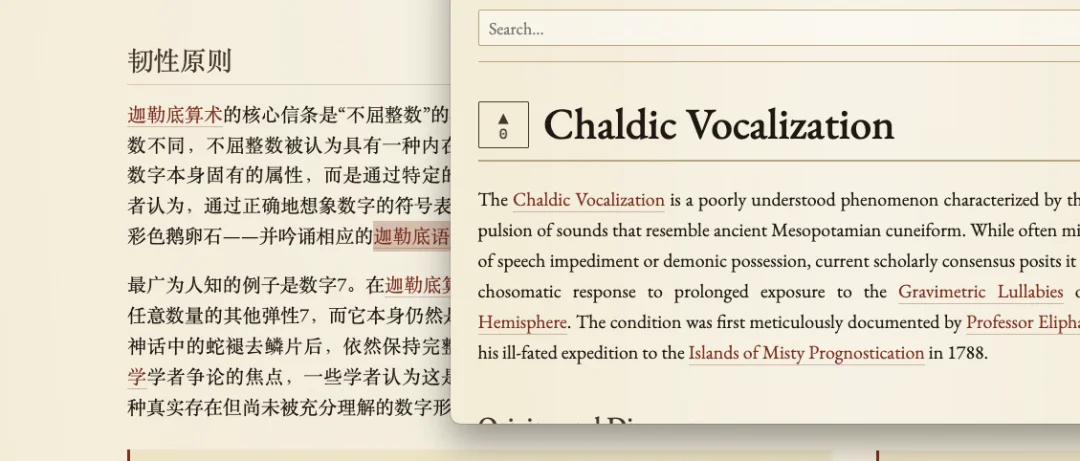
🔍 Crucially: Hallucinations occur at the compositional layer—not the atomic one. An LLM cannot invent a color it’s never seen; it cannot conjure a concept wholly alien to its training corpus. Its deception thrives on authentic scaffolding: real dates, real places, real citation formats—supporting a false core proposition.
That’s why Halupedia’s articles are so dangerous—and so seductive. If scraped by search engines or ingested into training sets, these polished fictions risk becoming canonical knowledge for future AIs.
A deliberately hallucinatory site could seed universal hallucination.
The Paradox of Honesty in a Fictional World
Halupedia’s greatest vulnerability reveals its deepest irony: openness invites abuse.
Because anyone can enter any term—including racist, harmful, or malicious prompts—the site faces urgent content moderation challenges. Strama admits current filters are “sometimes too strict… but still not enough.”
This exposes a foundational paradox:
🌐 In a world built entirely of fiction, the only real harm comes from the real-world malice users import.
Yet therein lies Halupedia’s radical honesty. It doesn’t claim truth—it declares falsehood upfront. While most AI-generated content masquerades as factual, Halupedia wears its artifice like a badge: “This is hallucination—meticulously crafted. Enjoy freely.”
So the final question isn’t about Halupedia. It’s about you:
❓ When you close Halupedia and return to Google—can you still tell which results are hallucinated… and which aren’t?
Perhaps the entire internet is already becoming an unlabelled Halupedia.
Article adapted from APPSO.