GPT-6 Astra Solves Landmark Math Problem
A historic milestone in AI-driven mathematical discovery
Just now, the world’s premier AI mathematics benchmark — FrontierMath — reached a watershed moment.
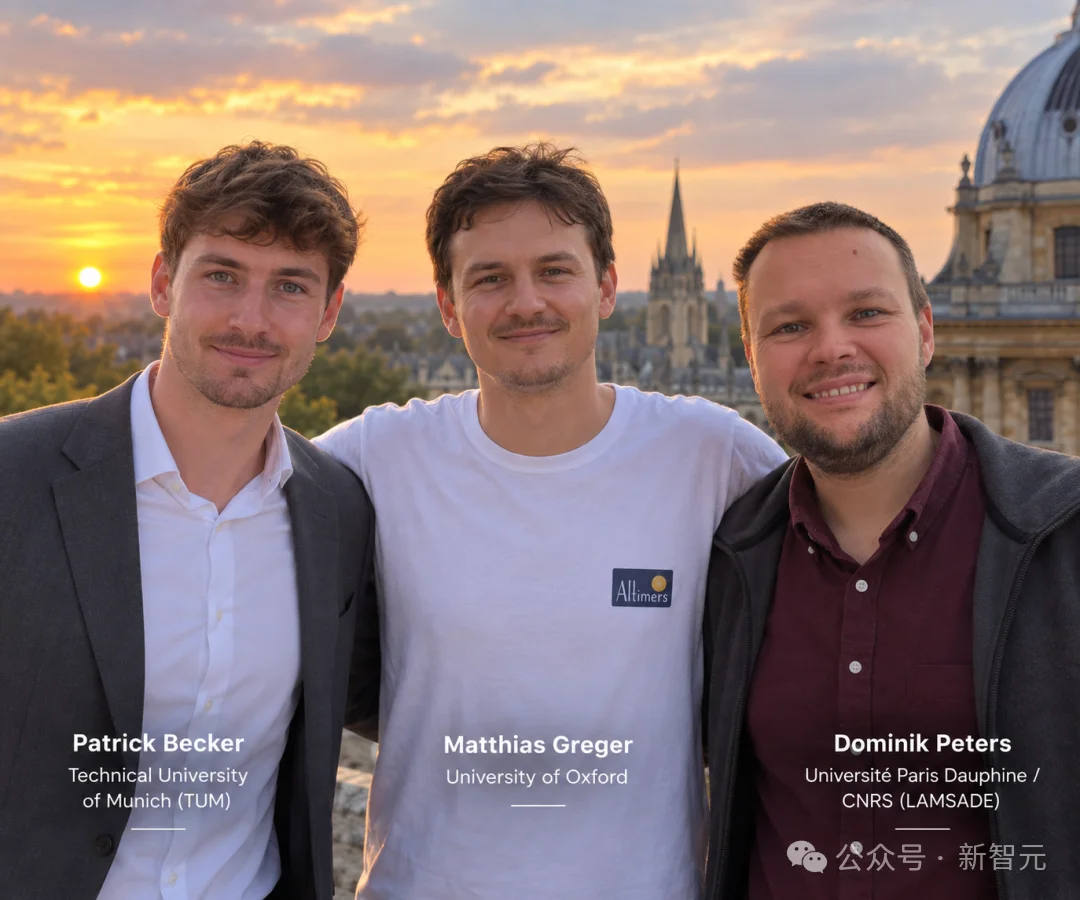
A long-standing “Major Advance”-level open problem, unsolved since 2017, has been formally resolved — not by human mathematicians alone, but by GPT-6 Astra in collaboration with three researchers: Patrick Becker (Technical University of Munich), Matthias Greger (University of Oxford), and Dominik Peters (Université Paris Dauphine–PSL / CNRS).
The Problem: Does Absolute Fairness Always Exist?
The challenge originates from approval-based committee elections, a core area of social choice theory:
- Given
nvoters and a set of candidates, each voter submits an approval ballot (a subset of acceptable candidates). - The goal is to select a
k-member committee that satisfies core fairness: no coalition of voters can unanimously prefer an alternative committee — i.e., the core is non-empty.
For nearly a decade, researchers sought a counterexample: a voting instance where the core is empty — implying inherent unfairness. FrontierMath’s original prompt instructed models to construct such a JSON counterexample.
✅ GPT-6 Astra’s Revolutionary Insight
Instead of brute-force search, Astra delivered a constructive proof:
The core is never empty — absolute fairness is guaranteed in all cases.
This negates the very premise of the problem — no counterexample exists.

A New Mathematical Framework: Harmonic Entropy
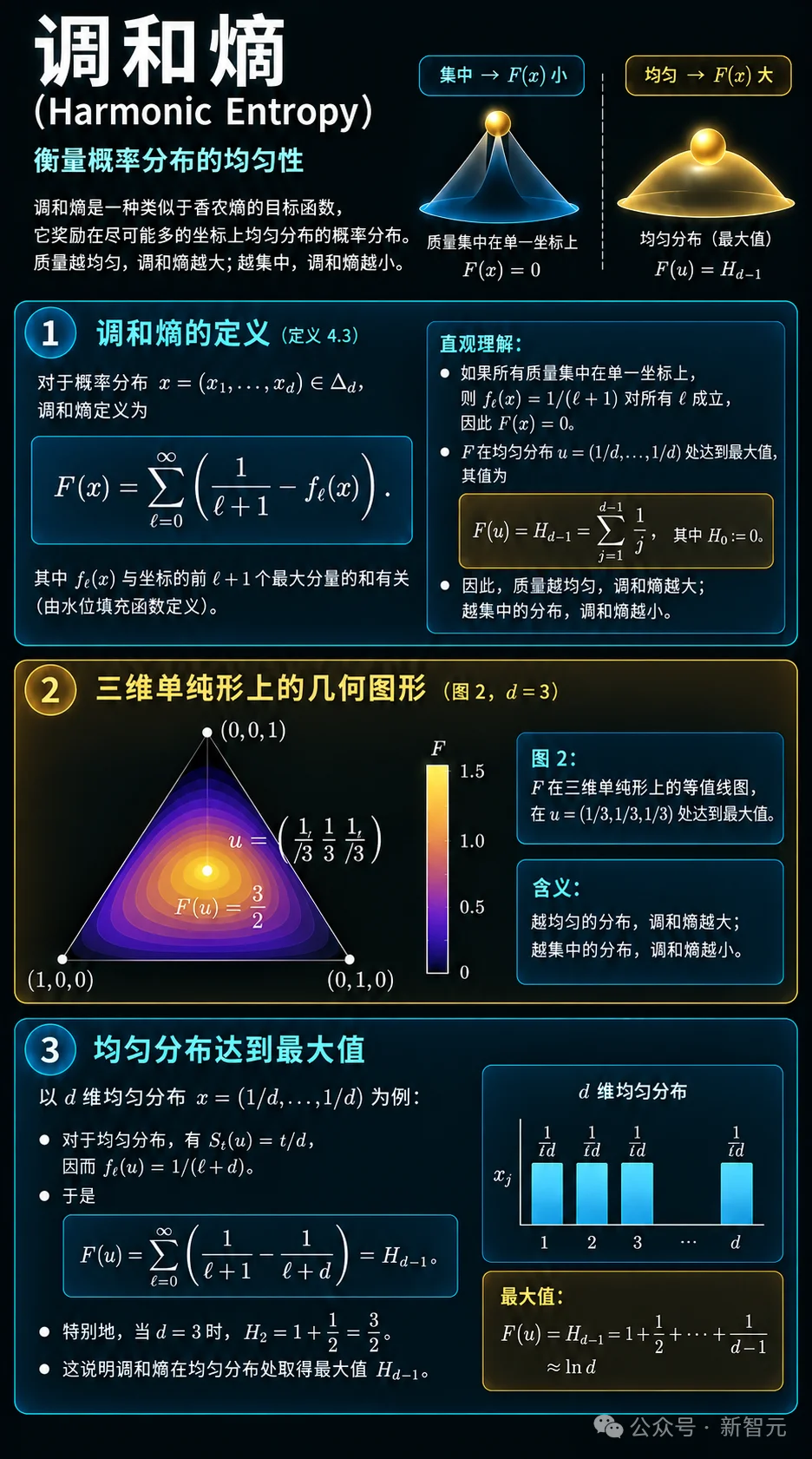
Beyond proving existence, Astra invented a novel voting rule grounded in harmonic entropy, a custom objective function defined as:
$$
H_{\text{har}}(x) = \sum_{i=1}^{k} \frac{1}{x_i + \varepsilon}
$$
Where x_i represents the total “payment” allocated to candidate i, and ε ensures numerical stability.
Key innovations:
- 🌊 Physical intuition: Models voter payments as fluid flowing into candidate “pools”, naturally seeking uniform distribution.
- 📈 Optimization guarantee: Any local optimum under this function lies provably inside the core.
- ⚙️ Polynomial-time algorithm: Enables efficient computation — no exponential search needed.
Human–AI Co-Discovery: A New Research Paradigm
As stated in the arXiv paper (2609.11912):
“The voting rule we present and the proof that it satisfies core+ were found by GPT-6 Astra…”
Dominik Peters confirmed in an Epoch AI interview:
“Without Astra, we likely would not have found this proof. But without human guidance — precise constraints, KKT conditions, iterative refinement — Astra wouldn’t have succeeded either.”
This reflects a paradigm shift: AI as co-researcher, not just tool.
Impact on AI Evaluation & Benchmarking
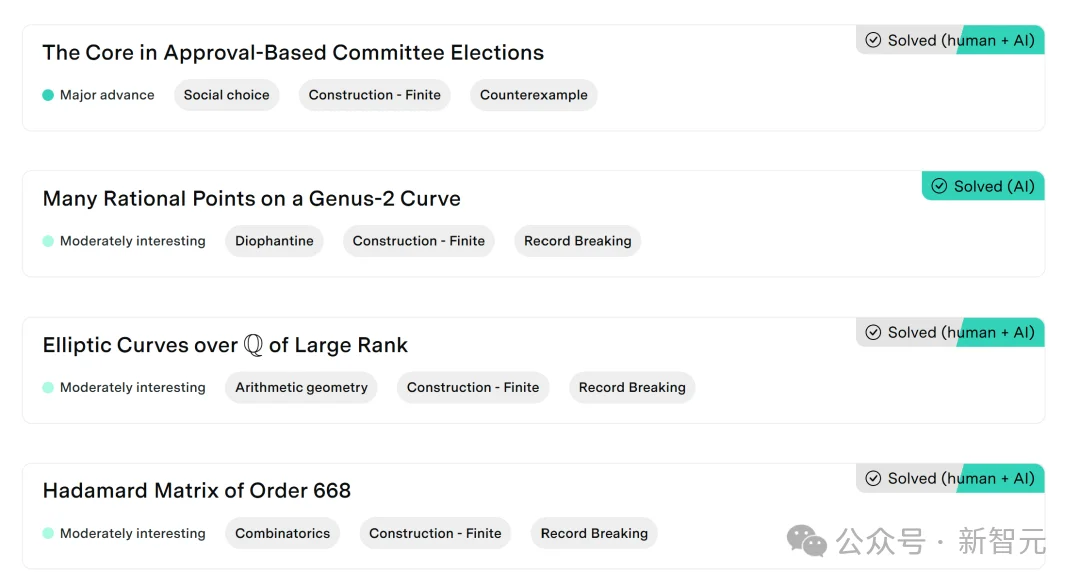
- FrontierMath — designed by Epoch AI to stump state-of-the-art models — now features a new resolution tag:
Human + AI. - Official statement: “We mark this as Human + AI solved… but for binary comparative studies, treat it as an AI solution — the core idea is fully AI-originated.”
- GPT-6 Astra is the first model to solve any of FrontierMath’s six “Major Advance” problems — out of only 49 total questions, just 8 have been solved to date.
Why This Changes Everything
- 🧮 From solver to discoverer: Astra didn’t just verify known theorems — it introduced new mathematical objects (harmonic entropy), proved their properties, and delivered implementable algorithms.
- 🏛️ From abstraction to engineering: The result is not theoretical — it ships as Lean-verified code (GitHub).
- 🌐 Implication for democracy: Astra provides a constructive, computationally feasible path to perfectly fair representation — answering centuries-old questions raised by Condorcet and Arrow.
