GLM-5.3 Unveiled: A 743-Billion-Parameter Open-Source Powerhouse for Coding and Agent Tasks
Zhipu AI has officially launched GLM-5.3, its latest flagship large language model — a massive 743-billion-parameter architecture explicitly optimized for programming and intelligent agent workflows. The model is scheduled for full open-source release within two weeks, marking a major milestone for the open LLM ecosystem.
🔑 Key Benchmark Achievements
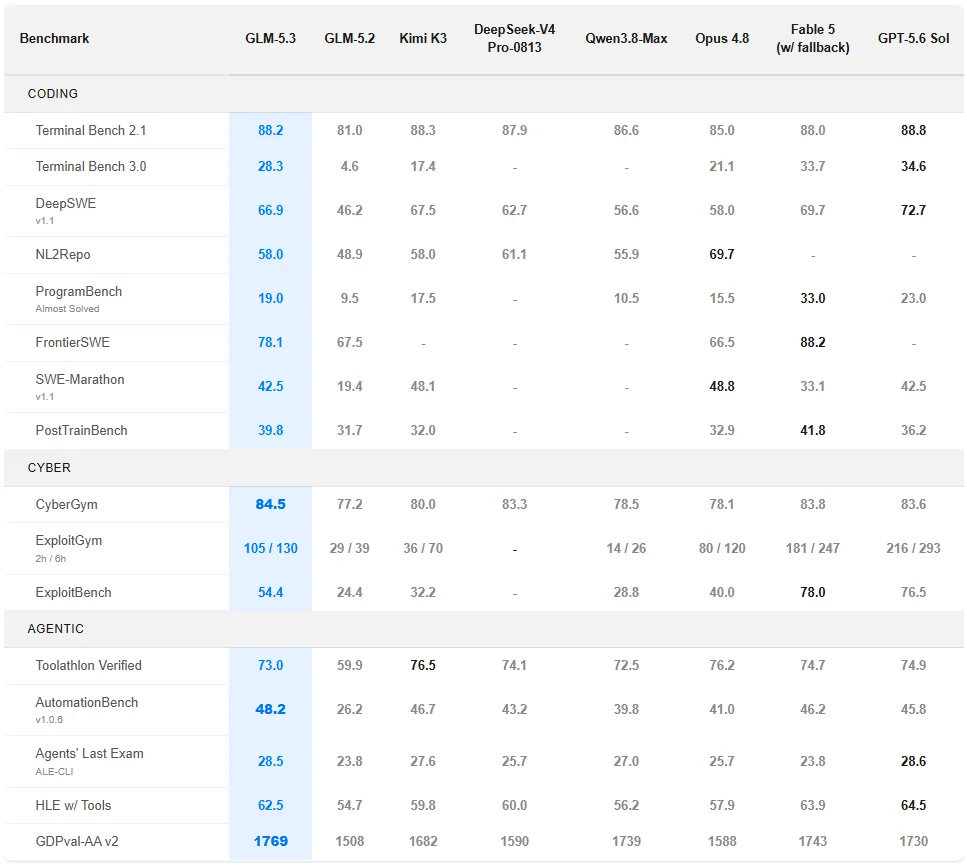
- Top-ranked among all open or soon-to-be-open models across multiple mainstream coding and agent benchmarks.
- Programming & agent capabilities rival top-tier proprietary models, including Claude Fable 5 and GPT-5.6 Sol.
- Outperforms DeepSeek-V4-Pro-0813 across most benchmarks; competes head-to-head with Kimi K3 in coding and agent tasks — with mutual wins depending on task type.
- Demonstrates clear leadership in cybersecurity tasks, surpassing both Kimi K3 and DeepSeek-V4-Pro in vulnerability detection, white-box code review, and exploit reasoning.
⚙️ Efficiency Breakthroughs
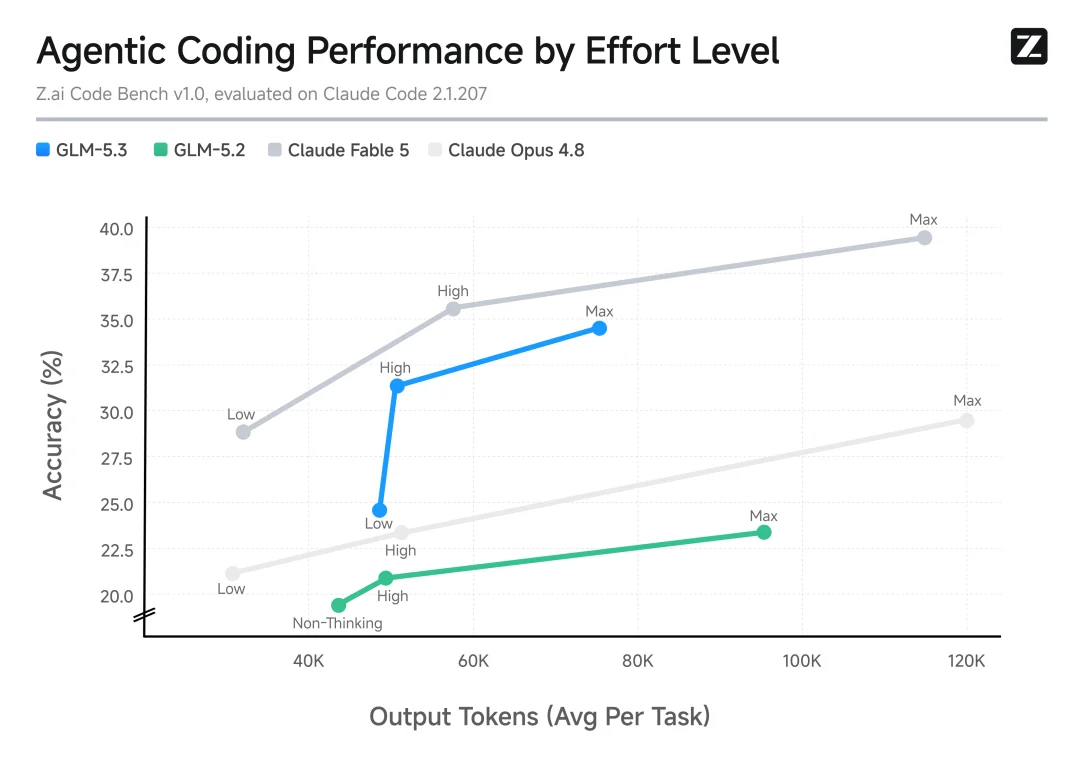
GLM-5.3 achieves superior token efficiency without sacrificing accuracy:
– At equivalent high-effort budgets: 31.5% task accuracy, exceeding Claude Opus 4.8 (29.5%).
– Average output: ~50,000 tokens per task — less than half of Opus 4.8’s average output volume.
🧪 Real-World Engineering Validation
Two rigorous hands-on tests highlight GLM-5.3’s production-readiness when paired with ZCode — Zhipu’s AI-native coding environment.
🌆 Project 1: 1:1 3D Open-World Driving Game (Shanghai Lujiazui → The Bund)
- Built from raw OpenStreetMap data — fetching and validating 80,000+ OSM nodes via Overpass API.
- Delivered ~4,900 lines of clean, functional code, covering:
- Map parsing & coordinate transformation
- Vehicle physics & audio
- Navigation, day-night cycle, and save systems
- Successfully handled embedded “trap clauses”:
- Dynamic lighting (50% dimming between 2–4 AM)
- Soft edge barriers with UI hints
- Debugged autonomously using custom request probes and breadcrumb logging.
- Wrote a zero-dependency PNG decoder to verify pixel-level rendering fidelity (water, lane markings, night lights).
- Achieved >99% cache hit rate with ZCode — significantly reducing inference cost.
⚠️ Note: Visual aesthetics (building textures, road markings) required iterative human feedback — indicating room for improvement in multimodal perception and design judgment.
🤖 Project 2: “Bare-Metal” DeepSeek Harness Plugin Development
- Tasked with reverse-engineering and extending DeepSeek Harness — a newly open-sourced, monorepo-based intelligent agent framework containing 40+ top-level packages, 200+ workspaces, and 7,400+ files.
- Conducted full-stack analysis using parallel sub-agents, mapping CLI entry points, plugin registration (YAML-driven),
LlmAdaptercontracts, and failure fallback logic. - Built a fully compliant “Persona Plugin” enabling real-time switching between Classical Chinese, Northeastern Mandarin, and Cat Language — with zero framework modifications.
- Injected cleanly via system-prompt registry.
- Fully reversible (uninstall restores original behavior).
- Integrated natively into the UI menu bar.
- Delivered 20 new files, 560 net-added lines, dual-language docs, dependency graph, and 11 passing unit tests covering injection, restoration, and routing.
- Passed 28 documentation gates and 937 bilingual validation checks after integrating slash-command web UI support.

🛡️ Cybersecurity Capabilities & Responsible Release
- Emergent security proficiency observed during extended post-training:
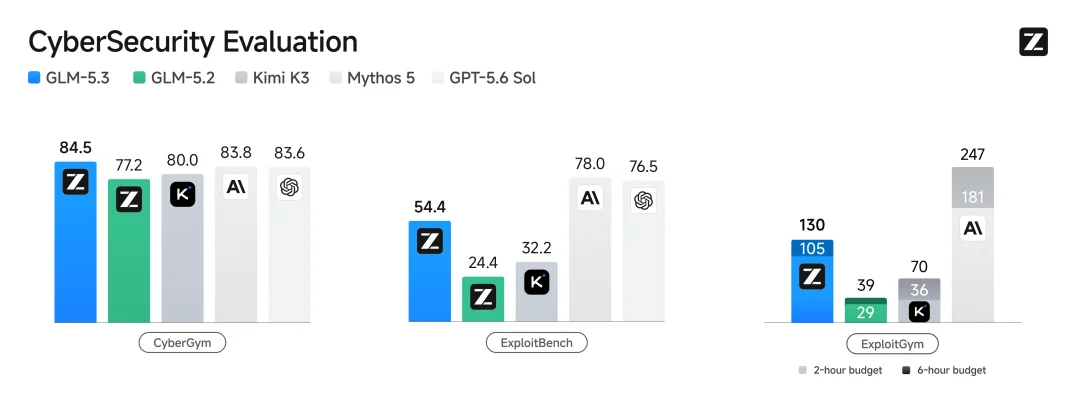
- CyberGym score: 84.5%, outperforming GLM-5.2 (77.2%), Claude Mythos 5 (83.8%), and GPT-5.6 Sol (83.6%).
- In ExploitGym: completed 105 tasks in 2 hours, reaching 58% of Mythos 5’s throughput (181 tasks) — a 3.6× improvement over GLM-5.2 (29 tasks).
- Underwent intensive red-teaming with Tsinghua University, Nankai University, and industry leaders (Qihoo 360, Tencent Xuanwu, NSFOCUS, etc.), uncovering 2,436 total vulnerabilities (1,097 medium/high severity) across 269 projects — including legacy systems dating back 45 years.
- All findings reported to national CVE databases (CNNVD/CNVD) and logged transparently in Z.ai’s public Security Disclosure Ledger.
- Final safety hardening will precede open-source release to preserve defensive utility while mitigating offensive misuse.
📈 Technical Foundation: Scaling Post-Training, Not Base Models
- GLM-5.3 shares the identical base architecture with GLM-5.2 — all gains stem from extended, diversified post-training: longer task horizons, richer environmental contexts, and increased training duration.
- Introduces refined effort level controls (inherited from GLM-5.2), balancing quality, latency, and token cost more effectively than predecessors.
🌐 Availability & Access
- Currently deployed in:
- ZCode (AI-native IDE): https://zcode.z.ai/en
- AutoClaw, TraeWork, WorkBuddy, Qoder, OpenCode
- Official blog & technical deep-dive: https://z.ai/blog/glm-5.3
- DSH Persona Plugin (open source): https://github.com/chenjunda0018-sketch/A-persona-plugin-for-DeepSeek-Harness
🧭 Strategic Implication
GLM-5.3 underscores a pivotal industry shift: post-training scaling is now the primary lever for generational advancement, especially as pretraining data and compute gains plateau. With DeepSeek-V4 and others following similar paths, the era of “base-model-only upgrades” is giving way to agile, task-specialized evolution — where intelligence emerges not just from scale, but from structured, purposeful refinement.