Espressif ESP-Claw Launches Chat-Based AIoT Development
Espressif Systems (688018.SH) has officially unveiled ESP-Claw, an AI agent framework built around Chat Coding — enabling intuitive, conversational development of intelligent edge devices.
Why It Matters
Traditional IoT devices remain largely passive: connected but not thoughtful; executable but not decision-capable; record-keeping but not learning-aware. They rely heavily on cloud infrastructure and lack natural, real-time interaction.
ESP-Claw shatters the assumption that AI requires high-end servers. By embedding a full Agent Runtime directly onto resource-constrained microcontrollers (e.g., ESP32-S3, ESP32-C5, ESP32-P4), it enables complete local perception → inference → decision → execution loops — propelling IoT toward true autonomous intelligence.
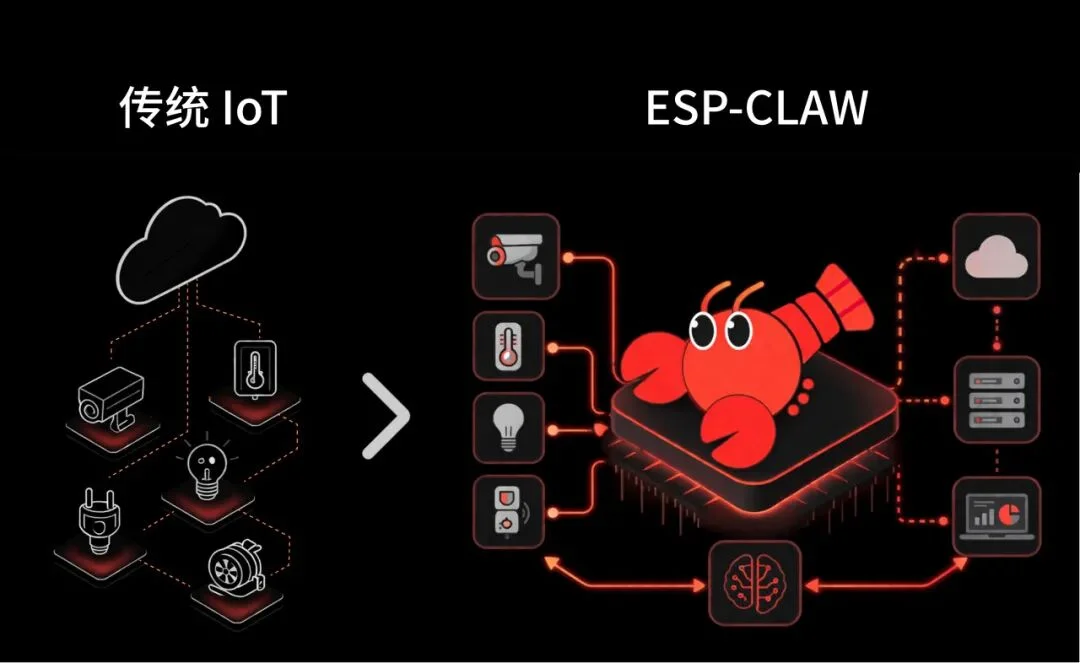
ESP-Claw enables full local perception, reasoning, and decision-making.
Four Core Capabilities
✅ 01 Chat-to-Device: Build Without Code
- Combines LLM-driven dynamic logic with Lua-based deterministic rules for safe, reliable execution.
- Users define device behavior via natural-language chat — no coding required.
- Example workflows:
- 📲 AI-generated driver code: Send a request via IM → auto-generate firmware-level control logic.
- 💡 One hardware, multiple functions: A single LED strip switches between weather display, ambient lighting, or nightlight mode — all via chat command.
- 🎮 Multi-peripheral composition: Combine screen, buttons, LEDs, and camera to build custom game consoles or music players.



Chat-driven control across diverse hardware.



Seamless, context-aware mode switching via conversation.


Complex DIY applications built through multi-step chat guidance.
💡 Critical operations (e.g., alarm triggers) are hardened into verified Lua rules — ensuring reliability even offline or during LLM model updates.
⚡ 02 Millisecond-Response Event Architecture
- Replaces polling with event-driven, active sensing — ideal for door sensors, PIR motion detection, or thermal anomalies.
- Local event bus triggers immediate Lua actions → sub-10ms latency, fully functional without internet.
- When no local rule matches, ESP-Claw intelligently escalates to LLM analysis.
- For compute-heavy tasks (e.g., video analysis), it performs cloud-edge orchestration: offloads data → processes remotely → returns actionable insight.

High-priority actions execute instantly using embedded rules.

Devices proactively report events to the local runtime.
🔍 Real-world example: A camera detects movement via PIR/frame-difference → captures image → uploads to cloud LLM for classification → if person detected, sends instant IM alert with photo; if animal, logs silently — then summarizes: “Filtered 4 animal events in past 3 hours; 1 human movement just occurred.”

🔌 03 Plug-and-Play Interoperability via MCP
Introducing the Model Context Protocol (MCP) — a standardized semantic interface bridging AI agents and physical devices.
| Capability | Description |
|---|---|
| Universal Device Onboarding | Devices shift from per-device SDKs to zero-configuration plug-and-play. |
| Cross-Device Orchestration | AI agents execute multi-step workflows across heterogeneous hardware. |
| Ecosystem Agnosticism | Any MCP-compliant agent (OpenClaw, Claude, Codex) can interoperate seamlessly. |
🔹 MCP Server Mode: ESP-Claw devices expose sensors/actuators as standard MCP Tools — e.g., Claude Code can invoke camera capture or render compile progress on device screens.

🔹 MCP Client Mode: ESP-Claw devices actively call external services — e.g., query live traffic via map APIs or send calendar reminders via messaging platforms. Devices evolve from passive executors to proactive intelligent nodes.

🧠 04 On-Device Memory & Lifelong Learning
- Implements a structured, persistent memory system fully resident on-device — zero data leaves the MCU.
- Automatically indexes high-value signals: explicit user commands (“Remember this”), behavioral preferences, and critical events (alarms, state changes).
- Uses lightweight “summary tags” (e.g.,
sleep-routine,device-status,food-preference) for efficient recall — loading full context only when needed. - Features automated memory pruning, deduplication, and compression — optimizing limited flash/RAM while enabling adaptive, personalized responses over time.

All sensitive data remains securely stored on-device.

Memory evolves continuously — turning raw logs into contextual intelligence.
Get Started in Minutes
ESP-Claw is open-source and production-ready:
✅ Supports ESP32-S3 / C5 / P4 chips
✅ Works with standard DevKitC dev boards
✅ Extensible with any sensor/actuator combo
🚀 Quick Setup Workflow
- Browser-based firmware flashing: Select chip model → upload firmware — no IDE or toolchain setup required.
- IM-native control: Use your existing messaging app (WeChat, Telegram, etc.) — no proprietary app or vendor lock-in. Switch LLM providers freely.

End-to-end IM-based device provisioning and control.
🔗 Explore the open-source repository and official documentation — join the Espressif community to pioneer AI-native IoT.
Article sourced from Espressif Community.