Embodied Robots Transform Retail Inventory Management
A wheeled robot glides slowly along supermarket shelves — while the store remains fully open for business.
It must navigate around customers and shopping carts, verify electronic shelf labels against actual product prices, dynamically adjust camera angles to see items obscured by front-row goods, and during restocking, extend its robotic arm into narrow shelves just 30–40 cm high to grasp and neatly reposition soft, collapsible snack bags.
Every motion — from recognition accuracy and operational safety to hardware cost — directly impacts retailers’ bottom line.
ROI is the non-negotiable gatekeeper for embodied AI entering real-world stores.
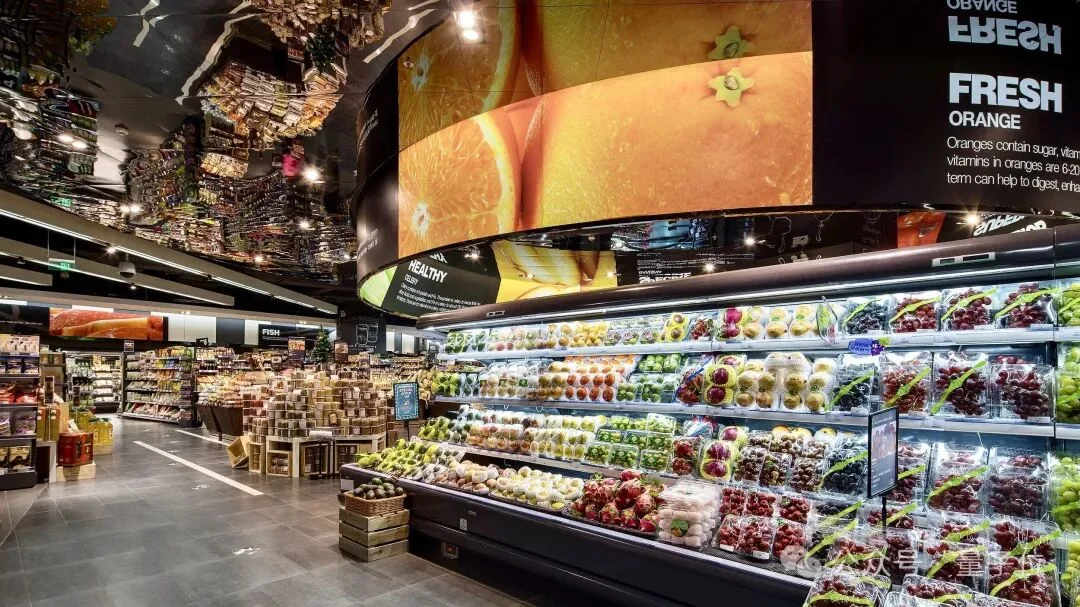
Now, two companies — Hanshow Technology and X-Era Lab (Tuoyuan Intelligence) — are jointly deploying this capability across live retail environments.
The Strategic Partnership: Scene + Brain
Hanshow Technology, a veteran in retail digitization, serves over 550 global retail clients across 80+ countries — with electronic shelf labels installed in nearly 70,000 stores.
These labels form a real-time, physical-world coordinate system: each tag links SKU, price, and precise shelf location — providing robots with pre-mapped spatial and semantic context before they even power on.
X-Era Lab, a Shenzhen-based AI lab spun out of Sun Yat-sen University’s HCP Lab and Pengcheng National Lab, specializes in native World Action Models — unifying environmental perception and physical action generation within a 4D spatiotemporal architecture.
Their flagship model, VWA, enables robots to reason about occlusion, lighting shifts, item deformation, and dynamic human movement — predicting environment changes and executing robust, adaptive actions.
Together, they confront a pivotal question:
When cutting-edge AI models interface with a globally distributed network of real stores, can embodied intelligence evolve beyond one-off demos into production-grade systems — stable, scalable, and commercially viable?
Three Core Retail Tasks: Inspection, Inventory, Restocking
Hanshow has distilled decades of retail insight into three mission-critical functions for embodied agents:
- ✅ Inspection: Real-time compliance checks (e.g., signage, layout, safety hazards)
- ✅ Inventory: Automated stock-level verification — eliminating manual night audits
- ✅ Restocking: Precise, dexterous shelf replenishment under dynamic conditions
Hanshow’s inspection robots are already undergoing POC trials in domestic and international malls.
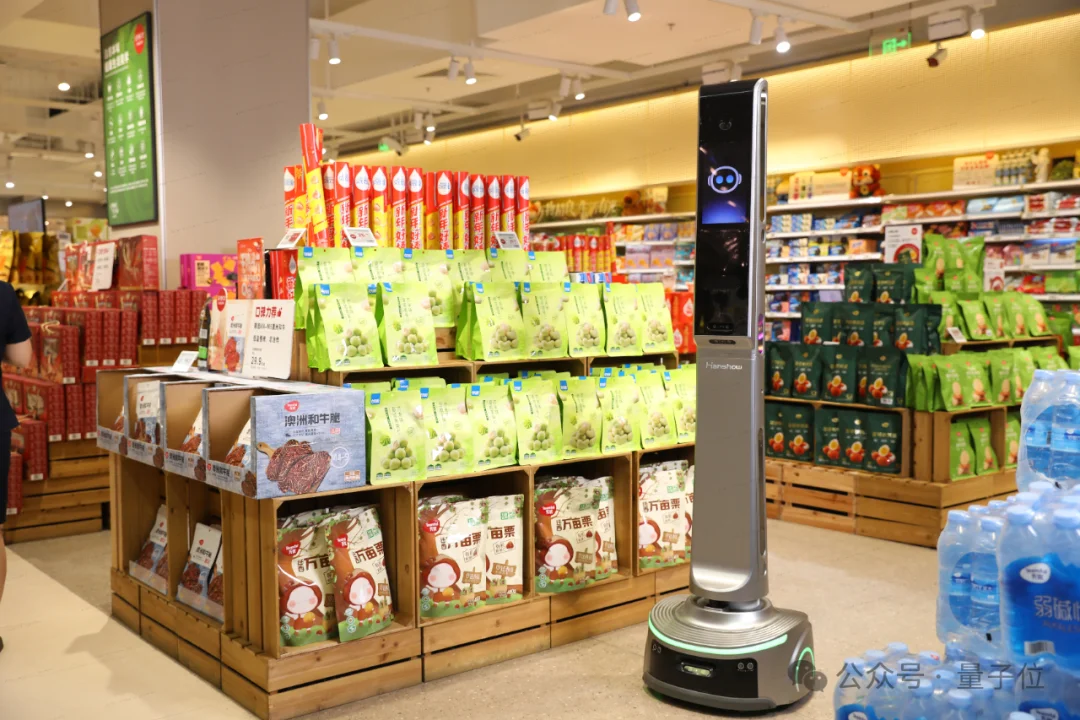
△ Hanshow inspection robot
Why Retail Is the Perfect “Testbed” for Embodied AI
While factory automation is highly structured — and home robotics faces extreme unstructured complexity — retail stores represent a uniquely balanced semi-structured environment:
- Fixed shelf layouts & standardized workflows provide strong priors
- Yet dynamic variables (customer flow, item displacement, seasonal displays) demand real-time adaptation
This makes retail an ideal proving ground — where performance is measured not in benchmarks, but in weekly inventory accuracy, labor-hour reduction, and shrinkage control.
Crucially, most large retailers conduct full-store physical counts only 1–2 times per year, exclusively after hours — leading to severe data latency and widespread stock discrepancies.
Robots operating during business hours, in scheduled regional patrols, could elevate inventory frequency to daily or even intra-day cycles — revolutionizing supply chain responsiveness, demand forecasting, and loss prevention.
Electronic Shelf Labels as Physical-World Infrastructure
As the world’s #2 ESL provider, Hanshow has built a foundational infrastructure:
- 🌐 70,000-store ESL network, deeply embedded at SKU-level shelf positions
- 🧩 Digital twin platform, mapping products, fixtures, devices, and operational states into unified digital space
- 📡 IoT-enabled real-time synchronization, linking ERP, pricing engines, and shelf metadata
This stack delivers three decisive advantages for edge robotics:
1. Drastically Reduced On-Device Compute Load
Each shelf label declares expected SKU and price — enabling lightweight on-device models to perform closed-set verification instead of open-world vision search. This slashes cloud dependency, latency, and energy use.
2. Native Semantic Spatial Coordinates
No SLAM mapping or manual annotation required. Thousands of ESL nodes collectively define an accurate, self-updating 3D map — turning physical space into machine-readable geometry.
3. Privacy-First Local Processing
In regulated markets like the EU, local inference — powered by label priors + compact models — satisfies GDPR and data sovereignty requirements by design, transforming compliance into competitive advantage.
VWA: A World Action Model Built for Real Shelves
X-Era Lab’s VWA (Vision-World-Action) model leverages 4D spatiotemporal representation to unify perception, prediction, and actuation — treating people, products, shelves, and lighting not as isolated pixels, but as interdependent elements of a coherent world state.
Key differentiators:
- ⚡ Efficient scale: Achieves SOTA results with just 1B parameters, outperforming many 10B+ models on retail-specific benchmarks
- 🧠 Hardware-ready: Optimized for deployment on 32 TOPS edge chips; partnered with StarFive on dedicated world-model accelerators (sub-millisecond latency)
- 🌍 Real-data flywheel: Trains on ~20,000 hours/day of real-world 4D interaction video — captured from active store deployments
- 🖥️ Open ecosystem: Released PhyAgentOS, the first open-source embodied intelligence OS — accelerating industry-wide standardization and interoperability
As Dr. Tian-Shui Chen, CTO of X-Era Lab, notes: “Retail doesn’t tolerate hype. Every task — from detecting a tilted cereal box to grabbing a crumpled chip bag — decomposes into dozens of fine-grained success metrics. Real business quickly exposes technical gaps.”
Hanshow’s Robot Product Line GM, Liang Tong, adds: “The semi-structured nature of stores is both challenge and opportunity: predictable enough for learning, dynamic enough to force generalization — far more valuable than synthetic simulation data.”
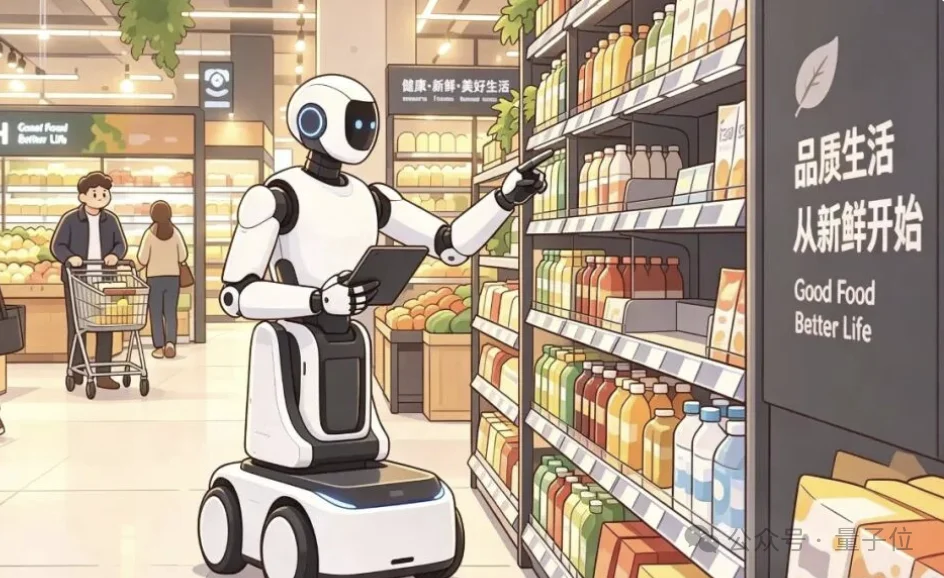
△ AI-generated retail scene visualization
The Flywheel: Real Stores → Real Data → Real Iteration
The true moat isn’t raw model size — it’s proprietary physical-world knowledge: real-time shelf changes, SKU-specific occlusion patterns, aisle width constraints, and typical customer interference vectors.
Hanshow’s 14-year retail domain expertise — accumulated across 70,000 stores — represents irreplaceable, non-synthesizable ground truth.
X-Era Lab’s VWA operates within Hanshow’s pre-built coordinate framework — interpreting deviations from expected norms, predicting next-state transitions, and generating executable motor commands.
Critically, every misidentification, failed grasp, or navigation detour becomes a high-value training signal, fed back into continuous model refinement — all validated against live KPIs (e.g., % shelf compliance, restock speed, error rate).
This closed-loop, store-to-cloud iteration engine transforms embodied AI from static software into a living, learning system — growing smarter with every store visit, every shelf scanned, every bag repositioned.
Conclusion: From Demo to Deployment
Embodied intelligence will succeed not through algorithmic novelty alone — but through deep integration with real-world infrastructure and relentless validation against commercial outcomes.
By anchoring AI in Hanshow’s physical-layer network and empowering it with X-Era Lab’s world-aware action engine, this collaboration pioneers a new paradigm: scalable, ROI-driven embodied AI — proven in 70,000 stores, iterating daily, and ready for global rollout.
Article originally published by QuantumBit, author: Yun Zhong.