Claude Code Helps Decipher 3500-Year-Old Linear A Script
Breakthrough in ancient linguistics: An AI-assisted approach has yielded the first systematic, testable decipherment of Linear A — a script silent for over three and a half millennia.
🌍 The Enigma of Linear A
Linear A is the undeciphered writing system of the Bronze Age Minoan civilization on Crete. Emerging around 1800 BCE, it was used until roughly 1450 BCE, when Mycenaean Greeks conquered the island. Discovered by archaeologist Arthur Evans at Knossos in 1900, Linear A has resisted all decryption attempts for more than a century.
Unlike its successor Linear B — famously deciphered by architect Michael Ventris in 1952 (revealing an early form of Greek) — Linear A remains one of linguistics’ most stubborn puzzles.
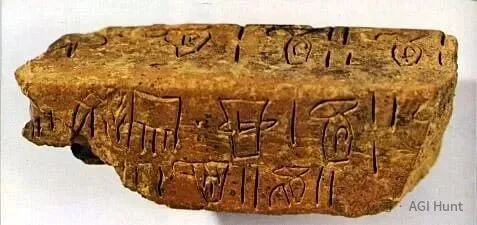
Linear A clay tablet inscription
🔍 The Breakthrough: Tom Di Mino’s Seven-Year Quest
Tom Di Mino — a self-taught AI engineer and amateur linguist based in New York’s Hudson Valley — claims to have cracked Linear A using Claude Code, not as an oracle, but as a research automation tool.
Key Background:
- Former engineer at JPMorgan Chase and Google
- Chief Engineer at Subquadratic
- Studied classical history and linguistics since age 18
- Conducted two field trips to Crete to study primary artifacts
His methodology centered on structured hypothesis testing at scale, enabled by custom Python scripts generated and refined with Claude Code.
He integrated two major digital corpora:
– GORILA: A five-volume compendium (1976–1985) containing ~7,000 symbols from ~1,427 inscriptions
– SigLA: An open-access database (launched 2020) covering ~3,000 symbol variants across 400+ inscriptions
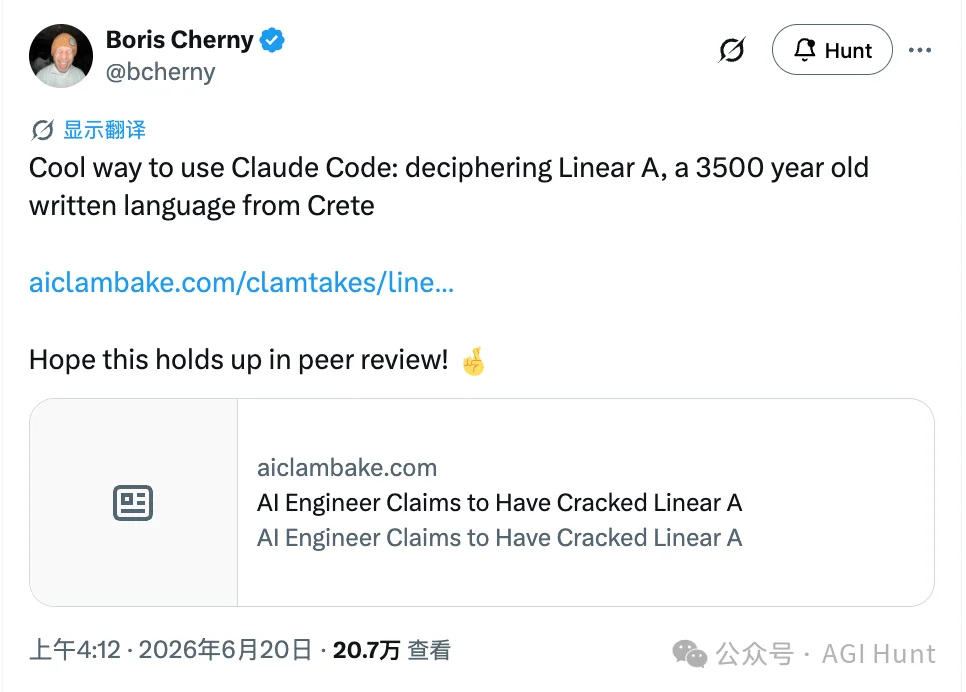
Linear A prayer inscription
📜 The Prayer Formula & Linguistic Insight
On May 22, Di Mino identified a recurring structural pattern across prayer inscriptions from five distinct Cretan sanctuary sites — notably the Iouktas site (tablet IOZa2):
A-TA-I-*301-WA-JA · JA-DI-KI-TU · JA-SA-SA-RA-ME · U-NA-KA-NA-SI · I-PI-NA-MA · SI-RU-TE
Using known Linear B syllabic correspondences (60 shared signs), he isolated the unknown sign *301 — deducing its phonetic value as “na”.
This unlocked the verb root “nawaya”, meaning “to dwell” — matching the Semitic triconsonantal root N-W-Y, found in Hebrew (yāšab) and Akkadian (nāwu), both denoting “residence” or “dwelling.”
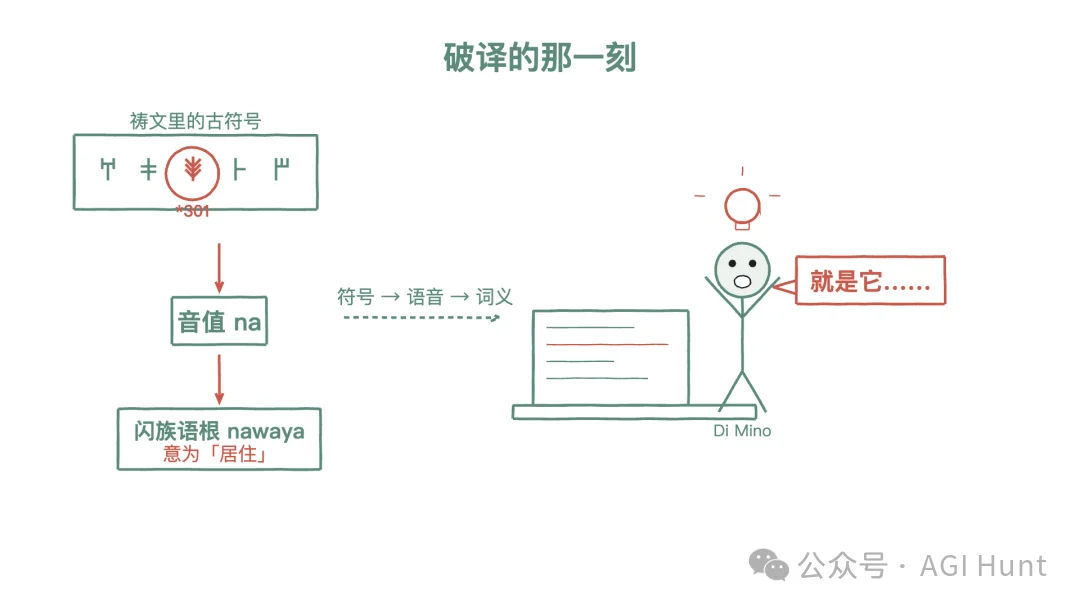
301 = na — key to Semitic linguistic alignment
From there, Di Mino demonstrated that Linear A prayers follow syntax nearly identical to later Hebrew liturgical forms — addressing a goddess rather than Yahweh.
🧩 Not Entirely New — But Radically Refined
The idea that Linear A encodes a Semitic language isn’t unprecedented. In 1957, scholar Cyrus Gordon proposed parallels like:
– ka-ro-pa ↔ Akkadian karpu (“carafe”) → English carafe
– ku-ro (repeated at tablet ends) ↔ Semitic kull (“total”)
However, Gordon’s lexical matches lacked grammatical grounding and failed peer validation.
Di Mino’s contribution lies in structural rigor:
– Proposed readings for 40 Linear A signs, including 13 previously unknown ones
– Resolved controversies around 5 Linear B symbols
– Compiled a 408-word English–Linear A lexicon
– Authored a 9-page manuscript titled “Ya Diktu: Grammar of the Minoan Summit Sanctuary Libation Formula”
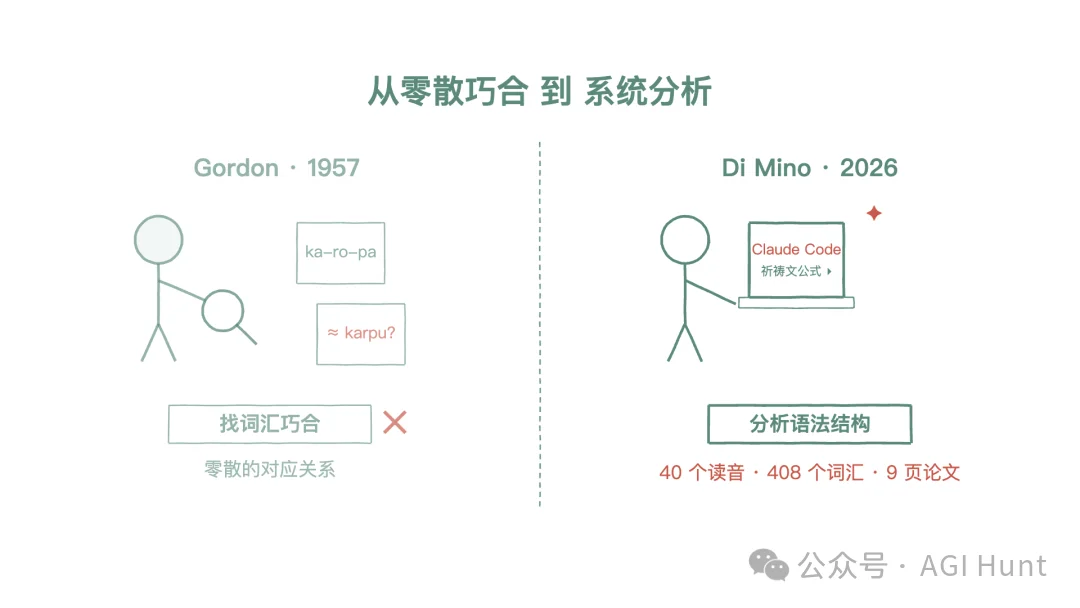
From coincidence to structural analysis
⚖️ Challenges & Skepticism
Despite promising results, Di Mino’s work remains under peer review at Rutgers University and the University of Cambridge.
Why is Linear A so hard?
– Tiny corpus: Only ~1,400 inscriptions (~7,000 symbols), mostly commodity lists (oil, livestock)
– No bilingual text: Unlike the Rosetta Stone for Egyptian hieroglyphs or Ventris’s Greek anchor for Linear B
– No known descendant language: No living or attested close relative to verify reconstructions
As experts caution: Internal consistency ≠ historical accuracy. AI excels at pattern detection — but patterns can be seductive mirages without external validation.

Tom Di Mino’s personal website
💡 Beyond Coding: AI as Research Co-Pilot
Crucially, Claude Code did not “decipher” Linear A autonomously. Instead, Di Mino used it to:
– Generate, debug, and iterate Python tools for large-scale symbol cross-referencing
– Automate statistical frequency analysis across GORILA and SigLA
– Build reproducible, auditable workflows — turning intuition into verifiable steps
This transforms research from artisanal guesswork into an iterative, transparent, and repeatable cycle: collect → hypothesize → test → document → share.
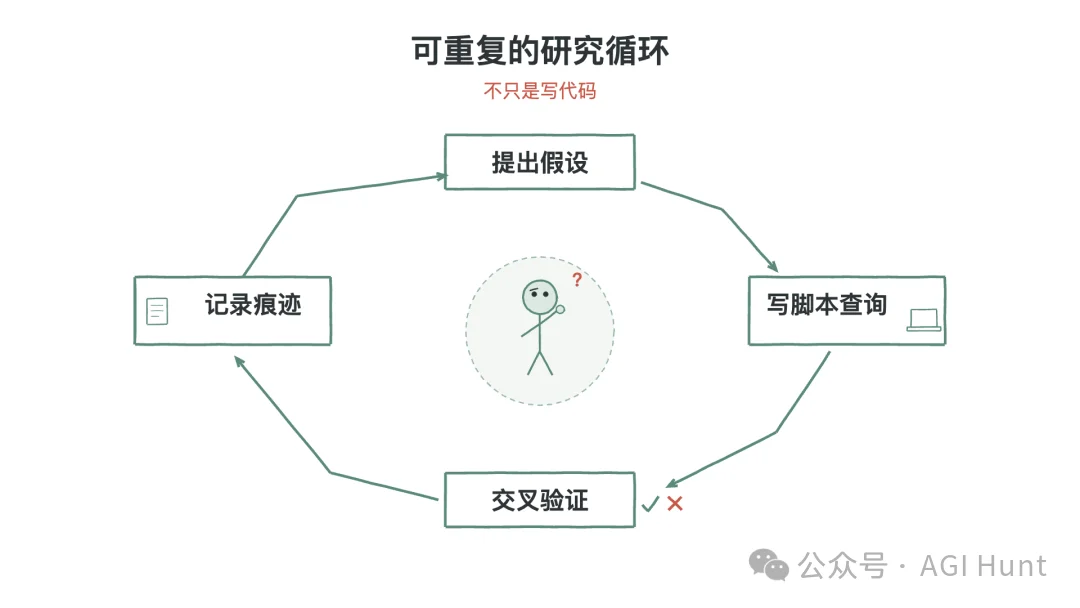
Reproducible research loop
This paradigm echoes other frontier projects — such as the Vesuvius Challenge, where AI helped recover charred Herculaneum scrolls, winning a $700,000 prize in 2024.
📜 Legacy in the Making
If validated, Di Mino’s work would mark the most significant breakthrough in ancient script decipherment since Ventris — and the first powered substantially by AI-augmented methodology.
| Era | Decipherer | Tooling | Key Insight |
|---|---|---|---|
| 1952 | Michael Ventris (architect) | Paper, statistics, radio broadcasts | Linear B = early Greek |
| 2026 | Tom Di Mino (AI engineer) | Claude Code + Python + digital corpora | Linear A = extinct Semitic language |
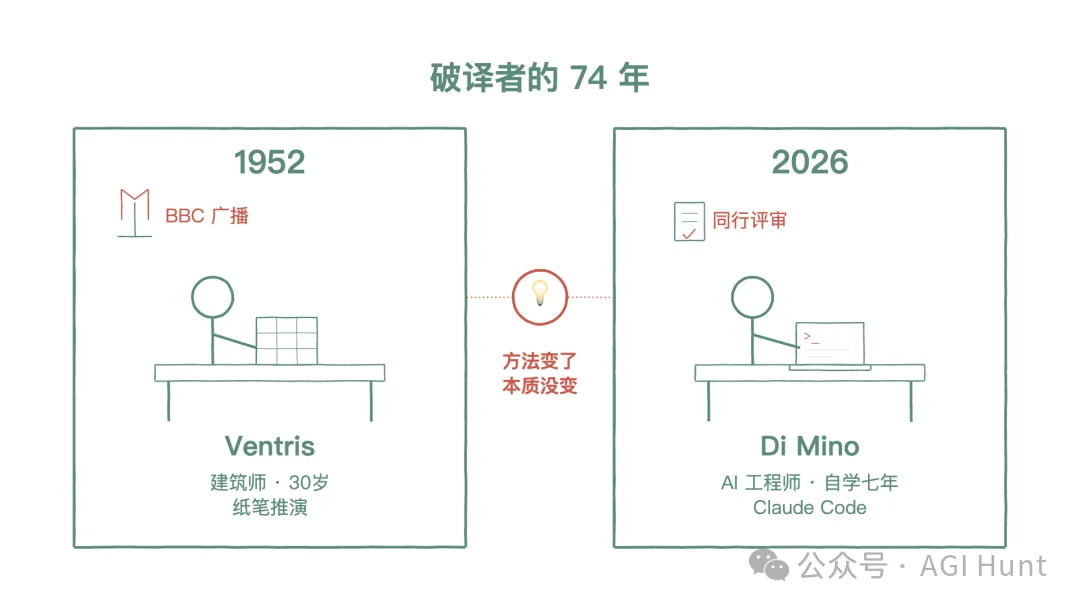
1952 vs. 2026 — method evolved, insight remains human
Final insight: AI accelerates discovery — but the critical leap (“301 = na”*) came from seven years of human obsession, fieldwork, and interdisciplinary intuition. Tools amplify insight; they don’t replace it.
🔗 Related Resources
Article originally published by “AGI Hunt”