OpenAI Unveils Historic ChatGPT Overhaul — The Era of “AI-Only-for-Chats” Is Over
Published June 7, 2026 (UK time), as reported by the Financial Times
Sam Altman, OpenAI Co-founder & CEO — image processed by AI
In a landmark strategic shift, OpenAI is preparing the most extensive redesign of ChatGPT since its 2022 launch. Rolling out incrementally over the coming weeks, this transformation redefines ChatGPT not as a conversational interface — but as a universal AI superapp: a unified platform capable of coding, scheduling, software orchestration, and real-world task automation.
🚀 Core Transformation: Codex Integration & Ecosystem Expansion
The centerpiece of the revamp is the full integration of Codex — OpenAI’s fastest-growing programming engine — into the ChatGPT interface. Simultaneously, ChatGPT will natively embed third-party applications from partners including Canva and Booking.com, turning the familiar chat window into a dynamic, multi-tool command center.
As one senior OpenAI engineer declared: “The era of AI used solely for chatting has ended.”
This signals a decisive pivot from passive Q&A to proactive agenthood: AI that acts, executes, and delivers outcomes — not just answers.
🔍 Strategic Rationale: From Entry Point to Revenue Engine
ChatGPT’s role is being fundamentally repositioned:
– Traffic gateway → Intelligent operating system layer
– Consumer-facing chatbot → Enterprise-grade productivity hub
– Free-tier engagement tool → Monetizable workflow engine
Thibaut Sottiaux, Head of All Core Products & Platforms at OpenAI, envisions seamless cross-device interaction: “You can access it via phone, desktop, or web — even while driving. It listens, understands intent, and acts — without you needing to know which tool is running underneath.”
🧩 Key Functional Shifts for Users
✅ Immediate Changes (Rolling Out Now)
- Prominent in-app prompts and UI entry points for code generation, image creation, and partner app integrations
- Toggle option letting users choose between ChatGPT or Codex for task execution
- Voice-first workflows for email drafting, calendar management, and daily briefing automation
✅ Real-World Automation Examples
- ✅ Dictate an email → Codex auto-generates content, matches recipients (via Slack/Email API), and sends upon confirmation
- ✅ Ask “What’s on my calendar next?” → Instant sync with calendar plugin + contextual meeting prep
- ✅ Set recurring daily 8 a.m. briefing: summary of meetings + top-priority inbox items
✅ Long-Term Vision
- Disappearance of manual prompt guidance and UI scaffolding
- Autonomous tool selection: model decides whether to run locally or in the cloud
- Context-aware, zero-friction interaction — no commands needed, only intent expressed naturally
“This feels like the first real step toward AGI — where the interface fades, and the intelligent agent takes center stage.” — Community observer
⚙️ Technical Foundation: GPT-5.5 & Codex Maturity
Behind the scenes, foundational upgrades power this leap:
- GPT-5.5 (released April 2026) delivers breakthrough reliability in long-horizon, multi-step reasoning — reducing need for human intervention by >70% compared to GPT-4.5
- Codex desktop app (launched February 2026) lowered the barrier for non-developers, enabling GUI-driven multi-agent workflows
- User trust surge: Notion engineers report Codex silently fixing latent bugs missed for weeks — a testament to production-grade robustness
📊 Growth metrics speak volumes:
→ Codex Google search volume peaked in mid-May — surpassing Claude Code
→ Weekly active users exceeded 5 million by end-May
→ Daily usage growing 5% MoM, enterprise revenue up 50% week-on-week
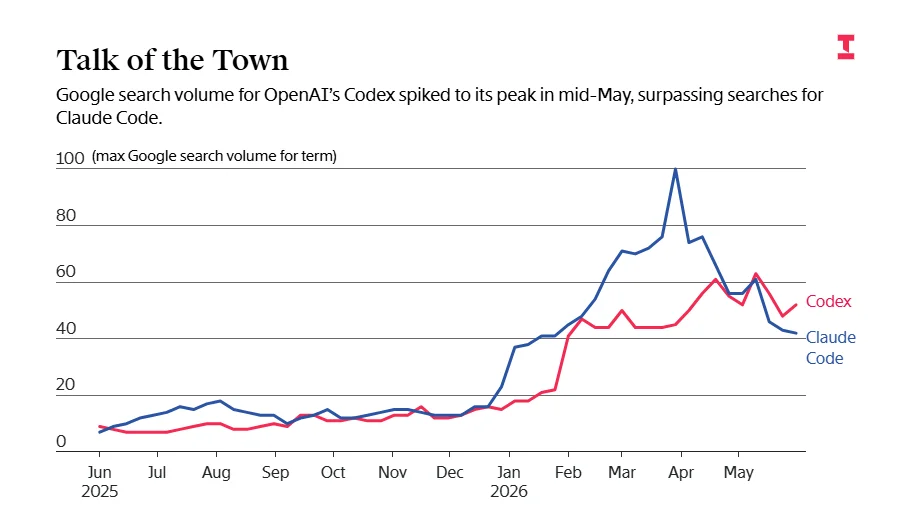
Codex search interest surged past Claude Code in mid-May 2026
⚔️ Competitive Catalyst: Anthropic’s Pressure & Strategic Pivot
This overhaul was accelerated by competitive urgency:
– Anthropic’s Claude Code preview (Feb 2025) revealed superior coding benchmarks — threatening OpenAI’s core AGI thesis
– Internal realization: Programming capability = R&D velocity = AGI leadership
In response, OpenAI:
– Formed a dedicated, high-autonomy Codex team led by Sottiaux
– Open-sourced key Codex components to accelerate community feedback
– Reorganized in January 2026 — merging ChatGPT, Codex, and API teams into one unified product division
– Deprioritized consumer experiments (e.g., Sora video gen, shopping checkout) to focus resources on monetizable enterprise tools
💰 IPO Imperative: Monetizing the Superapp
With IPO preparations intensifying, OpenAI’s financial calculus is clear:
– Enterprise customers (~2M) already generate ~40% of revenue — projected to reach 50% by year-end
– Codex users show significantly higher conversion: >85% are paid subscribers
– Anthropic’s $47B annualized revenue (May 2026) sets a formidable benchmark — pushing OpenAI to unlock latent value from its 900M+ consumer user base
Crucially, OpenAI abandoned browser-mimicking agents (e.g., Operator) in favor of native code generation — recognizing that writing software is faster and more reliable than clicking through websites.
🌐 Final Outlook: A New Operating Paradigm
The vision is unambiguous: ChatGPT as the OS for intelligence — embedded across devices, context-aware, and outcome-oriented. But a pivotal question remains unanswered:
Will billions of free-tier users — accustomed to casual conversation — pay for an AI that does their job?
This bet isn’t just about features. It’s the opening hand in the high-stakes race to define the standards, economics, and architecture of the post-AGI era.
Source: Tencent Technology | Author: Helen Li
Note: All images are sourced directly from AITNT News and preserved in original resolution and URL.