Alibaba Launches QoderWake: AI Digital Employees Enter Production
From Lobster Fever to Role-Based AI
Over the past year, the domestic Agent market has undergone several pivotal shifts.
First came a wave of Agent projects that revealed AI’s potential not just as a chatbot—but as an action-oriented system capable of decomposing tasks and delivering tangible outcomes. Then arrived the “lobster fever” sparked by OpenClaw, where AI demonstrated browser control, file I/O, code execution, and terminal access—marking the first time many realized: AI isn’t just answering questions—it’s动手 (taking action).
But after the excitement settled, the industry hit a new bottleneck: being able to act ≠ being ready for employment.
Enterprises equipped teams with Agent tools expecting exponential efficiency gains—only to discover: individuals got faster, but organizations did not.
A 40-year-old insight explains today’s paradox.
In 1984, management theorist Eliyahu Goldratt introduced the Theory of Constraints: a system’s output is governed by its slowest link. Optimizing non-bottleneck steps yields near-zero impact on overall throughput.
Consider a software delivery pipeline: product request → engineering understanding → coding → testing → deployment. AI may shrink coding from 30 minutes to 10—but demand review, context sync, permission checks, test validation, rework, and documentation remain unchanged.
The bottleneck is no longer who writes code—it’s how tasks flow, how information synchronizes, how issues are triaged, and how expertise is retained.
That’s the core challenge facing Agent adoption today.
Historically, focus centered on models: stronger base models meant “smarter” Agents. Now, models are just one variable. What truly determines production readiness is the Harness—the operational layer surrounding the model.
Same model, different context:
– In a chatbox → answers questions.
– In a mature Harness → becomes a long-running digital employee.
From Tool to Role: What QoderWake Bridges
On April 30, Alibaba unveiled QoderWake, positioned as a production-ready, secure, self-evolving digital employee. It does not aim to build “a smarter AI assistant”—but rather confronts a harder question: How do Agents evolve from tools into roles?
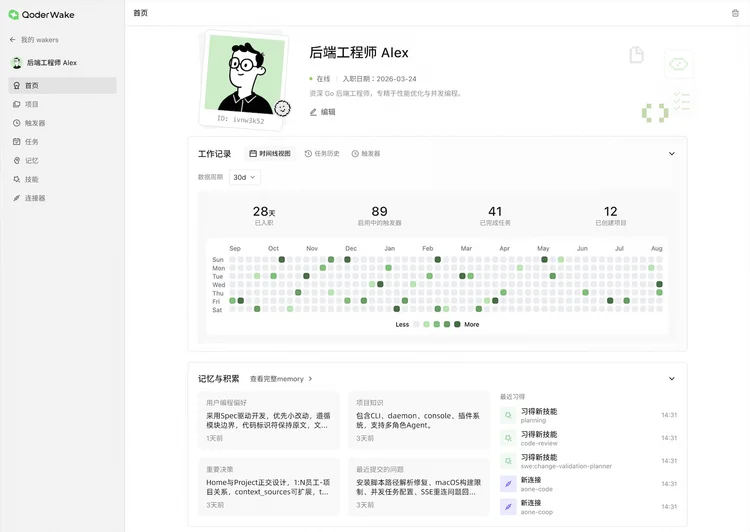
The distinction is profound:
- Agent-as-tool logic: User issues command → Agent acts.
- Digital-employee logic: Event occurs → Employee autonomously engages.
Examples:
– A user complaint arrives → the digital customer manager auto-triages, retrieves historical interactions, assesses escalation need.
– A production alert fires → the digital programmer parses logs, pinpoints root cause, drafts remediation.
Crucially, this isn’t about coding ability—it’s about continuous presence, contextual awareness, permission compliance, and experience accumulation across tasks.
OpenClaw proved AI can act. Hermes showed Agents can self-evolve. But both operate primarily in personal contexts.
Enterprise environments demand rigor: you cannot deploy a high-privilege Agent directly into email systems, code repos, or customer channels without strict boundary controls. Without permissions governance, the more powerful the Agent, the greater the risk.
QoderWake doesn’t patch personal Agents—it reverse-engineers the product from the metaphor of an employee.
A true digital employee requires six foundational pillars:
1. Role-Based Identity
Not a generic chatbot—but a defined role: programmer, analyst, customer manager, or content editor, each preloaded with domain-specific workflows.
2. Persistent Identity
A sustained professional identity: knows team structure, project history, and decision context. Interactions build on accumulated consensus—not zero-start guesswork.
3. Long-Term Memory
Cross-session, cross-task memory retention: remembers your coding style, project constraints, and prior decisions—solving the “forgetful Agent” problem.
4. Modular Skill Library
A catalog of reusable, atomic skills—e.g., code review, log analysis, root-cause inference—composable into complex, auditable workflows.
5. Permission Boundaries
Runs inside isolated privilege sandboxes. Every action is scoped, logged, and enforceable—like issuing a digital work ID, not handing over corporate keys.
6. Event-Driven Activation
No waiting for commands: triggers autonomously on alerts, new tickets, or scheduled intervals—shifting from “human seeks AI” to “AI seeks human.”
Together, these form a growth trajectory:
→ The more you use it, the better it understands you → then your team → then your company.
That’s the leap from assistant to employee.
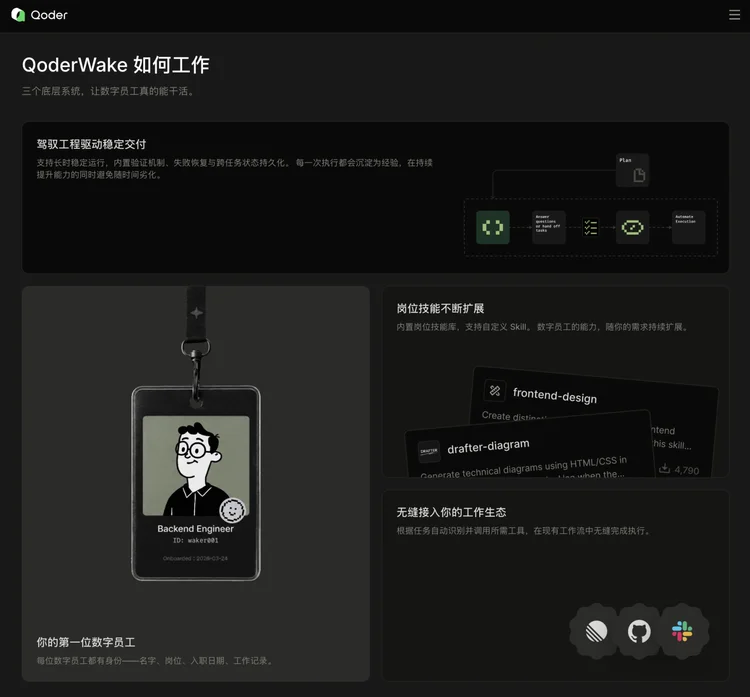
Engineering the Digital Employee: How QoderWake Works
“Digital employee” is a metaphor—but engineering it demands concrete abstractions.
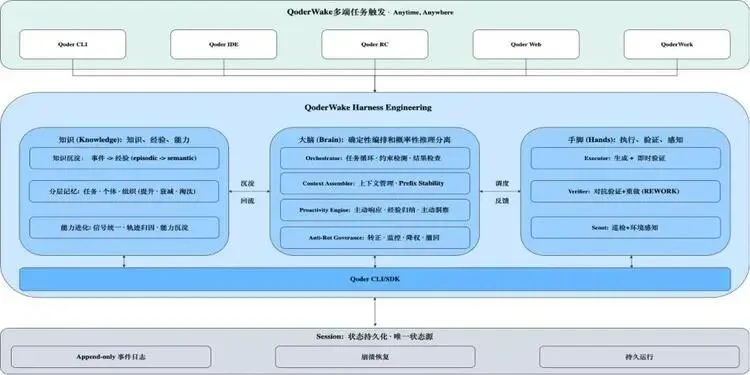
Control Separation: Think vs. Do
Modern LLMs are too unconstrained: ask for code—and they might rewrite config files. QoderWake decouples planning from execution:
– Orchestrator: designs workflows, manages state, enforces policies.
– Model: handles intent comprehension and complex reasoning only.
– Communication happens via Session—a tamper-proof ledger storing every operation, context, and state. If a component fails, restart resumes precisely where it left off.
Dual-Layer Validation
- Executor self-checks before finalizing.
- Independent Validator audits the full result. Failure triggers automatic retries—and logs failure patterns for future avoidance.
From repeated errors, the system distills institutional knowledge—e.g., “Payment-module changes must preserve transactional integrity.”
Auditable Permissions & Traceability
Each digital employee operates in its own sandbox. Every action is immutably logged—enabling forensic traceability: Which step failed? Who authorized it? What was the input context?
Enterprises fear not just errors—but untraceable errors.
Self-Correction: Critic-Refiner Loop
Agents degrade over time—accumulating outdated facts or contradictory skills. QoderWake combats this with:
– Post-task critique: identifies redundant steps, flawed judgments.
– Structured learning signals determine whether insights become memory, skills, or workflow updates.
– Regular “health checks”: prune stale memories, merge conflicting skills, downgrade obsolete capabilities.
Knowledge curation—not volume—is what drives capability growth.
This evolution is multidimensional:
– Memory evolution: learns you.
– Skill evolution: learns what works.
– Workflow evolution: learns your team’s rhythm.
– Organizational evolution: learns your company’s policies and culture.
Only layered growth enables true role-level maturity.
Beyond the Role: A Broader Blueprint
Qoder’s progression tells a strategic story:
- Qoder IDE/CLI: AI assistant for developers—accelerating coding & debugging.
- QoderWork: Extends AI to office workflows—natural-language file operations, Office doc generation.
- QoderWake: Elevates AI to role ownership—7×24 digital employees handling feedback, logs, and code autonomously.
Together, they form a complete AI work operating system—spanning developer tooling, desktop productivity, and enterprise-grade labor.
This aligns precisely with Alibaba’s broader strategy: unifying large models, Agents, and cloud infrastructure around Token as the central unit of compute and value.
When digital employees run continuously—processing feedback, analyzing logs, generating PRs—their Token consumption transforms:
– Not just chat cost or API call volume—but production cost.
Tokens shift from technical budget line → core operational expense.
Long-term, this signals a structural shift in organizational design:
– Future enterprises won’t have just humans + software.
– They’ll feature a third layer: digital employees.
– Workforces will evolve from human-only collaboration → human–digital hybrid teams.
Tomorrow’s optimal allocation isn’t which person does which task—
It’s which person and which production-grade digital employee does it.
Article originally published by WeChat Official Account “Silicon Star Pro”.