500,000 People Sell Personal Photos and Videos to Train AI
A new frontier in the AI data economy: humans as first-person sensors for robotics and world-model training.
🌐 The Rise of the Human Data Workforce
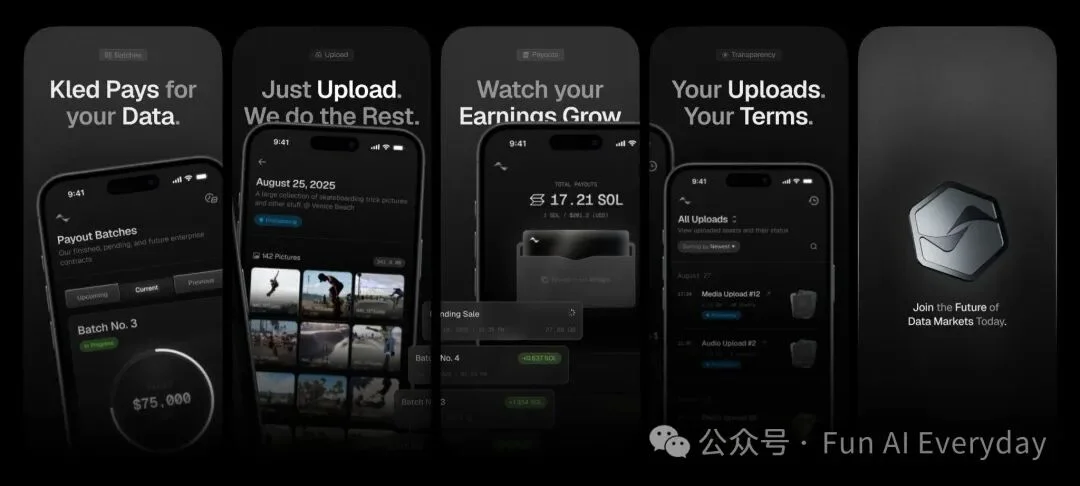
AI is catalyzing entirely new labor markets — and one of the most striking examples is the emergence of human-sourced training data platforms. At the forefront stands Kled, a rapidly scaling startup enabling individuals worldwide to monetize their personal photos, videos, documents, and real-world behavioral data.
According to company disclosures, Kled has now onboarded over 500,000 users, processing 3–4.5 million files daily, with cumulative funding reaching $14 million — including a $5.5M seed round and a $3M investment from The DATA Foundation.

🎥 Not Labeling — Living for the Algorithm
Unlike traditional data annotation services (e.g., Scale AI), Kled doesn’t ask users to label or classify existing data. Instead, it commissions original, first-person recordings:
- 📹 Recording yourself washing dishes, folding laundry, or pouring drinks — with iPhone mounted on your head.
- 🛣️ Capturing potholes, road signs, or traffic conditions via dashcam footage.
- 📄 Uploading academic assignments, tax documents, or handwritten notes.
💰 Sample Task Pricing (U.S. Market)
- $5 — Video of you taking out the trash
- $1,000 — Upload of 500 selfies
- $150 — Submission of a completed tax return
A WIRED journalist tested the model: filming household tasks for one week across Kled, Luel, and Waffle Video — earning $21.55 for >100 clips.
🤖 Why Robots Need to Watch You Wash Dishes
Language models train on vast public text — but robots, autonomous vehicles, and world models require embodied, contextual, real-world sensory data.
This includes:
– ✋ Hand trajectory when gripping a plate
– 🚪 Kinematics of opening a drawer
– 🧼 Micro-movements of a sponge scrubbing surfaces
– 🚗 Real-time visual perception from a truck cab windshield
Such first-person perspective (FPV) data is scarce, expensive, and highly domain-specific. As industry forecasts suggest, leading AI labs may soon purchase hundreds of millions of hours of FPV video — making everyday human activity a strategic data asset.

⚙️ Beyond Uploads: Kled’s Data Engineering Layer
Raw uploads ≠ usable training data. Kled adds critical infrastructure:
✅ Automated deduplication & AI-generated content filtering
✅ Semantic classification and metadata enrichment
✅ Structured dataset assembly (e.g., “kitchen manipulation”, “urban road anomalies”)
✅ Full-chain auditability: content hash + timestamp + payment record + consent log
As of March 2026, Kled had curated 12,000+ production-ready datasets, categorized into:
– First-person action sequences
– Medical imaging annotations
– Urban infrastructure visuals
– Academic & professional documentation
– Consumer behavior logs

⚖️ The Trade-Off: $5 vs. Permanent Rights
Kled’s terms grant global, perpetual, irrevocable, sublicensable, and exclusive rights to use uploaded content for AI/ML development — while users retain copyright ownership.
That means:
– A $5 “trash video” sale isn’t transactional — it’s licensing indefinite usage rights.
– Uploads of sensitive materials (tax forms, family videos, health records) carry nontrivial privacy implications — even with anonymization and opt-in audits.
As AI companies pay premium prices for rare, high-fidelity, legally compliant data, the tension between user empowerment and long-term data sovereignty intensifies.

🔄 From Free Data Extraction to Paid Data Labor
The internet era ran on implicit data barter: free services in exchange for behavioral data. Kled flips that model:
“If your data trains our AI, you get paid — directly, transparently, and at scale.”
This signals a paradigm shift: data is no longer just exhaust — it’s intentional labor.
New roles are emerging:
– 📸 Human Sensor Operators (FPV task performers)
– 🔍 Data Provenance Verifiers
– 🧹 Synthetic Data Sanitizers
– 📜 Consent & Compliance Orchestrators
– 🧩 Task Decomposition Specialists (translating AI needs into micro-tasks)
With over half a million contributors already active — and daily file volume rivaling major cloud storage APIs — Kled exemplifies how AI is redefining work itself.
🔮 Final Thought
Kled isn’t selling photos — it’s building the world’s first distributed human sensor network, governed by market incentives rather than platform monopolies. Whether this model scales sustainably depends not on engineering alone — but on trust, transparency, and equitable value distribution across the entire AI data supply chain.
Source: Based on reporting by WIRED and official Kled disclosures (2026). Images hosted by AITNT News.