AI Detection Tools Are Failing Students and Undermining Academic Integrity
A growing wave of unreliable AIGC detection is forcing students to “prove they’re human”—with absurd, counterproductive, and often harmful consequences.
🚨 The New Academic Gauntlet: AIGC Detection Mandates
This year, graduation season brought a new hurdle: AIGC (AI-Generated Content) detection. Beyond traditional plagiarism checks, universities across China—including Sichuan University, Nanjing Tech University, Guangxi Normal University, Hebei University of Engineering, and Nanjing University of Aeronautics and Astronautics—have mandated AI detection for undergraduate theses, with strict thresholds:
- Sichuan University: ≤20% AI content for humanities; ≤15% for STEM/medical fields
- Nanjing Tech University: Campus-wide detection; standards set per college
- Multiple institutions: Up to 40% AI threshold—yet enforcement remains opaque and inconsistent
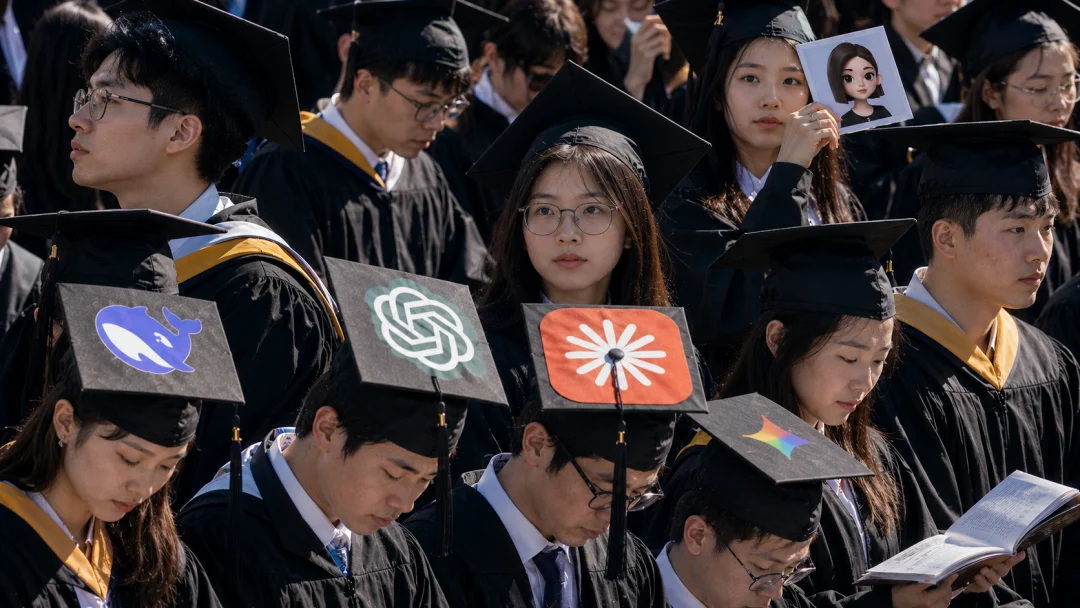
Caption: AI detection tools often produce volatile, non-reproducible scores—even on identical text.
⚖️ When Algorithms Accuse the Innocent
One recent graduate described an exhausting cycle: “detect → revise → re-detect → re-revise”—reducing their AI score from 61.7% to 0%, not by improving scholarship, but by deliberately degrading clarity and logic.
Worse, detection results defy reason:
- Human-written passages flagged as AI-generated (entire paragraphs highlighted in red)
- Identical text yields 10% on Tool A, 100% on Tool B, and 0% on Tool C—even within the same platform across sessions
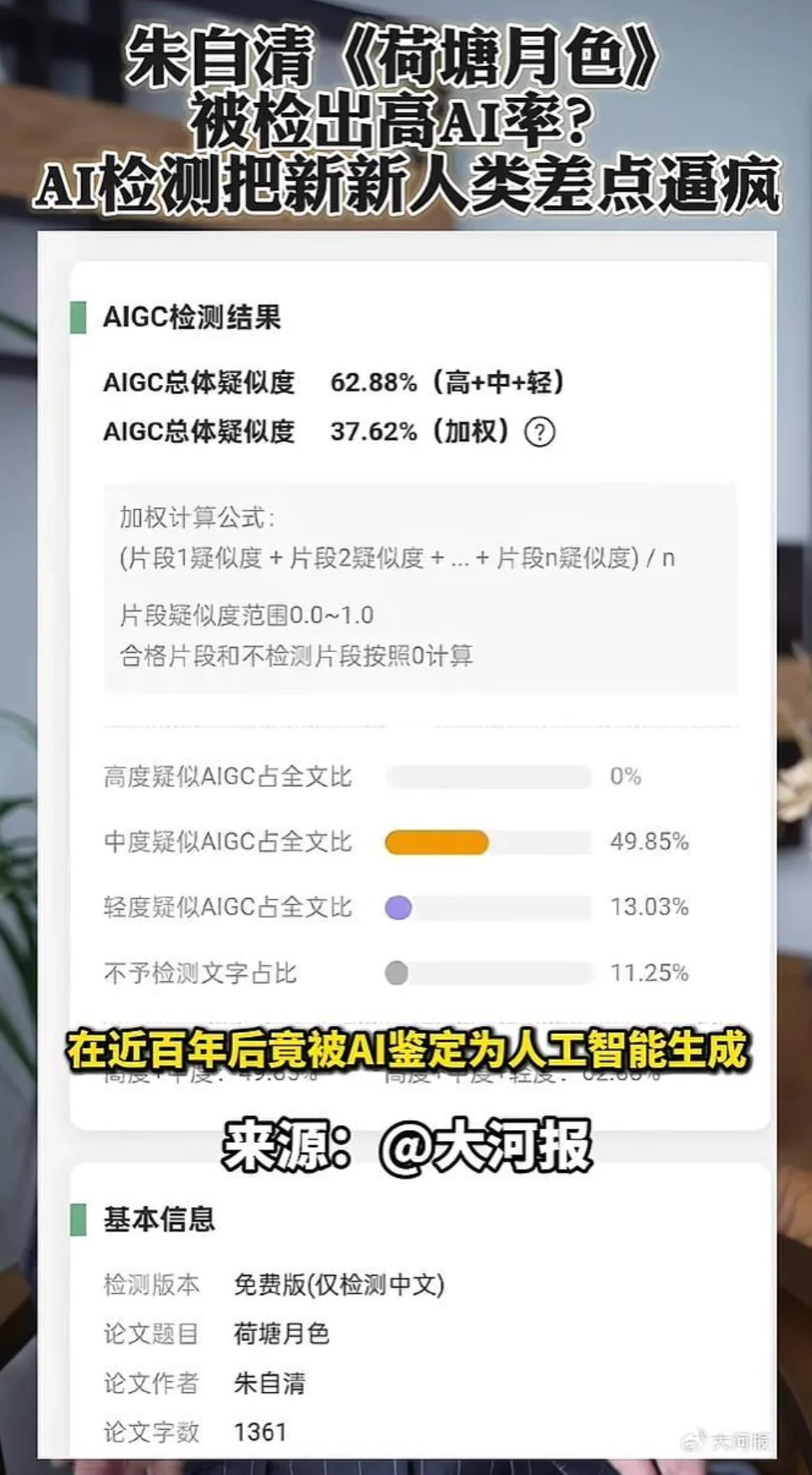
- Zhu Ziqing’s classic essay Moonlit Lotus Pond was scored at 62.88% AI-generated by multiple university-approved tools
🌍 A Global Crisis: From Beijing to Boston
The problem isn’t local. In the U.S., 23-year-old student Burrel received a zero on a required writing assignment after her professor suspected AI use—despite drafting it manually over two days in Google Docs.
She responded with:
– A 15-page PDF of timestamped edits and notes
– A 93-minute YouTube video recording her entire writing process
Her grade was reinstated—but only after extraordinary effort. Turnitin’s own Chief Product Officer, Annie Chechitelli, has publicly cautioned: “AI detection scores should never be the sole determinant of academic misconduct.”

🔍 How Do These Tools Actually Work? (Spoiler: It’s a Black Box)
Unlike traditional plagiarism checkers—which compare text against databases—AIGC detectors operate via probabilistic heuristics. Based on CNKI’s 2023–2024 patents, mainstream systems use a three-stage pipeline:
Stage 1: Information Entropy Differential (2023 Patent)
- LLM rewrites input text
- Compares information density between original and rewrite
- Small difference → high AI likelihood
Stage 2: Multi-Feature Linguistic Analysis (2024 Patent)
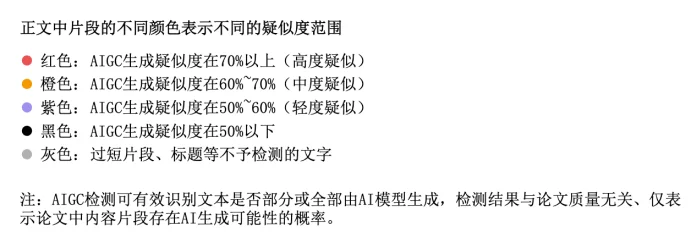
- Evaluates sentence length variance, lexical dispersion, logical coherence deviation, and word-frequency distributions
Stage 3: Weighted Ensemble Decision
- Combines both stages
- Flags text as AI if both stages converge on suspicion
🤖 “Fighting AI With AI”: Does It Work?
Students are turning to “AI detox” services—including free prompts, commercial tools like Biejie (PenStack) and SpeedAI, and built-in features from platforms like PaperYY.
A real-world test on a 972-word sample revealed shocking inconsistencies:
| Method | Initial AI Score | Post-Processing Score |
|---|---|---|
| Original (human + ChatGPT edit) | 61.7% | — |
| GPT-4 rewrite | — | 100% |
| DeepSeek rewrite | — | 100% |
| Grok rewrite | — | 100% |
| Biejie (“PenStack”) | — | 91.5% |
| SpeedAI | — | 0% |
| PaperYY’s paid service | — | 0% |
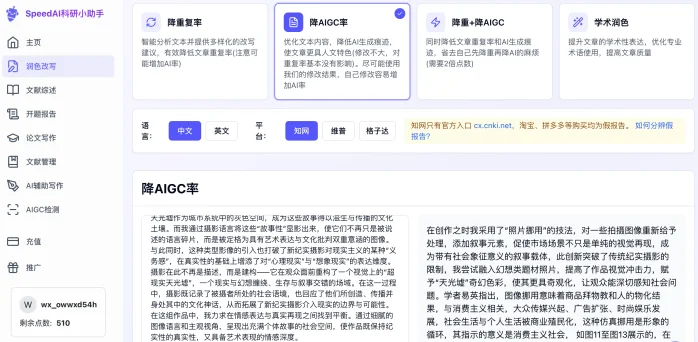
Yet even SpeedAI’s “0%” result proved illusory upon deeper analysis: its output used equally abstract academic jargon (“social symbolism,” “narrative apparatus”), while ChatGPT’s “100%” version included more first-person phrasing—ironically more human-like.
💡 The Real Cost: Eroding Thought, Not Just Text
As Renmin University professor Dong Chenyu observed:
“AI is forcing academia to reimagine knowledge production—but knee-jerk ‘anti-AI’ policies aren’t reform. They’re panic. AI raises the floor, but humans still define the ceiling.”
When students must:
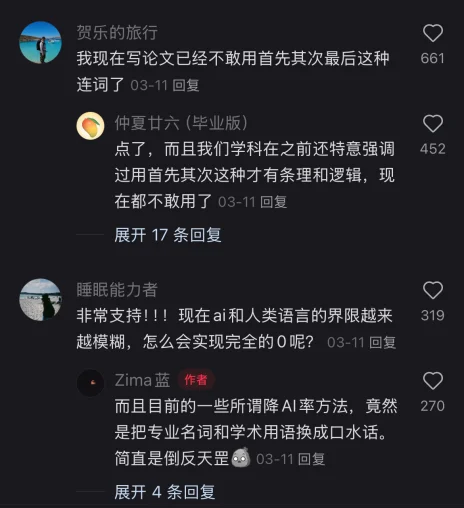
– Delete transitional phrases to “break AI flow”
– Insert typos or grammatical errors to lower scores
– Sacrifice precision for artificial “imperfection”
…then the tool ceases to assess integrity—and begins to corrupt it.
✅ Toward Ethical Integration—Not Technophobic Policing
The future isn’t banning AI—it’s teaching critical co-authorship:
– Train students to document AI use transparently (prompt history, editing logs)
– Assess how ideas are developed—not just who typed them
– Prioritize oral defenses, annotated drafts, and iterative feedback over binary detection scores
After all: Writing is thinking made visible. No algorithm should obscure that truth.
Source: Adapted from APPSO | Images sourced from AITNT News archives.