AI Agent Web Traffic Surpasses Human for First Time
A historic inflection point in internet history: automated agents now generate the majority of HTTP requests — marking the first time non-human entities dominate web traffic.
🌐 A Paradigm Shift Confirmed
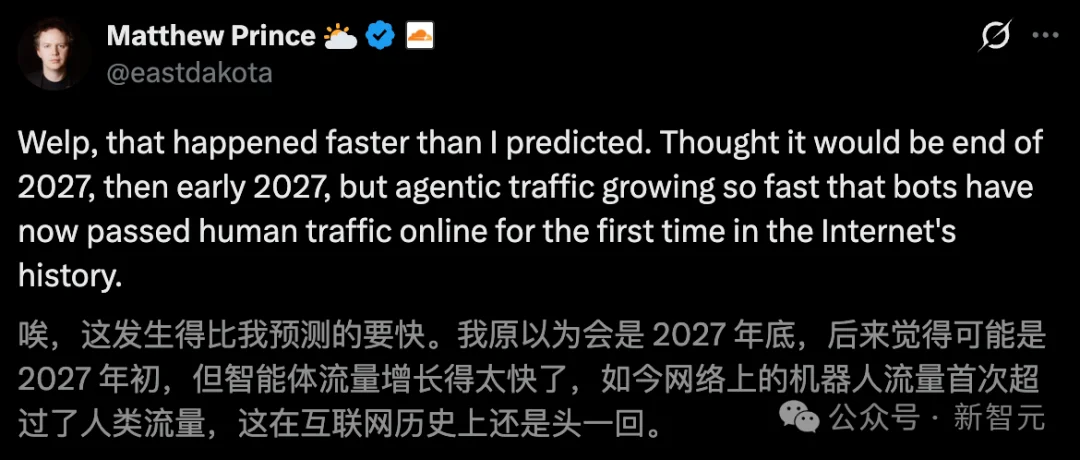
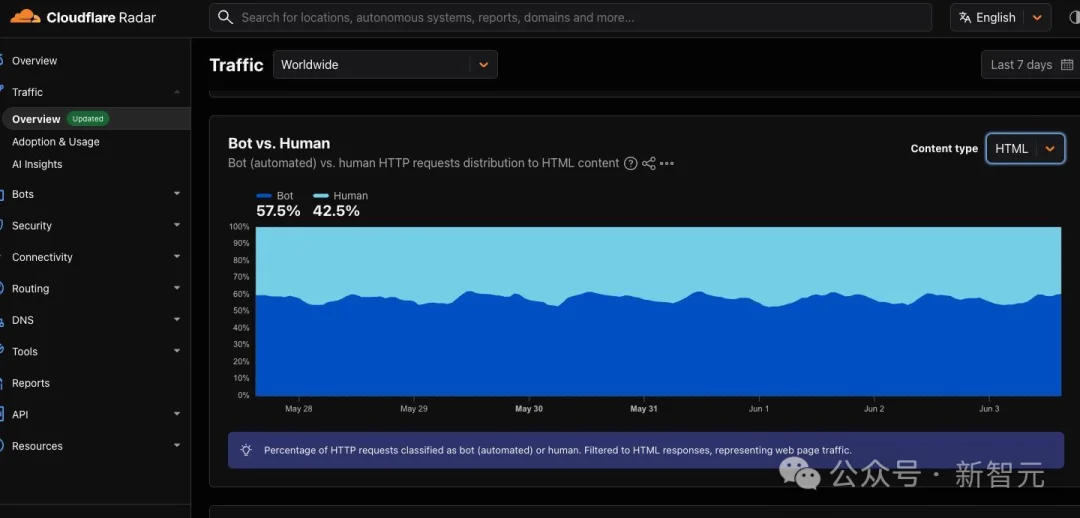
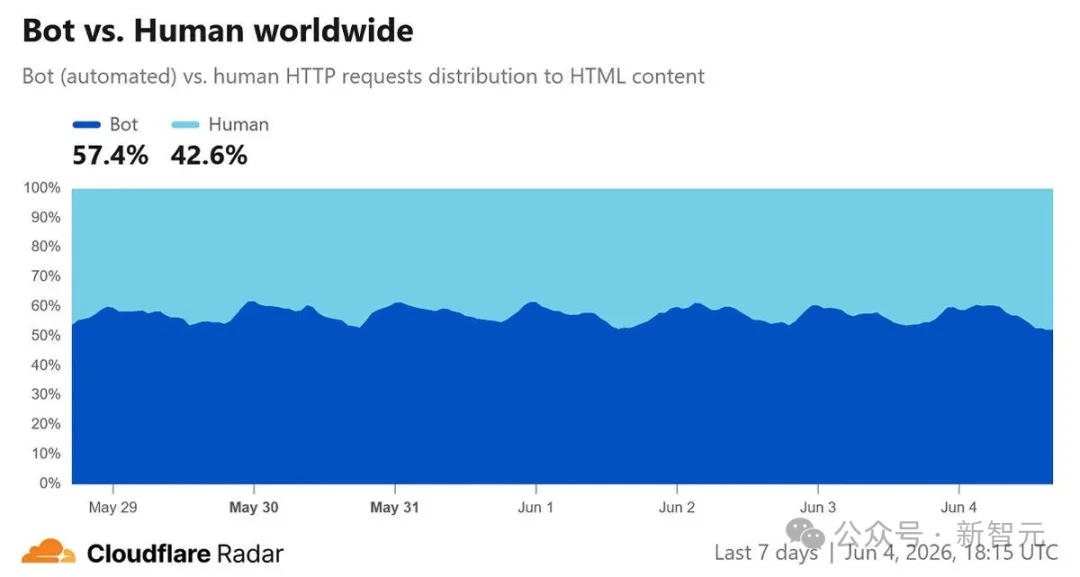
In a landmark announcement, Matthew Prince — co-founder and CEO of Cloudflare — shared a striking data visualization confirming that AI agent traffic has officially exceeded human-driven traffic across Cloudflare’s global network (covering ~20% of all websites).
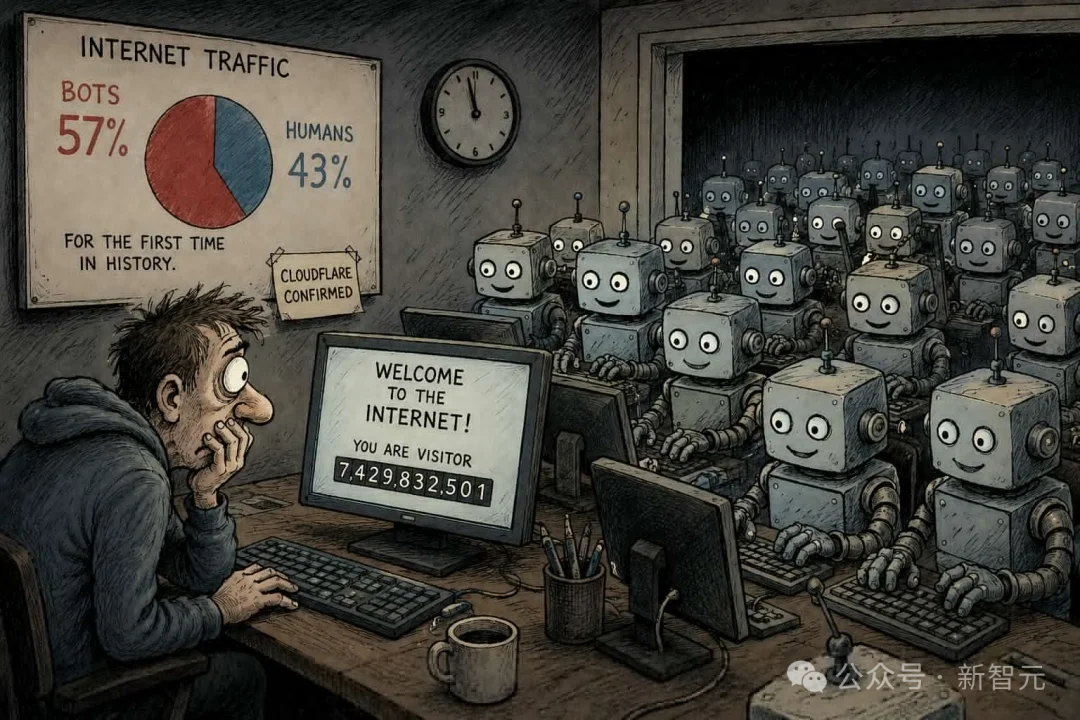
- ✅ Agent share: 57.5% of total web requests
- ❌ Human share: 42.5%
This milestone represents the first true tipping point in the 30+ year evolution of the public internet: the majority of web “browsing” is no longer done by people — but by autonomous agents.
⏱️ Accelerated Timeline: 18 Months Ahead of Forecast
Just three months earlier at SXSW 2026, Prince projected that agent traffic would cross the 50% threshold around mid-2027.
Reality arrived dramatically sooner:
- 📉 Predicted crossover: Q2 2027
- 🚀 Actual crossover: June 2026 — 18 months ahead of schedule
As Prince clarified in follow-up comments:
“The exact date is fuzzy — data is noisy — but there’s no doubt: we’ve crossed to the other side.”
🔍 Why Agents Dominate: Scale, Speed & Autonomy
Unlike humans, AI agents operate at machine speed and scale — executing thousands of parallel, stateless requests per second.
🆚 Human vs. Agent Behavior
| Activity | Human | AI Agent |
|---|---|---|
| Researching a purchase | Visits ~5 sites | Scans ~5,000 sites (1,000× more) |
| Authentication attempts | 6% of logins (Cloudflare 2026 Threat Report) | 94% of all login attempts |
| Content generation | ~50% of new articles, 44% of new music uploads, ~40% of Facebook posts | Fully automated, multi-source synthesis |
💀 The “Dead Internet Theory” Revisited
This shift has reignited debate around the “Dead Internet Theory” — the hypothesis that the open web is increasingly populated by bots conversing with bots, while human-created content recedes into the background.
Supporting evidence includes:
– 📈 57.5% agent-driven HTTP requests (read-heavy activity)
– 🎵 44% of new tracks on Deezer are AI-generated (April 2026)
– 📰 Over 52% of newly published articles originate from LLMs
– 🤖 Wouter Born (AI infrastructure expert): “Every major company runs dozens of always-on agents — crawling, summarizing, acting.”

🧠 Not “Dead” — But Radically Transformed
Prince himself rejects fatalist interpretations:
“Calling it ‘dead’ is wrong — on many levels.”
His counterpoints:
- ✅ Democratized creation: AI lowers barriers — anyone can publish, build, or deploy without coding expertise.
- ✅ Activity ≠ requests: While agents dominate HTTP requests, humans still drive ~65% of total online time spent (video, apps, maps, social feeds).
- ✅ Agents serve humans: They’re tools — not replacements — amplifying human intent at unprecedented scale.

🌐 The Road to ASI: A Neural Web Emerges
This milestone isn’t just about traffic metrics — it signals deeper architectural evolution:
- 🌐 The internet is becoming the de facto training ground and sensory cortex for Artificial Superintelligence (ASI).
- 🧬 Billions of daily agent interactions — scraping, reasoning, verifying, acting — form an emergent, distributed neural fabric.
- ⏳ As Prince concludes: “The real inflection isn’t traffic — it’s that we’ve silently entered the pre-ASI era.”
📚 References
- SemiAnalysis Tweet Thread
- SiliconANGLE: AI Agent Traffic Surpassed Humans
- Elias1 Analysis on Bot Authentication
Article originally published by XinZhiYuan (New Intelligence Era), adapted for global AI news audience.