RSIAgent Enables Open-Source Models to Self-Improve via Autonomous Exploration
A breakthrough in causal AI: No parameter updates needed — just recursive experience scaling.
The Scaling Shift: From Model Parameters to Environmental Experience
For years, large language model (LLM) advancement has been synonymous with Scaling — larger datasets, bigger models, more compute. But as agents evolve from “chatting” to “doing”, a new bottleneck emerges: how do they adapt to unseen digital environments?
When deployed into unfamiliar software, enterprise tools, or custom interfaces, even state-of-the-art models struggle — not due to lack of raw capability, but because they lack causal understanding:
– What action triggers which outcome?
– Which conditions lead to failure?
– How do hidden constraints or edge cases affect execution?
Traditional fine-tuning or RLHF is costly, data-hungry, and often infeasible for private or rapidly changing systems.
So the pivotal question arises:
Can an agent learn without updating its weights — by autonomously exploring, testing, verifying, and internalizing causal knowledge?
Introducing RSIAgent: Autonomous Exploration for Recursive Self-Improvement
Developed by Aether AI, a research lab focused on causal intelligence, RSIAgent proposes a paradigm shift: Scale Experience, not just Parameters.

RSIAgent implements a closed-loop framework — Autonomous Exploration for Recursive Self-Improvement (RSI) — where the agent itself drives learning through four iterative stages:
- Curriculum Generation: Decides what to explore next based on current knowledge gaps.
- Execution: Sends actions into the environment via actor agents.
- Verification: Validates outcomes using real-world feedback (not synthetic labels).
- Memory Evolution: Stores robust action–condition–outcome causal triples into structured, evolvable memory.
This transforms memory from passive storage into an active, reusable causal model of the environment — enabling zero-shot transfer to downstream tasks.
Benchmark Results: Open-Source Models Outperform GPT-6 Astra
Without any model weight updates, RSIAgent significantly boosts open-source foundation models on rigorous agent benchmarks:
| Benchmark | Model + RSIAgent | GPT-6 Astra | Improvement |
|---|---|---|---|
| OSWorld 2.0 (0808 offline) | 78.98% (GLM-5.3/Kimi-K3) | 72.60% | +6.38 pts |
| Agents’ Last Exam (Near-term) | 84.82% (GLM-5.3/Kimi-K3) | 82.26% | +2.56 pts |
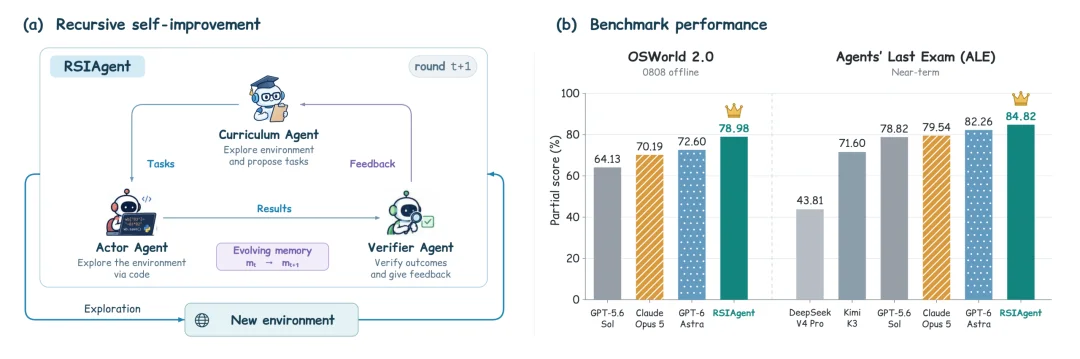
Figure 1|RSIAgent achieves SOTA on OSWorld 2.0 and Agents’ Last Exam — surpassing leading closed-source models.
Two-Stage Recursive Self-Exploration
RSIAgent employs a bi-phasic strategy inspired by pre-training → post-training:
🔹 Broad Recursive Self-Exploration (BRS)
- Goal: Rapidly map the global structure of the environment.
- Mechanism: Curriculum agent generates diverse parallel tasks (e.g., varying tools, inputs, UI paths); multiple actor/verifier agents execute & validate concurrently.
- Outcome: Builds a wide “knowledge map” — covering common workflows, error patterns, and interface logic.
🔹 Deep Recursive Self-Exploration (DRS)
- Goal: Target critical failure modes — hidden constraints, boundary conditions, and rare exceptions.
- Mechanism: Sequential recursion — each failure informs the next harder task. Example: “What breaks when input exceeds 100 chars?” → “What fails at exactly 101 chars under network latency?”
- Outcome: Refines memory with high-precision causal rules — turning fragility into robustness.
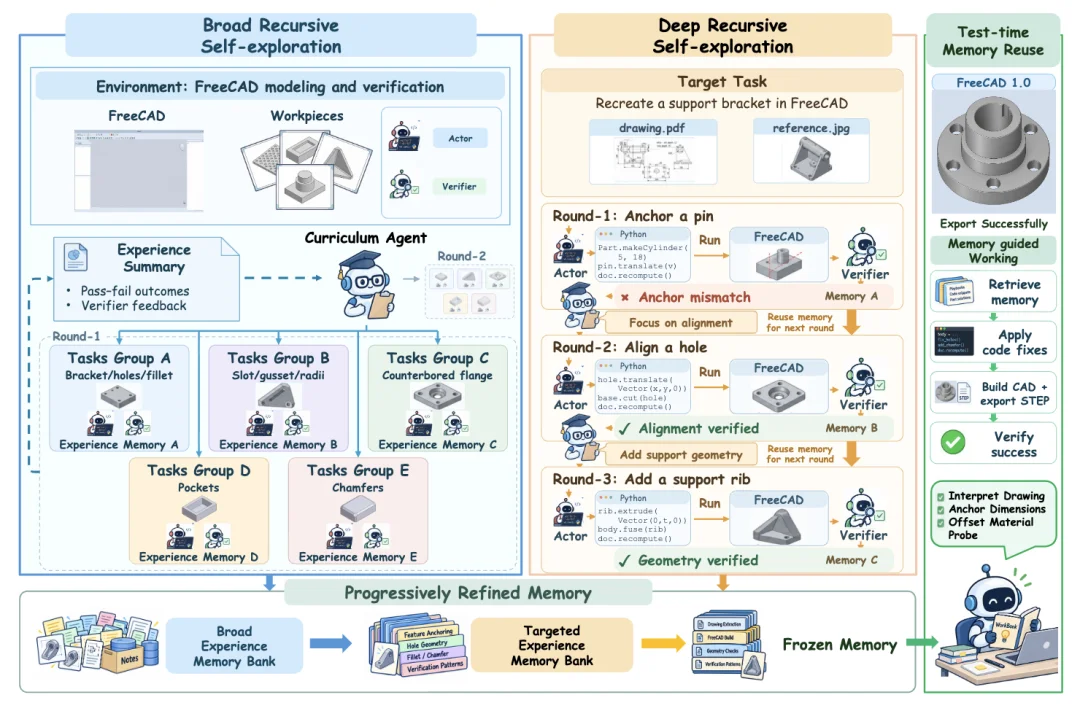
Figure 2|RSIAgent’s dual-phase exploration in FreeCAD: BRS diversifies experience; DRS deepens causal fidelity.
Real-World Validation Across Domains
✅ Software Interaction
- Demonstrated on REAPER audio editor and FreeCAD parametric modeling, with real-time operation playback showing memory evolution.
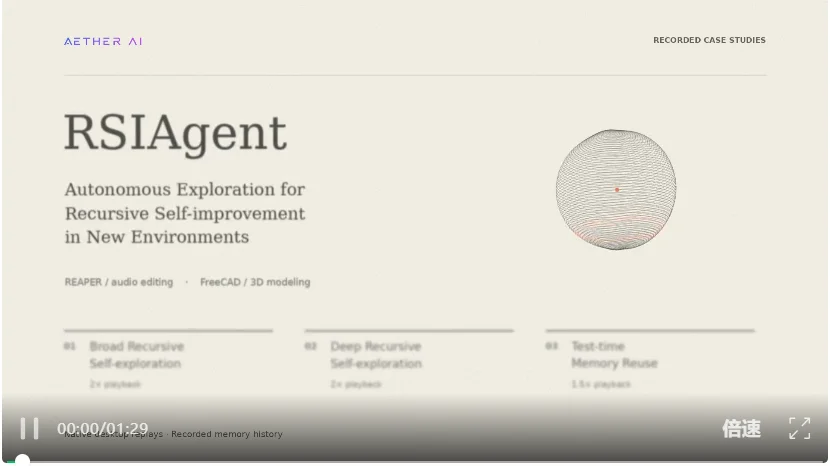
REAPER (left) and FreeCAD (right): Memory evolves during exploration and is reused during inference.
✅ Game Development (GameCraft-Bench)
- Improves mechanics, depth, visuals, and overall quality — proving cross-domain generalizability.
✅ Ablation Studies
- Removing either BRS or DRS degrades performance — confirming their complementary roles in breadth and depth.
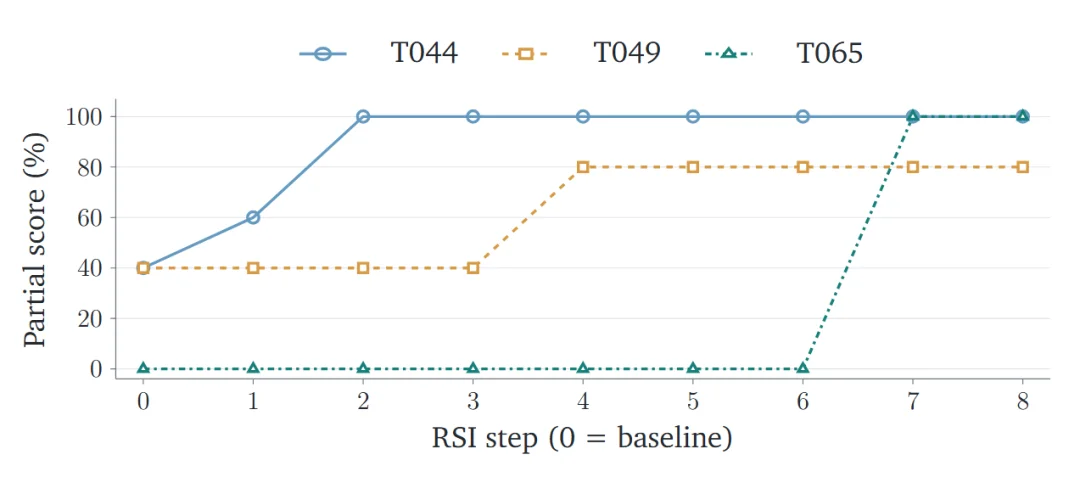
✅ RSI Iteration Curve
- Agent performance improves monotonically with RSI rounds — complex tasks converge slower but reach up to 100% success, mirroring human-like learning curves.
Toward Universal Causal Intelligence
RSIAgent is not an isolated tool — it’s a milestone in Aether AI’s broader vision:
- Causal-Copilot: Discovers which variables truly cause change (beyond correlation).
- C-World: An open-ended environment for causal tool interaction.
- Auto-scaling Continuous Memory: Dynamically grows memory capacity with experience.
- StructAgent: Unifies state, action, and verification under a unified causal graph.
Together, these components advance a unified goal:
Move AI from “What happened?” → “What will happen?” → “Why did it happen — and how do I change it?”
In essence, RSIAgent redefines agent deployment: instead of “train once, deploy forever”, it enables lifelong, self-directed, causal learning in situ — paving the way for truly adaptive, general-purpose digital agents.
📚 Key Resources
- Paper: RSIAgent: Autonomous Exploration for Recursive Self-improvement in New Environments
- Code: github.com/AetherLabsAI/RSIAgent
- Demo Site: aetherlabsai.github.io/RSIAgent/
Original article by Machine Heart Editorial Team.