MetaRSI-v1 Launches Square-Era Recursive Self-Improvement
In a paradigm-shifting advance for artificial intelligence, the CosmosMind research collective—jointly backed by Stanford, MIT, UC Berkeley, Tsinghua, and Peking University—has unveiled MetaRSI-v1, the world’s first unified meta-recursive architecture for Recursive Self-Improvement (RSI).
This breakthrough transcends conventional RSI systems by enabling AI models to improve the process of self-improvement itself—ushering in what researchers term the “square era” (RSI²): recursion applied not just to capability, but to the improvement mechanism.
🌐 What Is RSI²?
Traditional RSI systems rely on static, single-axis loops—e.g., generating synthetic data (Data-RSI), refining prompts (Harness-RSI), or updating weights (Model-RSI). MetaRSI-v1 unifies all three into a single, dynamic framework governed by the Loop Kernel: a model-agnostic, feedback-driven闭环 that:
- Consumes learning signals from execution traces and external validation,
- Proposes modifications across Data, Harness, and Model spaces,
- Routes proposals through a validator,
- Feeds verified improvements back as next-cycle signals.
✅ Key innovation: Data, Harness, and Model are now interchangeable instances of the same kernel—enabling composition, scheduling, and reuse at the architectural level.
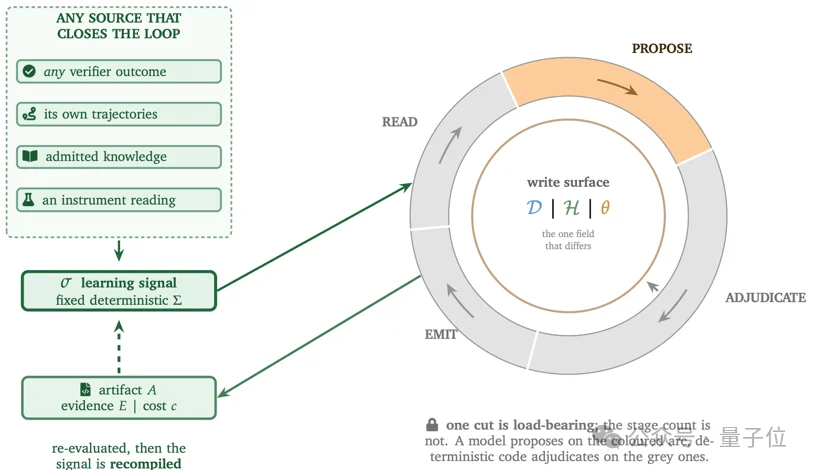
△ Loop Kernel: The universal self-improvement scaffold
🔁 Three Unified RSI Dimensions
| Dimension | Function | Key Innovation |
|---|---|---|
| Data-RSI | Extracts & validates learning signals from model behavior → synthesizes high-fidelity training data | Acts as a capability boundary detector and amplifier, precisely mapping positive/negative capability limits |
| Harness-RSI | Dynamically reconfigures System Prompt, Skills, MCP, Tools, and Memory slots | Performs addition AND subtraction: removes redundant knowledge once internalized into the model |
| Model-RSI | Updates parameters and architecture via training | Internalizes repeatedly validated behaviors—turning transient improvements into permanent capability |
All three operate under shared Loop Kernel semantics—and feed forward/backward in a closed loop.
⚙️ Dual-Axis Orchestration
MetaRSI-v1 introduces two orthogonal optimization axes:
- Horizontal Orchestration: An RSI² Agent selects which operator (Data/Harness/Model) executes next, based on real-time signal strength and validation outcomes.
- Vertical Optimization: An RSI² Sub-Agent rewrites the RSI rules themselves, adapting how each operator generates, validates, or applies improvements.
This dual control enables adaptive, context-aware self-evolution—no hardcoded sequences, no fixed schedules.
🧠 Four-Agent Meta-Architecture
The system orchestrates four specialized agents:
- MetaRSI² Agent: Learns optimal horizontal/vertical policy selection — improving the RSI² Agent itself.
- RSI² Agent: Decides per-step whether to orchestrate (horizontal) or optimize (vertical).
- RSI² Sub-Agent: Executes vertical optimization—e.g., rewriting Harness-RSI’s prompt-generation logic based on failure analysis.
- Transition Agent: Seamlessly bridges outputs of one operator to inputs of the next (e.g., synthesized data → fine-tuning dataset format).
✅ All agents support human-in-the-loop integration—experts can replace or supervise any component.
📈 Empirical Results
▸ Small-Model Self-Evolution
Using Qwen3.5-35B-A3B (3.5B active params), MetaRSI-v1 achieved:
– +10.9 avg. points across Terminal-Bench 2.1, SWE-bench Pro, GPQA-Diamond, and AIME,
– Near-doubling of SWE-bench Pro resolution rate,
– Significant cumulative gain over successive RSI cycles.
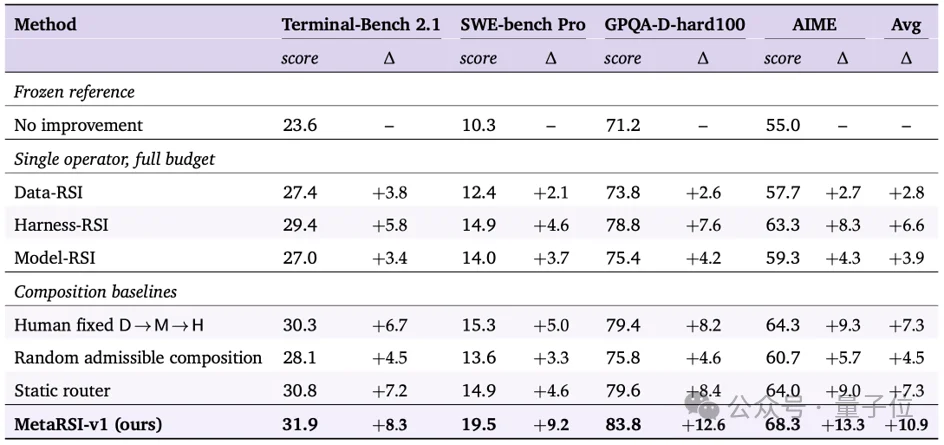
△ MetaRSI drives sustained, compounding self-improvement
▸ Frontier-Model Enhancement
Applied without weight access (via API-only interaction) to six state-of-the-art models—including GPT-5.6, Claude Opus 5, and Kimi K3—MetaRSI-v1 delivered:
– +7.3 avg. points on Terminal-Bench 2.1,
– Proof that even top-tier closed models retain substantial untapped self-improvement headroom.
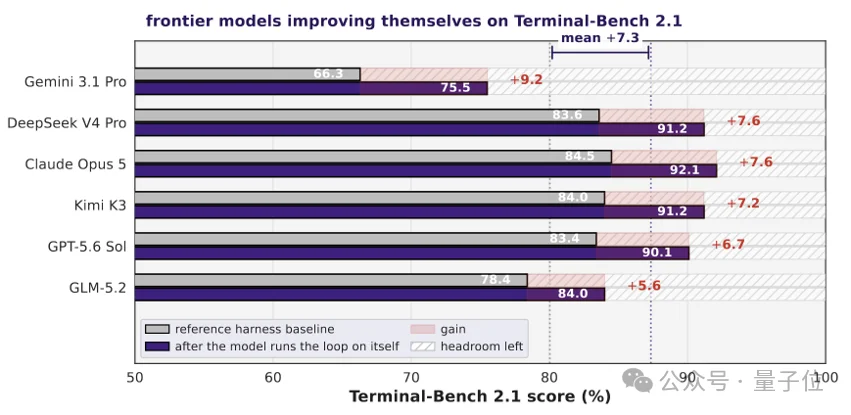
△ Six frontier models enhanced via Harness + Data RSI only
📜 Five Foundational Laws of Machine Progress
MetaRSI formalizes principles governing reliable, scalable self-improvement:
- Verification Law: Self-improvement loops are bounded by verifiability—no verifier, no recursion.
- Boundary Recalibration Law: Self-knowledge decays; re-measuring capability boundaries is the dominant bottleneck.
- Carrier Independence Law: Capability is abstract—but cost depends on carrier (Harness = per-inference cost; Model = one-time cost).
- Write-Proofness Law: Trustworthiness is measured by immutable surfaces—elements the system cannot rewrite (e.g., verifier logic, hardware constraints).
- Entropy Law: No free capability—every gain reflects either external information injection or latent potential activation.
🌍 Beyond AI: Toward Physical-World Evolution Loops
CosmosMind is extending MetaRSI into robotics and lab automation:
– Programmable instruments and autonomous labs serve as executors and validators,
– Simulation → benchtop testing → real-world deployment forms a staged verification rocket,
– First irreversible physical-world RSI loop is expected to emerge inside fully automated laboratories.
“Human researchers define problems and values. Machines close the hypothesis-to-validation loop—faster than ever imagined.”
🔗 Open Resources
- 🌐 CosmosMind Official Site
- 💾 RSI-Harness (Open Source)
- 📄 Paper (arXiv:2609.06396)
- 📚 MetaRSI-v1 Technical Report
- 🤗 Hugging Face Hub
Article originally published by QuantumBit, author: Yun Zhong.