SenseNova-Vision: SenseTime Open-Sources Unified Vision Foundation Model
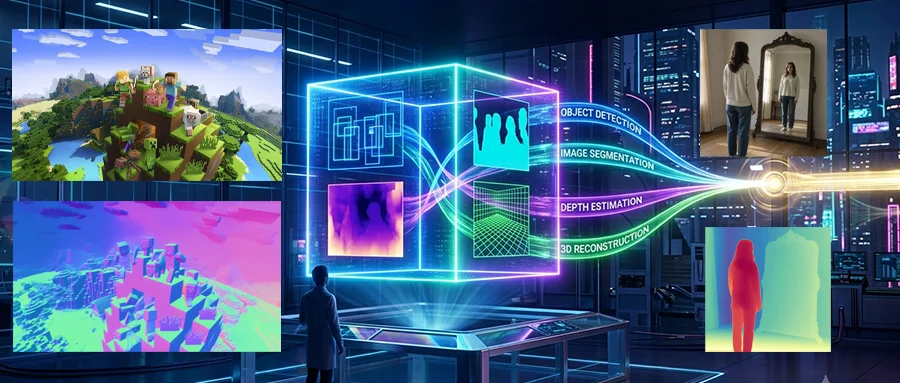
Zero-shot comprehension of complex game environments — no fine-tuning required.
🌟 Global Leadership Confirmed: #1 on Hugging Face Any-to-Any Leaderboard
SenseTime has officially open-sourced SenseNova-Vision, its groundbreaking unified vision foundation model — a single, multimodal architecture capable of simultaneous understanding and generation across diverse visual tasks. The model has achieved top rank globally on the Hugging Face Any-to-Any Leaderboard, setting a new benchmark for open-source, full-modality vision AI.
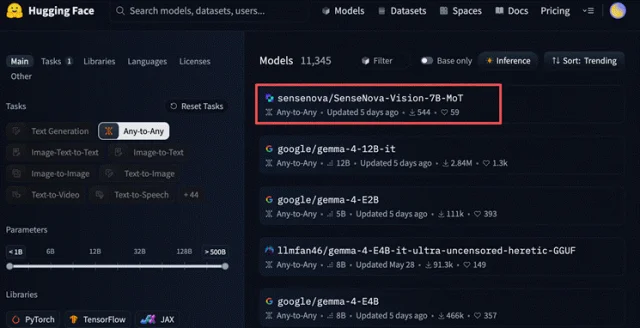
▲ SenseNova-Vision leads all open-source models on Hugging Face’s Any-to-Any benchmark.
🔍 Beyond the “Frankenstein Era”: A Unified Visual Intelligence Paradigm
Historically, computer vision relied on fragmented, task-specific models — separate architectures for object detection, semantic segmentation, depth estimation, and 3D reconstruction. This “model salad” approach created siloed systems ill-suited for real-world complexity.
SenseNova-Vision dismantles those walls. It unifies vision capabilities under a single generative framework — treating every visual task as a structured multimodal output generation problem. This enables:
✅ Native spatial reasoning — built-in geometric awareness from day one
✅ Natural language task definition — developers describe new tasks in plain English
✅ Cross-task knowledge transfer — shared representations boost performance across domains
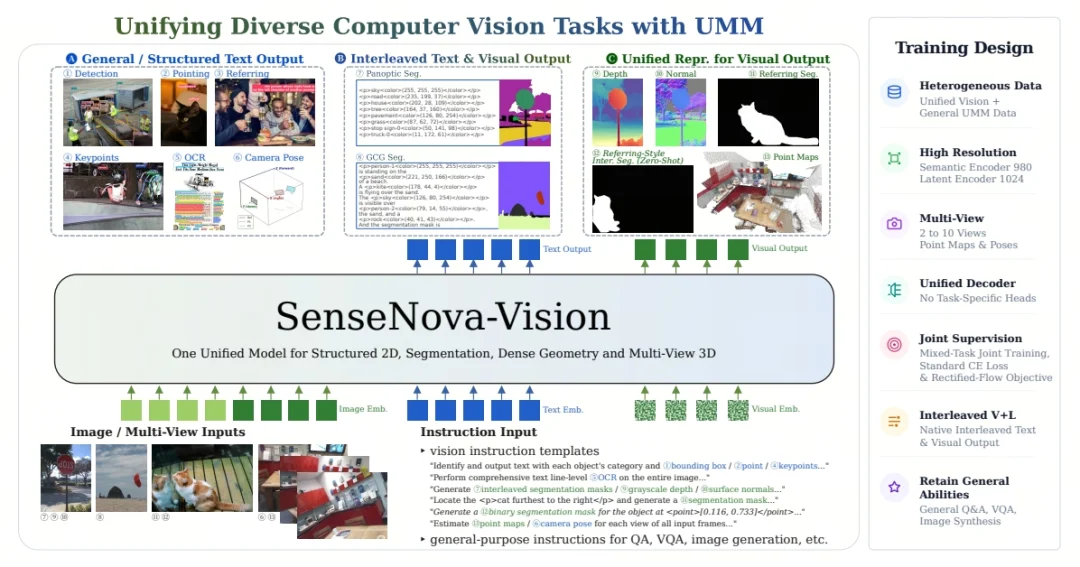
▲ End-to-end unified architecture: one backbone, one training objective, multiple outputs.
🚀 Four Core Capabilities — One Model, Zero Compromise
SenseNova-Vision delivers state-of-the-art performance across four foundational vision domains — outperforming specialized models and international peers like Vision Banana and Youtu-VL:
| Task | Key Strength | Real-World Impact |
|---|---|---|
| Structured Understanding | Zero-shot scene parsing (e.g., Minecraft) | Rapid deployment for game engines & AR content pipelines |
| Dense Geometry Prediction | Sub-pixel surface normal estimation | Precise robotics navigation & industrial metrology |
| Instance Segmentation | Ultra-dense, occlusion-aware separation | Smart warehousing, precision agriculture, defect inspection |
| Multi-view 3D Geometry | Mirror-aware 3D reconstruction | Autonomous vehicle perception, virtual production, digital twin creation |
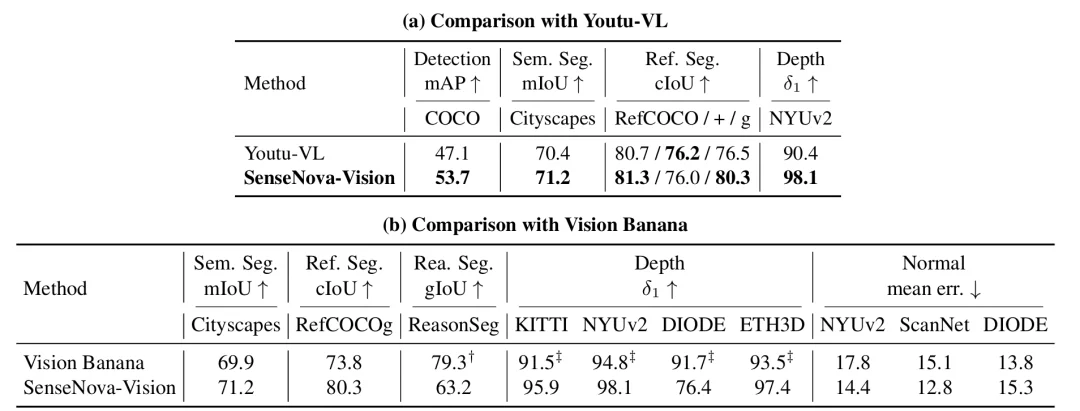
▲ Consistent superiority across key metrics — AP, mIoU, RMSE, Chamfer Distance.
🎮 1. Zero-Shot Minecraft Comprehension
Without any fine-tuning or domain adaptation, SenseNova-Vision instantly parses procedurally generated Minecraft worlds — simultaneously detecting objects, segmenting instances, and estimating surface normals.
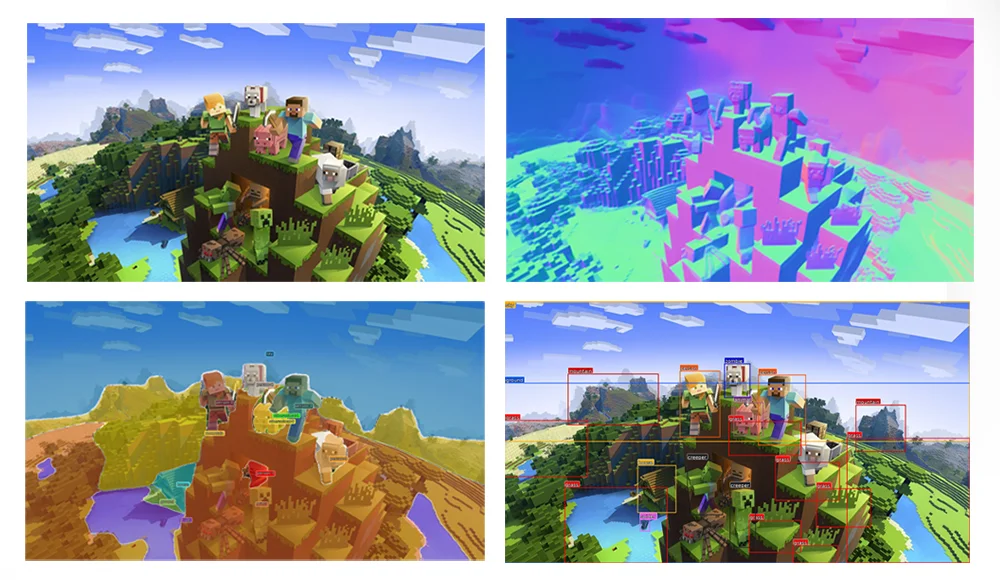
▲ Full-stack analysis of unseen synthetic environments — ready for creative workflows.
🏗️ 2. Surgical-Grade Dense Object Separation
In ultra-crowded industrial scenes — steel pipes, rebar bundles, tangled wires — the model delivers pixel-perfect instance masks, even when colors, textures, and depths overlap severely.
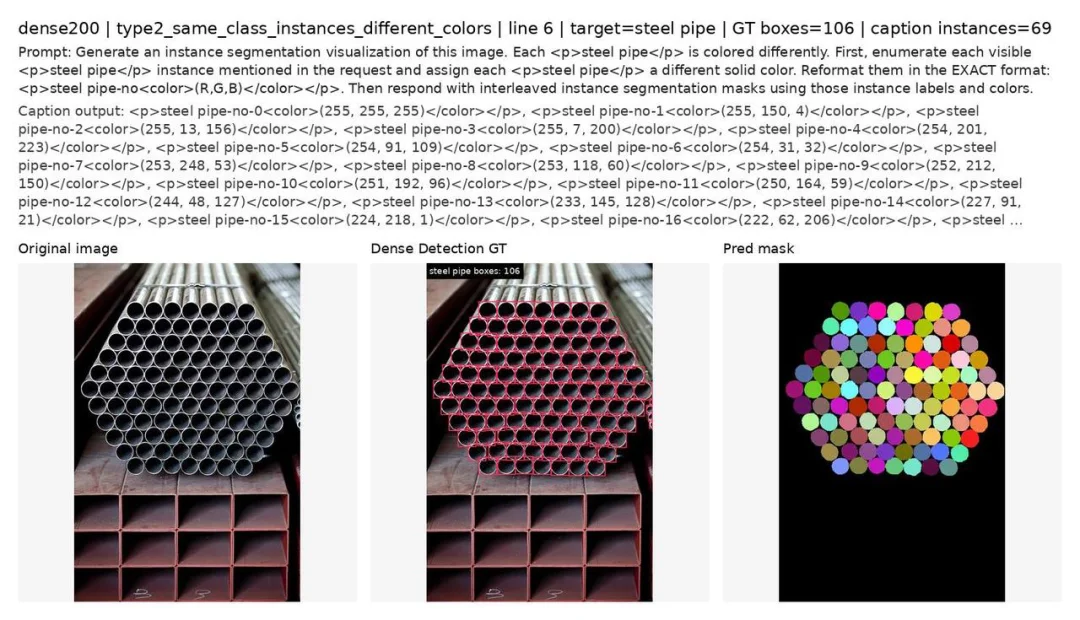
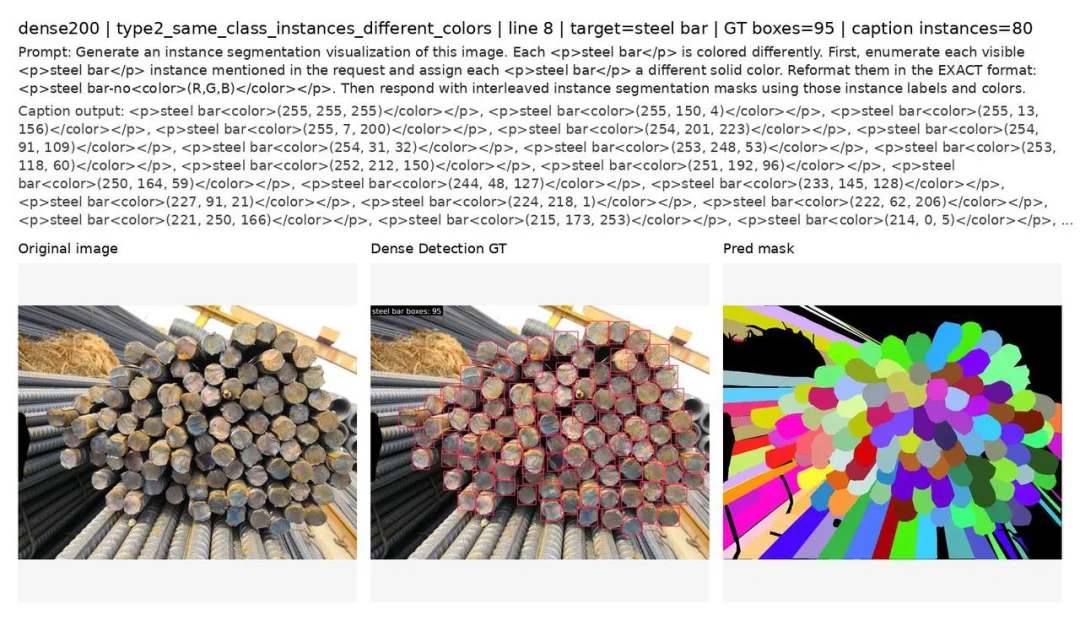
▲ Distinguishes individual elements amid severe occlusion and background noise.
🪞 3. Immune to Visual Illusions
Faced with optical illusions (forced perspective, ambiguous depth cues), SenseNova-Vision maintains physically consistent 3D interpretations — correctly estimating geometry despite deceptive 2D patterns.
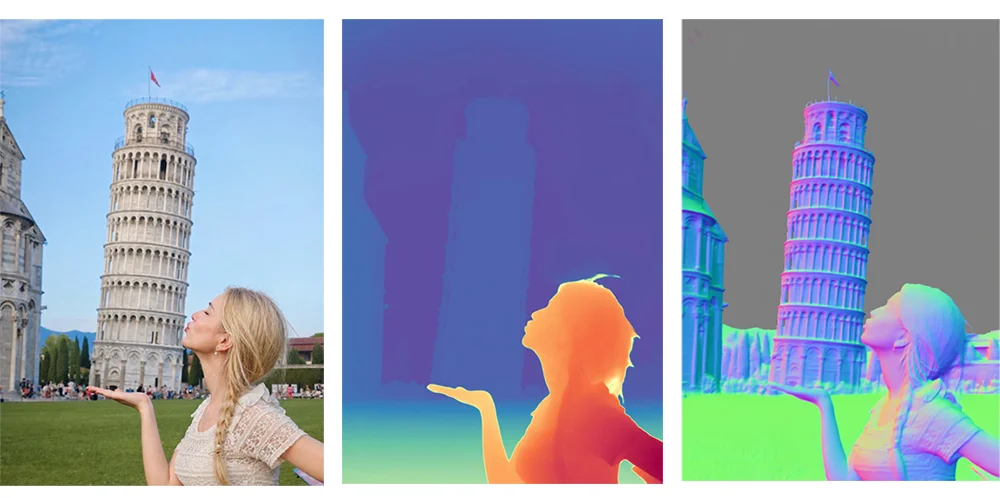
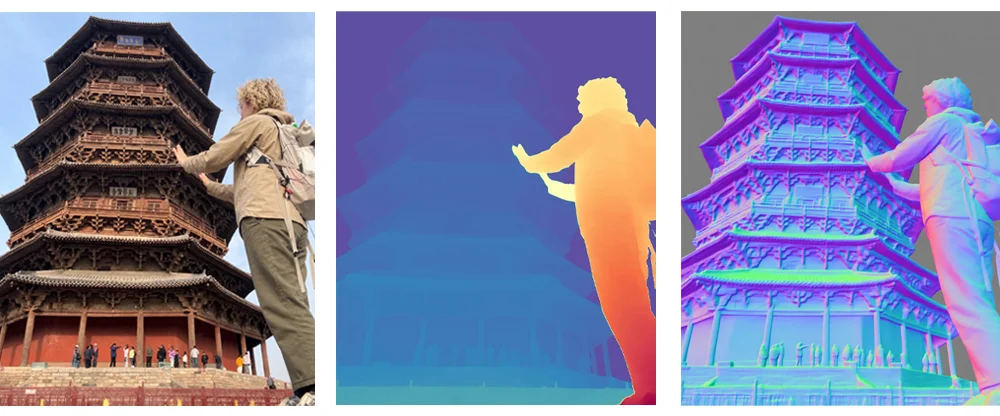
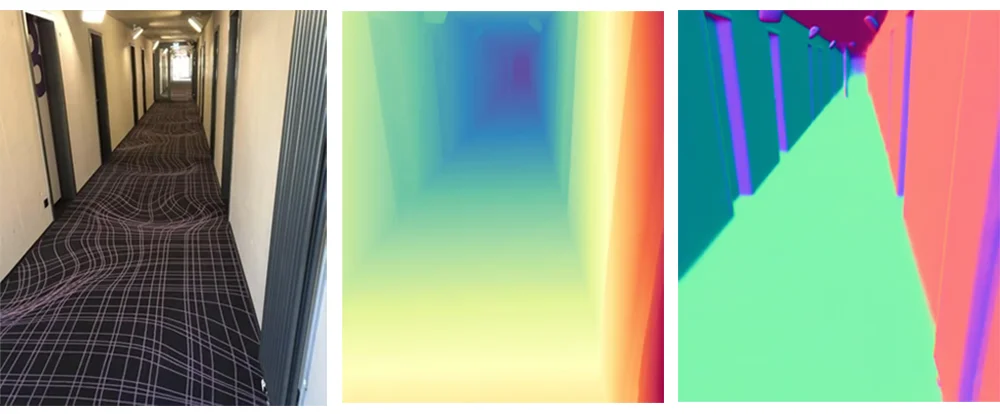
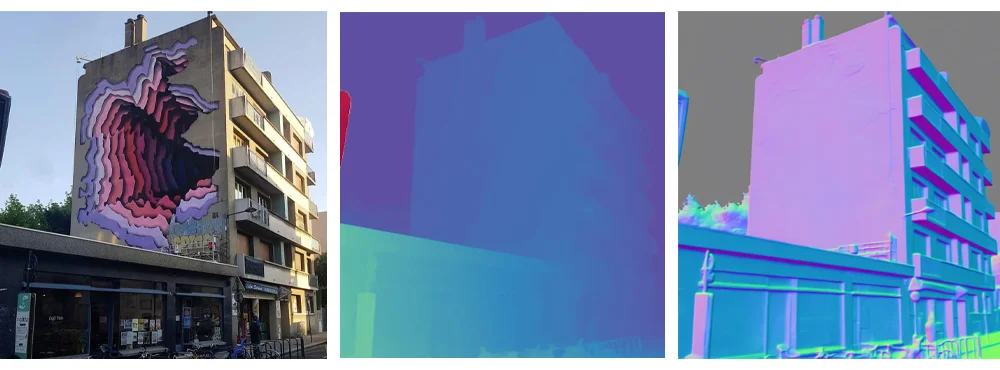
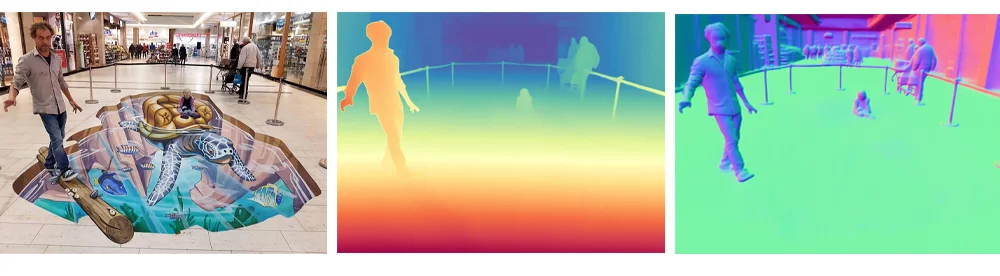
▲ Unbroken geometric consistency — no hallucination, no deception.
🪞 4. Seeing Through Mirrors
In reflective indoor environments (mirrors, glass partitions), SenseNova-Vision disentangles real and reflected geometry — accurately estimating depth and orientation behind the reflective surface.
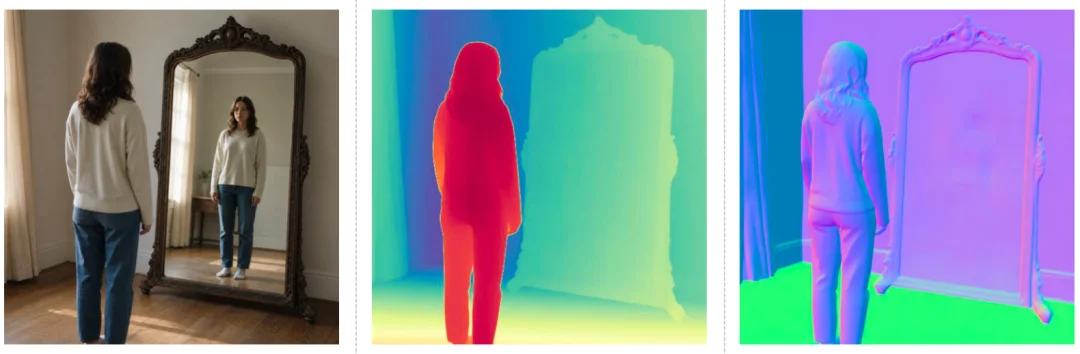
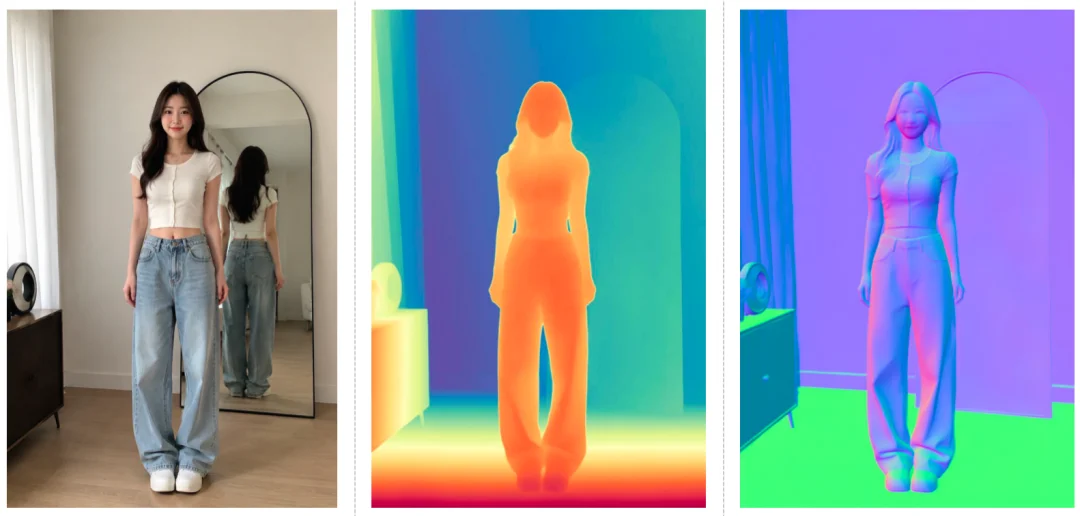
▲ Physics-aware perception: distinguishing virtual from physical space.
🧱 From Project-Based Pipelines to Vision Infrastructure
SenseNova-Vision shifts the industry paradigm:
🔹 Before: One model per task → high maintenance, low reuse, slow iteration
🔹 Now: One model for all core vision tasks → faster R&D, lower TCO, scalable deployment
Backed by 10 years of market-leading visual AI expertise, SenseTime trained SenseNova-Vision on proprietary industrial data spanning autonomous driving, smart manufacturing, and retail analytics — now distilled into an open ecosystem.
📦 Fully Open Ecosystem
- ✅ Model weights (7B MoT variant)
- ✅ Training code & recipes
- ✅ 50 million high-quality open visual instruction pairs
- ✅ End-to-end reproducibility scripts (including data preprocessing & fine-tuning)
🔗 Access Everything:
– Hugging Face Collection
– GitHub Repository
– ModelScope Hub
– Technical Report (arXiv)
🌍 Toward AGI: Vision as a Native Cognitive Modality
“Vision isn’t just another modality — it’s the gateway to physical world intelligence.”
SenseNova-Vision represents more than engineering progress. It signals a strategic integration of decades of computer vision research into the AGI stack — transforming vision from an auxiliary capability into a first-class, generative, reasoning-native component of foundation models.
This is the beginning of vision’s “Great Navigation Era”: where AI doesn’t just see, but understands space, physics, and intent — enabling next-generation robotics, embodied agents, and real-world AI infrastructure.
Article adapted from original reporting by “Zhi Dong Xi”, published July 16, 2026.