Lingchu Intelligence Raises $200M for Human-Centric Embodied AI
The future of embodied intelligence isn’t in the robot—it’s in the human.
Breakthrough Funding & Strategic Backing
Lingchu Intelligence, a pioneering embodied AI startup founded by post-00s talent and industry veterans, has secured approximately $200 million in combined angel and Pre-A funding, marking one of the largest early-stage capital raises in China’s robotics sector.
Capital Composition
- Angel Round: Led by national-tier institutional investors including:
- China Development Bank Capital (CDB Capital)
- China Zhong Investment (Guozhong Capital)
- CCTV Media Integration Industry Investment Fund
- Strategic investment arm of a multi-billion-dollar listed company
- Changfei Fiber Optic Investment Fund
-
Wodell Capital, Yuansheng Venture Capital, Zhuhai Science & Technology Industry Group, Junshan Investment, Yanyuan Venture Capital, Dami Capital, Wo Fu Capital, Binfu Capital, and Taihe Capital.
-
Pre-A Round: Co-led by Xuhui Capital (Shanghai SASAC), with participation from:
- Liangxi Sci-Tech Industry Phase II Mother Fund (managed by Bohua Capital)
- Wuxi Industrial Investment Group (Wuxi VC)
- Pufeng Capital, Timeng Capital, and multiple existing investors with oversubscribed follow-ons.
💡 Huaxing Capital serves as Lingchu’s long-term financial advisor.
This capital will accelerate Lingchu’s large-scale deployment in logistics environments and the construction of its proprietary human-native data infrastructure.
The Founding Team: Experience Meets Next-Gen Vision
| Role | Profile |
|---|---|
| CEO & Founder — Qibin Wang | 20-year veteran in consumer robotics and smart hardware; ex-executive at BlackBerry, Sonos, and CloudMinds. Deep expertise in product strategy and industrial scaling. |
| Co-Founder — Yuanpei Chen | Post-00s researcher; Ph.D. candidate at Peking University’s AI Institute under RL pioneer Prof. Yaodong Yang; former Stanford collaborator with Prof. Fei-Fei Li. Declined Huawei’s “Genius Youth” offer to pursue foundational embodied AI research. |
Paradigm Shift: From Robot-Centric to Human-Centric Data
Lingchu challenges prevailing industry assumptions—rejecting costly robot teleoperation and simulation-based data collection in favor of true human-origin data.
Why Existing Data Pipelines Fall Short
- 🚫 Simulation-to-Real Gap: Especially severe for deformable objects (e.g., fabrics), limiting generalization.
- 🚫 Teleoperation Scalability: Fragmented pilots → high labor cost, low data density, poor coverage of real-world physical distributions.
- 🚫 Hardware-Locked Data: Data collected on one robot platform cannot be reused across others—creating siloed, non-transferable ecosystems.
“UMI devices are a beautiful trap. Capturing only gripper data locks models into narrow robotic morphologies—like reducing a 21-DOF human hand to a binary ‘open/close’ claw.” — Yuanpei Chen
Psi-SynEngine: World’s First Human-Native Embodied Data Platform
Lingchu unveiled Psi-SynEngine, a full-stack, self-developed data acquisition system designed to capture what humans do—not how robots mimic.
Core Components & Advantages

- ✅ Wearable Tactile Exoskeleton Glove: Captures 21 joint DOFs + full-hand tactile feedback, fully non-intrusive during worker operations.
- ✅ Multi-Modal Synchronization: Records head-mounted & hand-held visual streams, tactile signals, motion trajectories, and verbal instructions—enabling precise multimodal alignment for pretraining.
- ✅ Cost Efficiency: Data acquisition cost is just 10% of traditional teleoperation (per Qibin Wang).
- ✅ Cross-Platform Transfer: Leverages world-model-guided reinforcement learning to map human motions onto diverse dexterous hands—bridging the Embodiment Gap.

“Robots evolve. Grippers change. But the human hand remains constant.” — Yuanpei Chen
Beyond Data: Selling the “Working Brain”, Not the Shovel
Lingchu doesn’t sell sensors or raw data—it sells generalizable, transferable operational intelligence.
The Model-Driven Data Flywheel
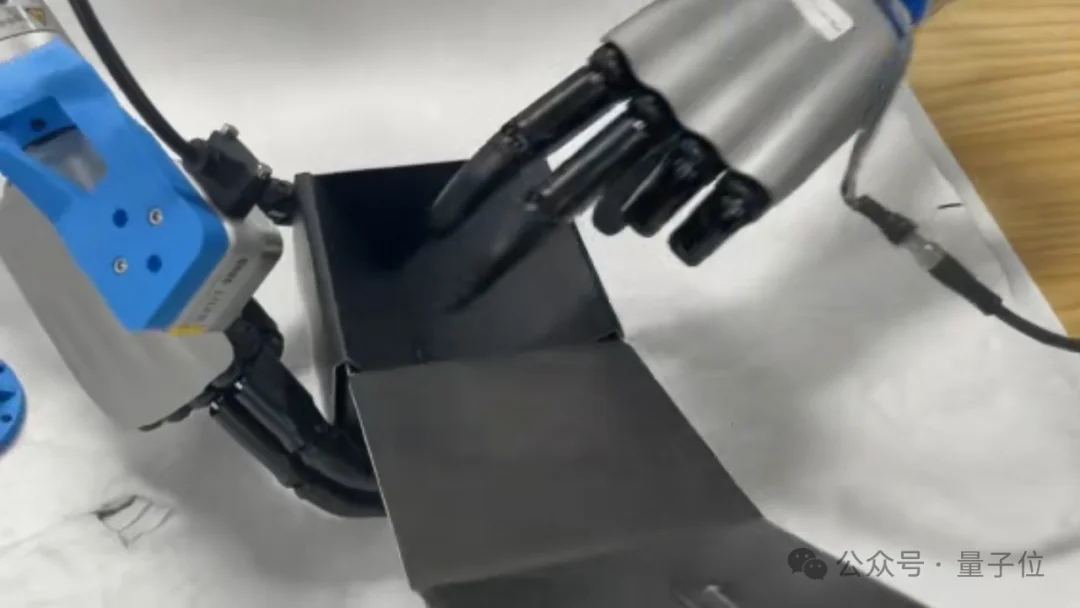
- 🔁 Step 1: Validate model capabilities via targeted tasks → identify which data truly matters.
- 🔁 Step 2: Build scalable acquisition systems only for those high-value signals.
- 🔁 Step 3: Continuously refine annotation schemas, collection protocols, and data structures based on model performance feedback.
This closed loop transforms static “raw material” into a living, evolving asset—tightly coupled to model objectives.
Focused Execution: Precision Over Hype
While peers chase grand narratives (“full-scene generalization”), Lingchu deliberately targets high-complexity, high-flexibility micro-tasks, such as:
- 👕 Garment feeding & packing: Achieves >1,000-item generalization, operating at 800 UPH (Units Per Hour).
- 📦 In-box inspection: Handles irregular, soft, and occluded items with robust tactile feedback integration.

This approach generates dense, high-signal problem sets—fuel for next-generation model evolution.
Strategic Full-Stack: Control Where It Counts
Lingchu adopts a principled full-stack philosophy:
| Component | Strategy | Rationale |
|---|---|---|
| Tactile Gloves & Dexterous Hands | ✅ Fully self-developed | Off-the-shelf solutions lack required precision in current-loop control and scalability for mass data collection. |
| Mobile Base / Wheels | ⚙️ Custom OEM partnership | Mature, commoditized domain—no core capability risk. Avoids resource dilution. |

“We build what’s strategically essential. We integrate what’s universally sufficient.” — Qibin Wang
Lingchu positions itself not as a robot vendor—but as a ‘Dexterous Operation Brain’ company: owning core algorithms and data pipelines while keeping hardware interfaces open for scenario-specific adaptation.

Valuation Surge & Industry Signal
- Lingchu’s valuation has surged 6–7× over the past year, signaling strong investor confidence in its differentiated path.
- Capital composition reflects broad consensus: national funds, provincial SOEs, telecom/optical leaders (e.g., Changfei), and top-tier VCs are all betting on embodied data infrastructure as the new bottleneck.

In embodied AI, time—not money—is the scarcest currency. Early access to rich, real-world task data compounds advantage exponentially. Lingchu’s flywheel is now spinning—and accelerating.
Article originally published by Quantum位 (QbitAI); author: Yun Zhong.