“Compared to Writing Python, My Engineers Prefer Building Agents” — Jensen Huang’s 26-Minute Vision for the AI-Native Enterprise
“When you need to augment your intelligence, don’t call a third party — do it internally.”
In a landmark 26-minute dialogue with Harrison Chase, CEO and co-founder of LangChain, NVIDIA CEO Jensen Huang shifted focus away from GPUs and next-gen chips — and placed intelligent agents at the center of enterprise evolution. This isn’t just about AI adoption; it’s about redefining corporate infrastructure.
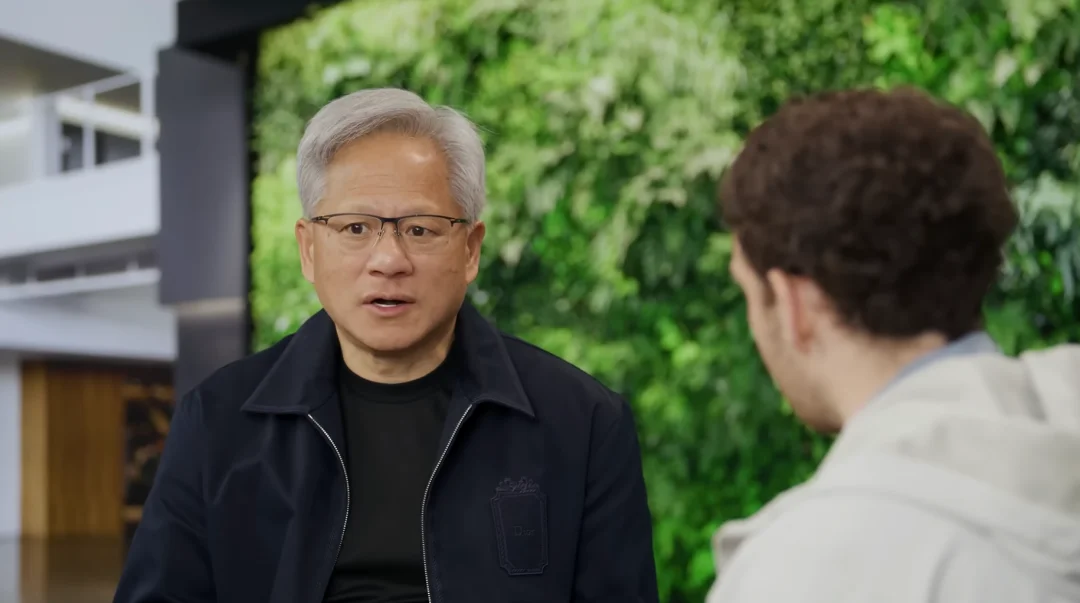
Full video: https://www.youtube.com/watch?v=Yy3JH6dDugc
🔑 Core Thesis: The Rise of the Harness
Huang declared a paradigm shift:
“Today’s companies are built on business processes. Tomorrow’s will be built on Harness.”
A Harness — not a model alone — is the full-stack system wrapping an LLM: tool orchestration, memory management, RAG augmentation, security guardrails, domain-specific knowledge injection, and iterative self-improvement capabilities. It transforms generic intelligence into proprietary, task-optimized super agents.
Why Harness Matters
- 🧠 Intelligence ≠ Model Alone: A world-class model (e.g., Nemotron-3-Ultra) only becomes mission-critical when anchored in proprietary data and workflows via Harness.
- 🛠️ Control & Ownership: “Outsourcing core intelligence makes no sense — for individuals, companies, or nations.”
- ⚙️ Iterative Evolution: Harness enables continuous fine-tuning, prompt optimization, tool-swapping, and even post-training — all within your secure environment.
🚀 Key Insights from the Dialogue
✅ Open Weights = Frontier Performance at 1/10th Cost
- Open-weight models (e.g., Nemotron-3-Ultra) now match top closed models (Claude Opus, DeepSeek) in benchmark accuracy (86% vs. 87%) — but cost one-tenth to run.
- Cost reduction unlocks massive search-space iteration: cheaper inference → more experiments → better answers.
✅ Start with Frontier Models — Then Specialize
- Huang’s workflow: “I always start with the most capable model — it shows me the ceiling.”
- Once baseline capability is proven, layer on domain-specific Harness to build super agents:
- Supply-chain optimizer (NVIDIA internal)
- Chip-design assistant
- Legal compliance auditor
- These aren’t general-purpose assistants — they’re autonomous, tool-connected, knowledge-anchored specialists.
✅ The New Corporate OS Is Open & Agent-Centric
- LangChain + DeepAgents + Nemotron + NIM (NVIDIA Inference Microservice) forms a complete, secure, deployable stack.
- Blueprints accelerate time-to-value — pre-integrated components for RAG, evaluation, safety, and runtime sandboxing.
✅ Security Isn’t Optional — It’s HR for AI
- Just as employees get role-based access, AI agents require granular permissions:
- Data scope (e.g., “only Q3 financial reports”)
- Tool entitlements (e.g., “can query ERP, but not modify payroll”)
- Network segmentation & IT-managed sandboxing
- “You wouldn’t give every employee admin rights. Why would you do it for AI?”
✅ Engineers Are Becoming Agent Architects
- At NVIDIA, software engineers now prefer building agents over writing Python scripts.
- Their new roles: designing evaluation systems, crafting guardrails, curating knowledge graphs, and engineering agent-to-agent collaboration.
- “Writing code is typing. Building agents is systems engineering — creating automation that thinks, acts, and learns.”
🌐 The Open Stack Imperative
Huang reaffirmed NVIDIA’s commitment to open ecosystems:
“Foundational models belong in the cloud — universal, accessible, and commoditized. But your specialized intelligence? That must be built, owned, and evolved in-house — using open tools.”
This dual-layer vision ensures:
– 🌍 Global accessibility of base intelligence
– 🏢 Enterprise sovereignty over proprietary workflows
– 🧩 Interoperability across frameworks (LangChain, NIM, RAGFlow, Dify, etc.)
🔮 Looking Ahead: Beyond Automation
The final frontier isn’t just replacing tasks — it’s enabling previously impossible outcomes:
- Doctors co-piloting with diagnostic agents trained on institutional patient histories
- Designers iterating photorealistic prototypes in seconds using multimodal agents
- Scientists simulating molecular interactions across billion-parameter parameter spaces
As Huang concluded: “Ambition — 100% agency — is the catalyst. The tools are ready. Now build your super agents.”
Source: CSDN | Published: July 14, 2026