EgoVerse Launches Global Embodied Human Data Standard
In 2009, Fei-Fei Li’s team launched ImageNet — catalyzing the deep learning revolution in computer vision. Seventeen years later, her doctoral student Danfei Xu is spearheading a parallel infrastructure for embodied AI.
From ImageNet to EgoVerse: A New Foundation for Physical AI
The success of ImageNet wasn’t just about scale — it was about standardization: a shared dataset, unified taxonomy, and reproducible evaluation protocol that enabled fair benchmarking and rapid progress across labs worldwide.
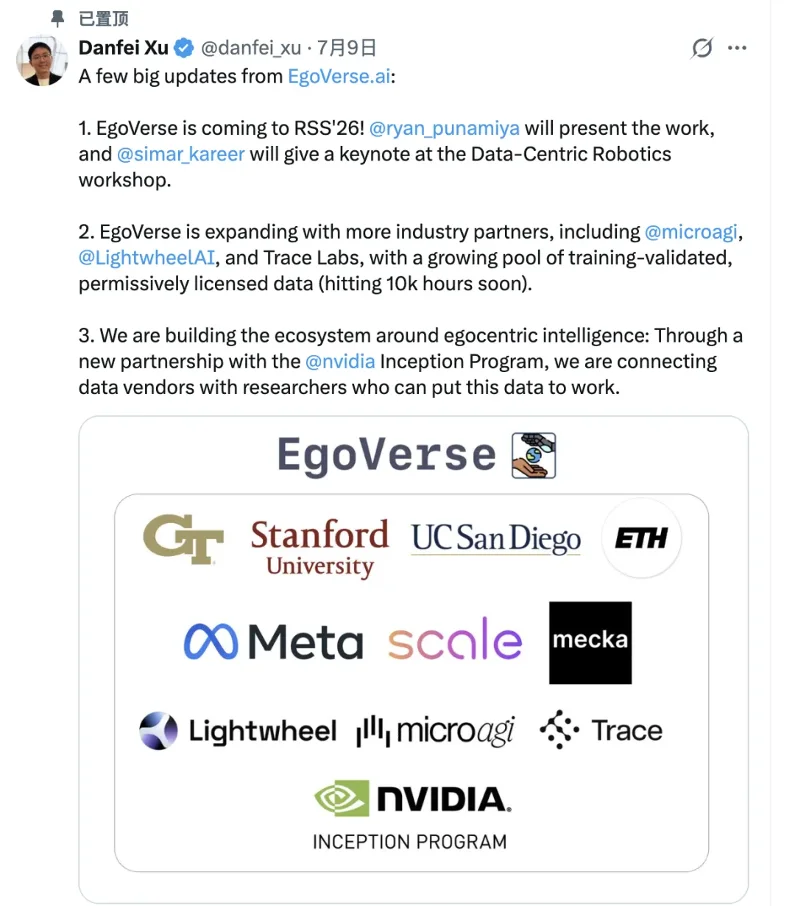
Now, EgoVerse emerges as the first open, collaborative ecosystem for first-person human demonstration data — designed not as a static dataset, but as a living, evolving standard for embodied intelligence.
✅ Current Release Stats (v1.0):
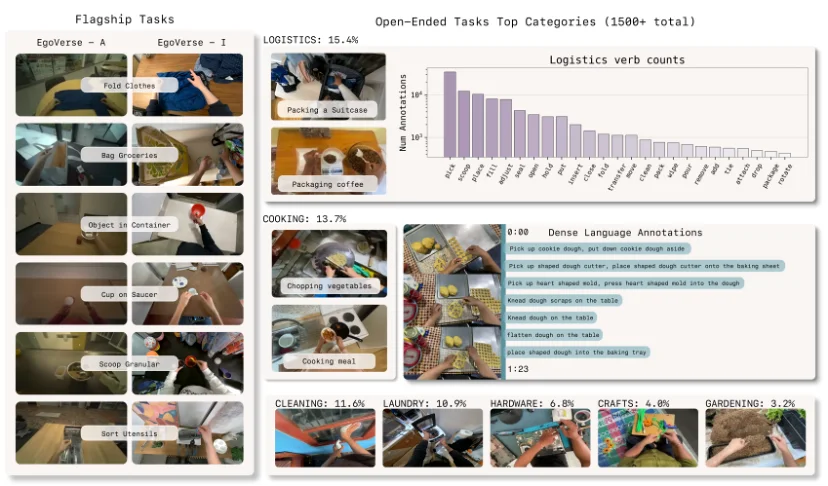
– 1,362 hours of human demonstration video
– ~80,000 episodes, covering 1,965 distinct tasks
– Captured across 240 real-world scenes by 2,087 diverse participants
– Enriched with synchronized camera poses, 3D hand tracking, and fine-grained language annotations
EgoVerse bridges the “embodiment gap” — transforming raw human behavior into robot-actionable knowledge through rigorous, cross-lab validated pipelines.
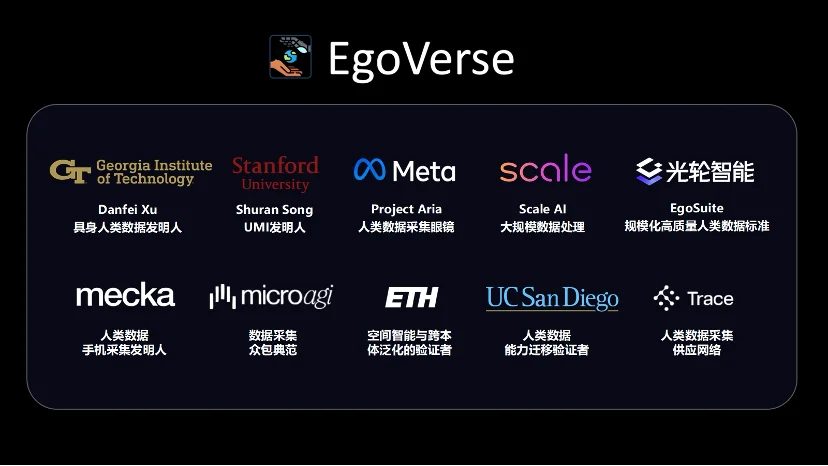
Core Consortium: World-Leading Institutions & Innovators
EgoVerse is built on global collaboration — each partner addresses a critical bottleneck in embodied data infrastructure:
🏫 Georgia Tech (Lead)
- Danfei Xu, Assistant Professor & RL² Lab Director
- Role: Architectural stewardship, defining interoperable protocols for cross-platform task replication and scalability validation
🧠 Stanford University (REAL Lab)
- Shuran Song, UMI (Universal Manipulation Interface) inventor
- Role: Human-to-robot action translation — portable handheld capture → deployable robotic policies
🕶️ Meta
- Contribution: Project Aria — industry’s first foundation-model-optimized wearable sensor suite
- Delivers synchronized RGB video, SLAM pose, 3D hand tracking, and spatial semantics
📱 Mecka AI
- Democratizes collection: iPhone + lightweight headgear → cloud-based 3D trajectory recovery
- Enables scalable, real-world capture beyond labs — homes, stores, workplaces
🏭 Scale AI
- Serves as the data factory: end-to-end pipeline for cleaning, annotation, QA, versioning, and model-in-the-loop feedback
🇨🇳 Guanglun Intelligence (Lightwheel AI)
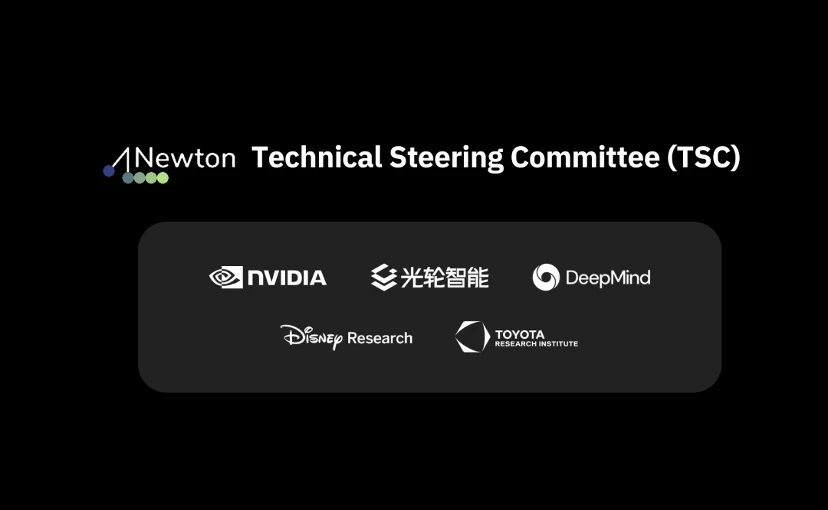
- Sole Chinese contributor — and the only company participating in both EgoVerse and Newton (NVIDIA/DeepMind-led physics simulation standard)
- Role: End-to-end quality assurance architecture, spanning edge capture → cloud processing → simulation validation
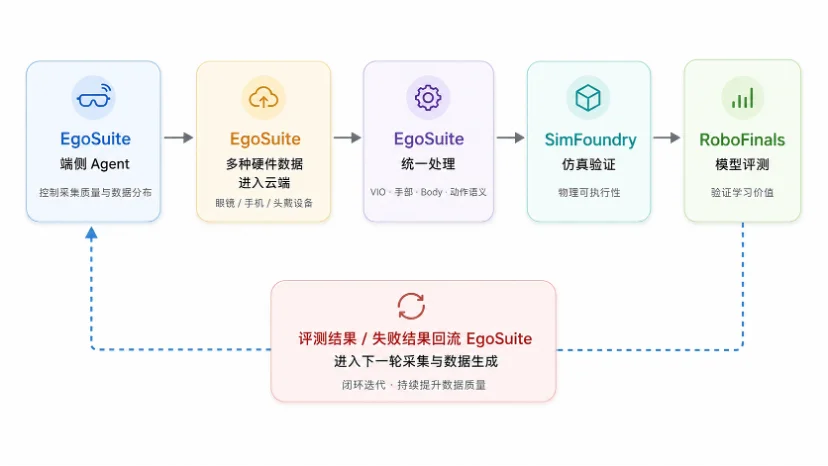
Lightwheel AI’s Tri-Layer Quality Framework
Unlike traditional QA focused on file integrity or labeling compliance, Lightwheel redefines quality as robotic learnability — verified across three tightly coupled layers:
🔹 Layer 1: Agent-Driven On-Device Capture Control
- Real-time monitoring of device health, task completeness, occlusion, viewpoint validity, and interaction fidelity
- Dynamic intervention: prompts recapture or on-site correction before upload
- Distribution-aware sampling: guides next collection to fill coverage gaps (demographics, tasks, environments)
🔹 Layer 2: Unified Cloud Processing Across Heterogeneous Hardware
- Agnostic ingestion: supports Project Aria, iPhone, custom rigs, and multi-modal sensors
- Standardized outputs:
- VIO-based camera trajectory reconstruction
- 3D hand + full-body pose estimation (robust under occlusion & close interaction)
- V7-level semantic action segmentation — temporally aligned with task steps
- Productized as EgoSuite, emphasizing hardware-agnostic interoperability
🔹 Layer 3: Simulation-Driven Value Validation
- SimFoundry: Converts human demonstrations into physically grounded, executable robot tasks in high-fidelity simulation
- RoboFinals: Industrial-grade evaluation across robots, scenarios, and physics conditions — quantifying which capabilities improve and where they fail
- Closed-loop feedback: failure modes feed back to capture agents and annotation rules for continuous iteration
Dual Standard Leadership: EgoVerse + Newton
Lightwheel is the only Chinese company co-building both foundational pillars of physical AI:
| Infrastructure | Purpose | Lightwheel’s Role |
|---|---|---|
| EgoVerse | Data layer — standardized collection, curation & sharing of human embodiment data | Full-stack quality architecture & cross-hardware unification |
| Newton (NVIDIA/DeepMind/Disney/TRI) | Physics layer — high-fidelity, scalable simulation for training & validation | Core contributions to physics solvers, simulation assets, and robot training/evaluation frameworks |
💡 Strategic Implication: Lightwheel isn’t just contributing tools — it’s helping define the interoperability grammar linking real-world data, simulated environments, model training, and capability verification.
The Bigger Picture: From User to Co-Architect
Just as ImageNet established common ground for vision AI, EgoVerse and Newton together form the dual bedrock for Physical AI — one sourcing what to learn (human behavior), the other validating how well it transfers (physical realism).
Lightwheel’s participation signals a pivotal shift: Chinese AI infrastructure innovation has moved from adoption to co-governance — shaping global standards that will underpin the next decade of robotics, automation, and embodied intelligence.
Source: QuantumBit, by Noah