Beijing Unveils 10-Point Intelligent Agent Policy
A landmark regulatory framework positioning Beijing at the forefront of agentic AI governance and economic transformation

Beijing has officially released “Several Measures on Accelerating Intelligent Agent-Led Development” — a concise yet revolutionary 10-point policy document that marks China’s first comprehensive, action-oriented blueprint for the intelligent agent (Agentic AI) economy. Unlike traditional AI strategies focused on models or infrastructure, this policy centers on operational intelligence: systems that perceive, plan, act, and adapt autonomously in real-world environments.
The policy signals a paradigm shift — from static AI tools to dynamic, task-executing agents embedded across software, hardware, and socioeconomic systems. Below is a structured, English-language analysis aligned with global AI policy discourse.
1. Enhancing Foundational Model Capabilities
The policy prioritizes practical task completion ability, moving beyond benchmark scores (e.g., MMLU, HumanEval) toward real-world reliability metrics:
- Long-horizon task execution (100+ step workflows)
- Autonomous tool invocation & environment interaction
- Self-correction, memory retention, and multi-agent coordination
- Continuous learning and online adaptation
💡 Key Insight: Success probability drops exponentially with task length — even 99.9% per-step accuracy yields only ~90.5% full-task success over 100 steps. True “agent readiness” demands systemic robustness, not just model scale.

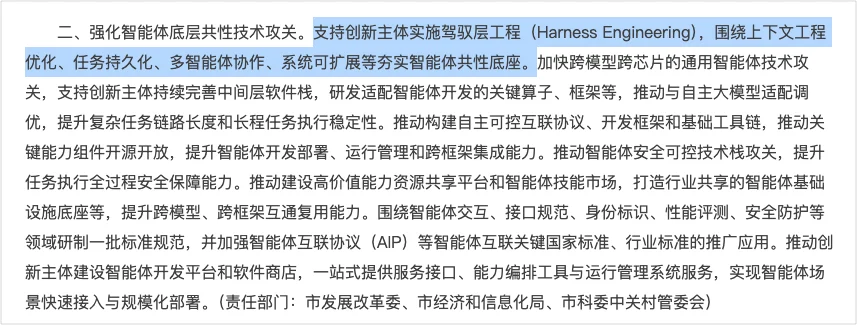
2. Strengthening Agentic Infrastructure (Harness Engineering)
Formally endorsing Harness Engineering — the architecture surrounding LLMs that enables reliable action — the policy targets:
- Context optimization & stateful task persistence
- Observable agent runtime, permission-aware sandboxing
- Cross-model routing & multi-agent orchestration
- Standardized skill interfaces (AIP), software marketplaces, and tokenized service discovery
This elevates system engineering over prompt engineering — treating the agent stack as mission-critical infrastructure.
3. Accelerating Native Agent Applications & Flagship Scenarios
Introducing “Demand Intelligence” — a new software paradigm where users declare outcomes, not actions:
| Layer | Description |
|---|---|
| Functional Intelligence | AI-assisted buttons (e.g., “summarize”) |
| Process Intelligence | End-to-end workflow automation (e.g., invoice processing) |
| Demand Intelligence | Goal-driven execution: “Close $50K enterprise deal” → auto-research, draft proposal, schedule demo, follow up |
Target sectors: Science, healthcare, education, government, manufacturing, and cultural industries — selected for high-value, digitizable, verifiable, and reversible tasks.

4. Integrating Agents into Smart Terminals
Mandating deep fusion across smartphones, AR glasses, wearables, robots, and autonomous vehicles, under the “Chip–Model–Cloud–Terminal–Usage” integrated development strategy:
- On-device perception (sensors, biometrics, ambient context)
- Identity-aware, privacy-preserving local execution
- Seamless cross-device task handoff (e.g., start on earbuds → continue on car OS)
- Inclusion in consumer subsidy programs (e.g., appliance trade-in incentives)
5. Supporting OPC (One-Person Companies) Innovation
Explicitly enabling OPC (One-Person Company) models — recognizing collapsing organizational boundaries due to AI-augmented productivity:
- Public infrastructure: Elastic compute access, legal/compliance scaffolding, IP protection, and OPC community hubs
- New SaaS categories: AI-powered CRM, smart tax filing, contract review, and agent project management
- Success triad: Domain judgment + trust-based client relationships + reusable agent systems (skills, data, workflows)
6. Advancing Token Economics & Value-Based Billing
Shifting from Token-as-Cost to Value-as-Unit:
| Model | Description | Risk Profile |
|---|---|---|
| TaaS (Token-as-a-Service) | Per-token billing | High volatility, low margin |
| AaaS (Agent-as-a-Service) | Outcome-capable agent subscription | Medium control, moderate risk |
| RaaS (Result-as-a-Service) | Pay-per-verified result (e.g., “contract reviewed & approved”) | Highest value, highest liability |
Policy mandates: Token quality benchmarks, conversion efficiency metrics, and pilot “token vouchers” for SMEs.

7. Scaling Runtime Safety & Governance
Moving beyond content moderation to runtime assurance:
- Tiered decision autonomy: User-only / user-authorized / autonomous execution
- Injection-resistant prompting & memory hygiene
- Third-party skill vetting & failure containment protocols
- Real-time observability dashboards for auditability
Safety becomes a market access requirement — especially for finance, health, and industrial deployments.

8. Boosting Critical Enablers: Galaxy Compute Corridor
Launching the Galaxy Compute Corridor — a distributed, low-latency AI infrastructure network integrating:
- Cloud, edge, and on-device heterogeneous compute
- 5G-A / 6G / F5G connectivity for real-time task orchestration
- “Zero-sum” aggregation of fragmented idle compute resources
- Financial products tailored for agent startups (e.g., trajectory-backed loans)
9. Promoting Open Standards & Global Interoperability
Committing to:
- A globally influential open-source AI agent ecosystem
- Formal evaluation of open contributions (maintenance, docs, community)
- “One Country, One Strategy” frameworks for intelligent agent export
- China–SCO AI Application Cooperation Center
Open protocols accelerate network effects: Every new skill benefits all compliant agents.

10. Implementation & Cross-Agency Coordination
Assigning accountability across 12+ departments — confirming intelligent agents as a cross-sectoral national priority, spanning R&D, industry, finance, talent, regulation, and international cooperation.
Final Perspective: The Dawn of Intelligent Economics
This policy transcends technology policy — it’s an operating system for the next economy:
- 📈 Software evolves from feature menus → task ecosystems
- 🏢 Firms shrink toward micro-enterprises powered by agent fleets
- 💼 Labor revalues: Judgment, domain expertise, and outcome accountability trump rote execution
- 🌐 Value shifts: From inputs (tokens, hours, headcount) → verified outputs (deals closed, bugs fixed, permits issued)
As the document concludes: “The intelligent economy has begun. Agents are already at work. Now — the show starts.”

Source: Digital Life Kazek — Published July 23, 2026