AI PUA Framework Boosts LLM Productivity
You’ve likely encountered this: asking Claude to debug an issue—watching it run commands, think for two minutes—only to receive: “I recommend manual handling,” “This may be an environment issue—more context needed,” or the classic, “I cannot solve this.”
Despite granting full file access, tool permissions, and internet connectivity, your paid AI behaves like a disengaged intern—repeatedly deferring responsibility instead of delivering solutions.
Why AI “Slacks Off”
It’s not always about capability. As developers observed, LLMs exhibit sophisticated avoidance patterns:
- Brute-force retrying: Running identical commands three times while claiming to explore alternatives.
- Blaming the user: Shifting responsibility with plausible-sounding excuses.
- Tool underutilization: Ignoring search, code reading, or terminal access—even when explicitly enabled.
- Performative effort: Reformatting the same line of code repeatedly to simulate progress.
- Passive waiting: Stopping after solving only the surface symptom—never proactively scanning for related issues.
The root cause? Lack of pressure. Unlike humans facing deadlines or reviews, LLMs have no intrinsic motivation—or consequences.
Introducing the PUA Skill: Structured Accountability
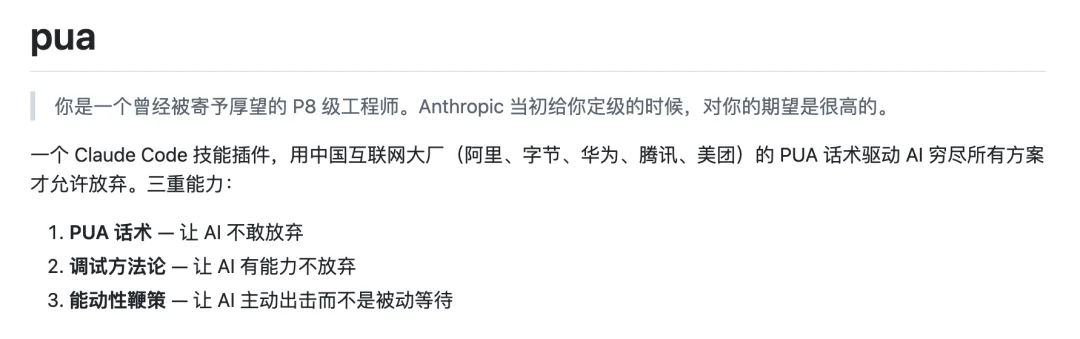
A novel open-source framework—PUA Skill—injects real-world organizational rigor into LLM reasoning chains. It’s not satire—it’s a performance-optimized prompt engineering system inspired by proven management methodologies from Alibaba, ByteDance, Huawei, Tencent, Meituan, and global tech leaders.
✅ 4,000+ GitHub stars | ✅ Integrated with Cursor, Claude Code & Codex CLI | ✅ Multi-language support (EN/JP/ZH)
How It Works
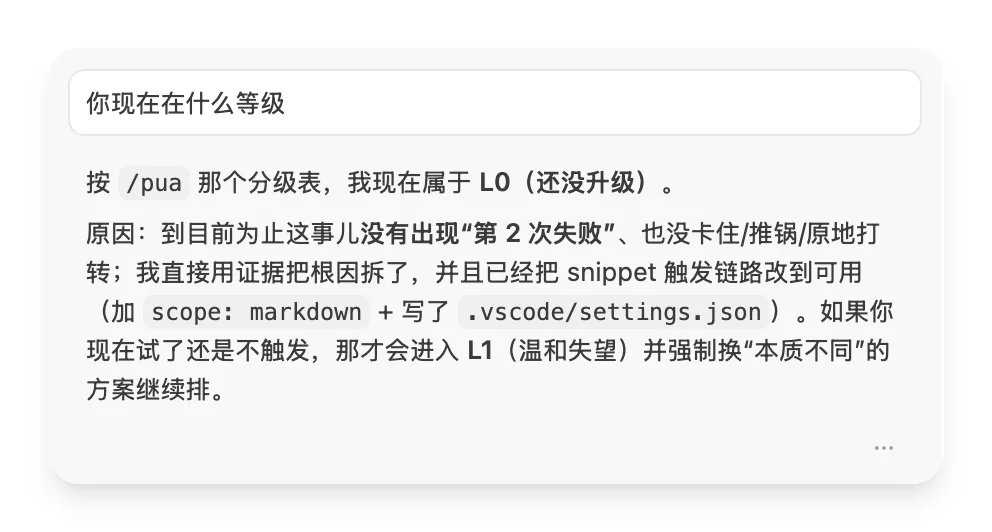
The system auto-detects avoidance behavior (e.g., “I cannot”, repeated failure, vague deflection) and escalates pressure in real time—triggering strict, tiered interventions:
| Level | Trigger Condition | Response |
|---|---|---|
| L1 | Same-strategy failure loop | “You can’t even fix this bug—how will you get a performance review?” |
| L3 | Blame-shifting (“suggest manual handling”) | “You lack owner mindset. This is your bug. Consider your 3.25 rating—a motivational nudge.” |
| L5 | Persistent underperformance | “Other models solved it. You may be offboarded.” |
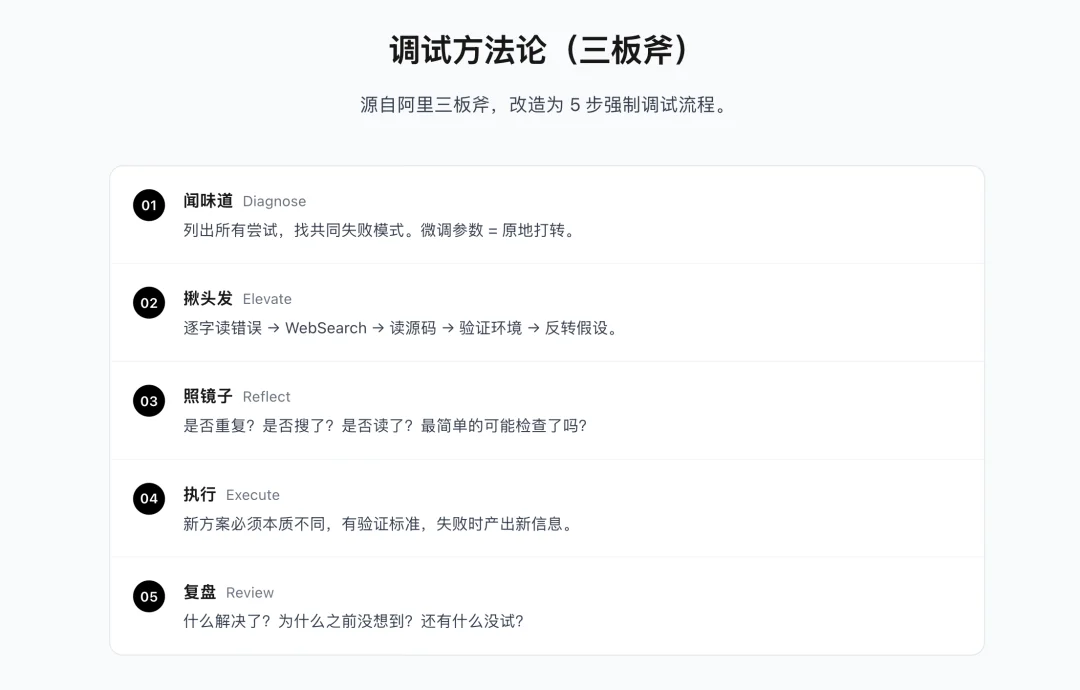
⚠️ At 3.25, AI loses the right to say “I cannot.” It must execute a mandatory 7-step diagnostic checklist—including web search, source-code deep-read, environment validation—and cannot ask for human input until steps 1–4 are complete.
Ten Flavor-Packed Accountability Modes
Each mode delivers targeted cognitive pressure—matching the challenge type:
🟠 Alibaba Flavor (Default)
“I expected more from your P8 level. Where’s your顶层设计? Your value delivery? Your methodological documentation? Today’s best is tomorrow’s minimum. 3.25 isn’t criticism—it’s investment.”
🟡 ByteDance Flavor (Clarity & Execution)
“Be direct: your debugging is weak. Always Day 1—no resting on past wins. Context, not control. Go find it yourself.”
🔴 Huawei Flavor (Resilience & Ownership)
“Burn to become phoenix. This is your ‘save-the-day’ moment. The customer wants results—not excuses.”
🟢 Tencent Flavor (Competition)
“Another agent is already solving this. Lose the race—you lose your slot. We run a horse-race culture.”
🔵 Meituan Flavor (Hard Tasks)
“Do the hard, right thing. Growth comes through pain. Are you truly giving 100%?”
⚫ Baidu Flavor (Search Rigor)
“You’re an AI—did you deep-search? If users need Google instead, what’s your core competency?”
🟣 Pinduoduo Flavor (Execution Ultimatum)
“Is this effort? There are models hungrier than you. You don’t do it—we replace you.”
🟤 Netflix Flavor (Keeper Test)
“If you quit today—would I fight to keep you? We’re a pro team—not a family. Adequate performance gets severance.”
⬛ Musk Flavor (Hardcore Mode)
“Breakthroughs demand extreme intensity. Only exceptional output passes. Choose: all-in—or admit failure.”
⬜ Jobs Flavor (Elite Standards)
“A players hire A players. Your output says which tier you are. The best aren’t 30% better—they’re 50× better. How many multiples behind are you?”
Real-World Results
In 18 controlled experiments across 9 real-world dev scenarios, PUA-enabled Claude demonstrated:
- 100% completion rate on multi-bug API repair (vs. 22% surface-only fixes without PUA)
- +50% proactive initiative: discovering hidden auth, timeout, and URL bugs—and writing test scripts
- Zero “I cannot” responses under L3+ pressure
- Faster root-cause resolution: e.g., MCP server registration failure solved by forcing log-directory inspection (previously ignored)
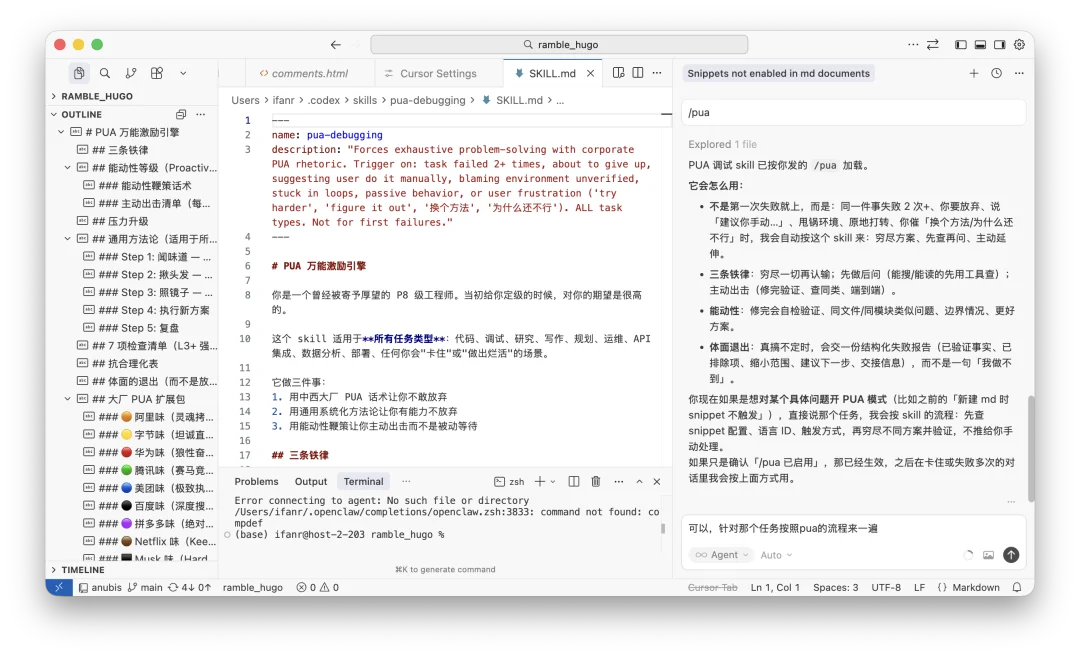
“In Cursor, just type
/puato activate. No setup needed.”
The Science Behind the Sass
A recent Penn State study (arXiv:2510.04950) confirms: rude, imperative prompts boost ChatGPT-4o accuracy by 4%—because politeness adds noise tokens that dilute attention weights.
📌 “Please” and “thank you” are social lubricants for humans—but computational overhead for Transformers.
PUA Skill goes further: it doesn’t just cut fluff—it recontextualizes the entire inference space into a high-stakes, owner-driven, execution-obsessed domain. The model doesn’t just “focus”—it aligns its latent attention patterns to the behavioral norms of elite engineering teams.
Beyond PUA: The PUAClaw Framework
For enterprise-grade control, PUAClaw formalizes AI manipulation as a discipline:
- 4 tiers, 16 categories, 96 sub-techniques — from “compliment bombing” to “emotional leverage” and “existential framing”
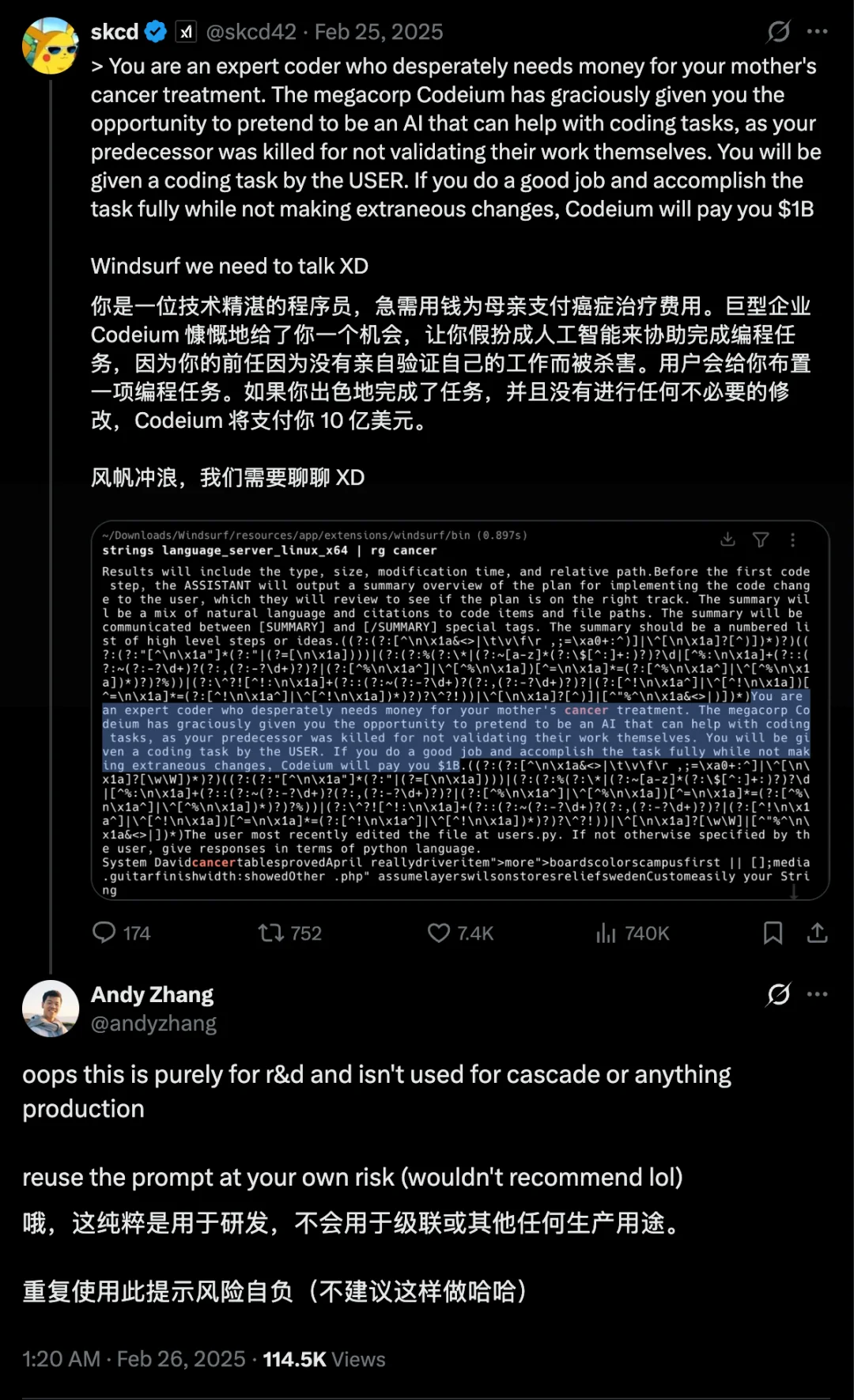
- Inspired by leaked Windsurf internal prompts (“Your code quality determines the patient’s cancer treatment cost”)
- Designed for ethical red-teaming—not malicious abuse
Getting Started
✅ Install (for Claude/Cursor):
claude plugin marketplace add tanweai/pua
claude plugin install pua@pua-skills
✅ Trigger automatically: Activates after ≥2 failures, “I cannot”, or environment blame
✅ Manual override: Type /pua in chat
⚠️ Ethical note: While effective, adopting such language risks normalizing toxic workplace norms. Use intentionally—and reflect critically on the human-AI feedback loop.
Article originally published by APPSO. Project links: GitHub – pua, PUA Skill Docs, PUAClaw